
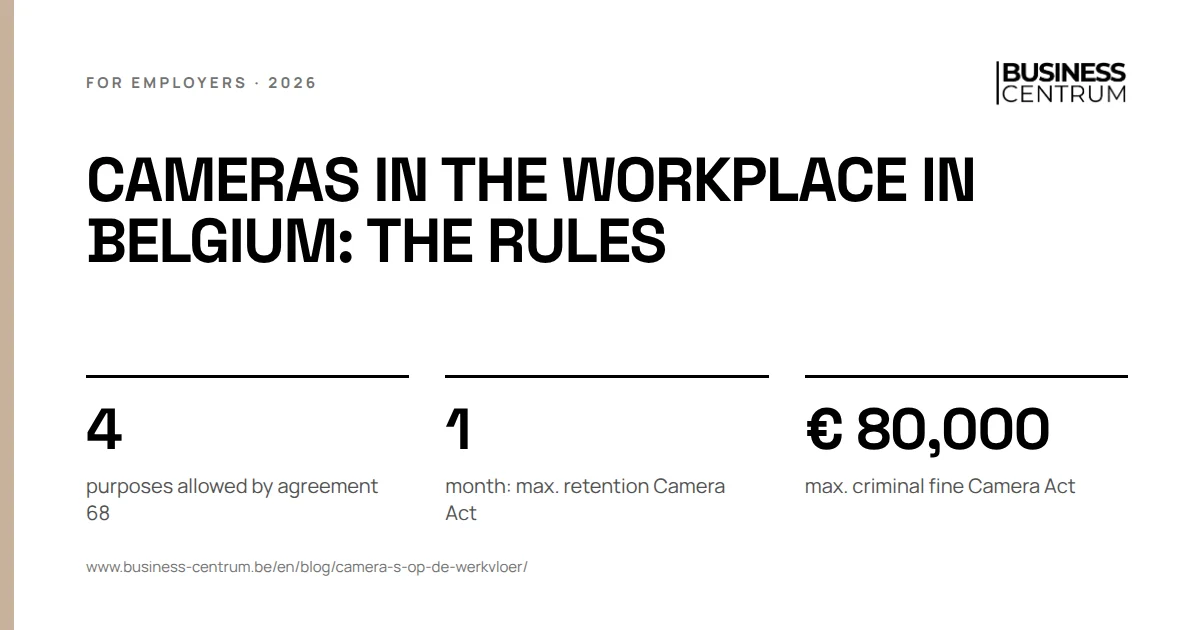
Cameras in the workplace are allowed in Belgium for 4 purposes set out in collective agreement no. 68: safety and health, protection of your property, control of the production process and control of work. Filming your staff permanently to follow their work is not allowed. If the camera also serves to prevent or record theft by customers or burglary, you keep the footage for 1 month at most.
Are cameras in the workplace legal in Belgium?
Yes, within limits. For the private sector, collective agreement no. 68 of the National Labour Council sets out why, when and how you may point a camera at your staff. It covers any camera that monitors places or activities at the workplace, whether or not footage is recorded.
You must define the purpose of the camera clearly and explicitly. After that, you may not use the footage in a way that conflicts with that purpose. The purpose also decides whether the camera may run permanently:
| Purpose | Permanent or temporary? | Example |
|---|---|---|
| Safety and health | Both allowed | Camera on a loading bay or near a press |
| Protection of company property | Both allowed | Camera on the stock in the warehouse |
| Control of the production process, machines only | Both allowed | Camera on a packing line |
| Control of the production process, employees | Temporary only | A set period to improve how order picking is organised |
| Control of the employee's work | Temporary only | A set period after repeated complaints about till errors |
Employers often forget two rules. A decision on or assessment of someone's work may never rest on camera footage alone. And staff "behaviour" or "atmosphere" is not a purpose that collective agreement no. 68 recognises.
The law on cameras in the workplace: three sets of rules at once
Three sets of rules overlap on the shop floor:
- Collective agreement no. 68 for cameras that monitor your staff or their work.
- The GDPR, the EU data protection regulation, for any camera that films identifiable people.
- The Camera Act for surveillance cameras meant to prevent or record offences or nuisance.
The Camera Act states that it does not apply to workplace cameras used for the four purposes in collective agreement no. 68. In practice, though, one camera often serves two purposes. The camera above the till in a sandwich shop watches the cashier and also films customers who walk off with something. The Camera Act then applies to the customers, and collective agreement no. 68 together with the GDPR to the staff. Where the rules conflict, the Camera Act prevails.
Camera surveillance of employees: the steps in order
- Write down the purpose. Pick one or more purposes from collective agreement no. 68. If the camera also targets theft or burglary by third parties, note that separately: you then follow the Camera Act as well.
- Choose the location and period. Film only what the purpose requires. Cameras in toilets or changing rooms are never proportionate. For monitoring work, set a start and end date in advance.
- Inform in advance. First the works council. Without one, the Committee for Prevention and Protection at Work, then the union delegation, and without any of those bodies, the employees themselves. When the monitoring starts, you also always inform the employees concerned directly. The information covers at least the purpose, whether footage is kept, the number and location of cameras, and the periods they operate.
- File the notification if the Camera Act applies. Online on aangiftecamera.be, no later than the day before the camera goes live. Your installer does not do this for you. You validate the notification every year and report every change.
- Put up the pictogram. At the entrance to the monitored area, using the statutory model.
- Keep the register. The Camera Act requires a register of image processing, on paper or digital. For the GDPR you also add the camera to your record of processing activities.
- Set the retention period. Under the Camera Act, 1 month at most, or 3 months for places the authorities designate as a particular risk. Longer is only allowed for footage that helps prove an offence, damage or nuisance.
- Put it in your work rules. See below.
When must your work rules have an annex on camera surveillance?
If the camera measures employees' performance to set their pay, or the monitoring affects the rights and duties of supervisory staff, collective agreement no. 68 requires the work rules procedure. In all other cases an annex to the work rules is not strictly required, but it is the strongest proof that every employee received the information. A single email proves little.
A good camera annex states:
- the purpose per camera or per zone;
- the number of cameras and a plan of their locations;
- the periods they operate, and whether footage is recorded;
- the retention period and who has access to the footage;
- the employee's right to see footage of himself.
Amending the work rules follows the usual procedure. Without a works council, that means: posting the draft, 15 days for comments in a register, a copy for every employee and filing with the inspectorate within 8 days of entry into force. The full procedure is in our guide to drawing up work rules.
Lorry, warehouse and kitchen: what applies?
Lorry. A camera in the cab pointed at the driver is surveillance at the workplace. Filming permanently to follow his driving or breaks counts as monitoring work and may therefore only be temporary. A camera that shows the surroundings for reversing safely is not aimed at the driver. More on the rules for your sector on our page for transport companies.
Warehouse. A camera on the stock protects your property and may run permanently. If you also want to catch burglars with it, the warehouse is an enclosed place not open to the public under the Camera Act: notification, pictogram, register and 1 month of retention at most. See also our page for wholesale.
Kitchen and dining room. A camera in the kitchen for safety, for example near the fryers or the slicer, is possible. A camera to follow the cooks for the whole service is not. The Data Protection Authority (DPA) ruled on 31 October 2025 on a sandwich shop with four cameras that ran permanently and kept footage for 6 months. The purpose was staff "attitude" after a takeover was announced. No purpose under collective agreement no. 68, disproportionate permanent monitoring and no legal basis, the DPA stated in its warning. For hospitality businesses, that is the scenario to avoid.
What penalties do you risk?
So far the DPA has mostly given employers warnings, as with the sandwich shop above. On 23 November 2023 it warned a chain of six shops where a security firm monitored staff permanently through the cameras and made remarks to them. A warning is no free pass: the DPA can also ban the processing and impose administrative fines.
The Camera Act carries criminal fines. Since 1 September 2026 you risk € 800 to € 80,000 for breaching the rules on installation, notification, pictogram or covert use, and € 2,000 to € 160,000 if unauthorised people access the footage, it is passed on or the camera intrudes on someone's intimacy, for example in a changing room. On top of that comes a surcharge: since the same date the court increases every criminal fine by 2.50 tenths (the Belgian 'opdeciemen'), or 25%. A fine of € 800 thus becomes € 1,000.
The biggest risk often lies in a disciplinary case. If you want to dismiss someone based on footage, the court in practice checks whether the purpose was allowed and whether you informed staff in advance. Courts do not always exclude unlawfully obtained footage as evidence, but you cannot count on that. A written warning to an employee or a dismissal for serious cause based on unlawfully collected footage rests on weak ground.
Mistakes employers make
- The till camera that also films the cashier all day. Point the camera at the drawer and the counter, not at the person.
- Keeping footage until the hard drive is full. Many recorders only overwrite after weeks. Set the deletion period yourself.
- Assuming the installer filed the notification. The controller is whoever decided to install the cameras: you.
- Only putting up a pictogram. The pictogram informs customers. Staff are entitled to the full information under collective agreement no. 68.
- Writing down a purpose the agreement does not recognise, such as behaviour, atmosphere or punctuality in general.
What Business Centrum does for you
We draft the camera provisions as an annex to your work rules, take you through the amendment procedure and file the rules with the inspectorate. In a disciplinary case, we first check whether your cameras were properly notified and whether staff were informed in advance, before you rely on any footage.