In Belgium, a written warning to an employee is a disciplinary sanction. You may only give one if your work rules provide for it, and you must notify it by the 1st working day after you establish the breach. Too late and it is void. You then enter it in the sanctions register before the next payday.
What is an official or written warning?
A warning is the lightest sanction you can give an employee. It says: this conduct is not acceptable, and a heavier sanction will follow if it happens again. Official warning, written warning and reprimand mean the same thing in practice, as long as your work rules list them as sanctions.
The Act of 8 April 1965 on work rules sets the ground rules:
- You may only impose the sanctions listed in the work rules.
- The work rules state which sanctions exist, for which breaches, and to whom the employee can submit a complaint or comment about a sanction.
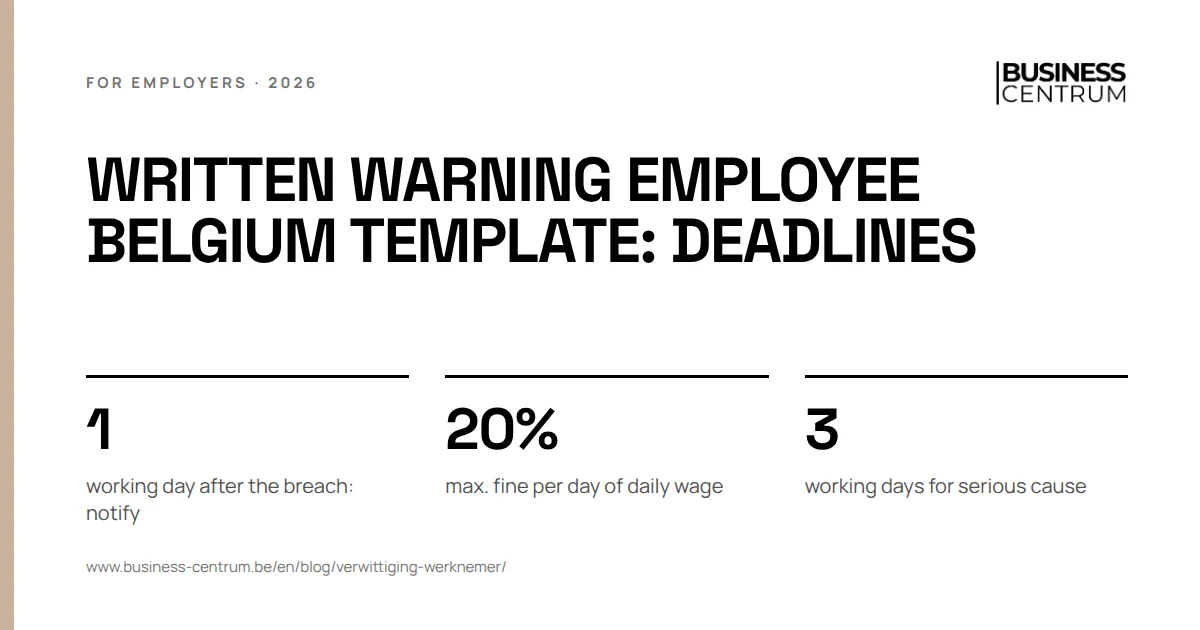
- You notify the sanction by the first working day after the breach is established, on pain of nullity.
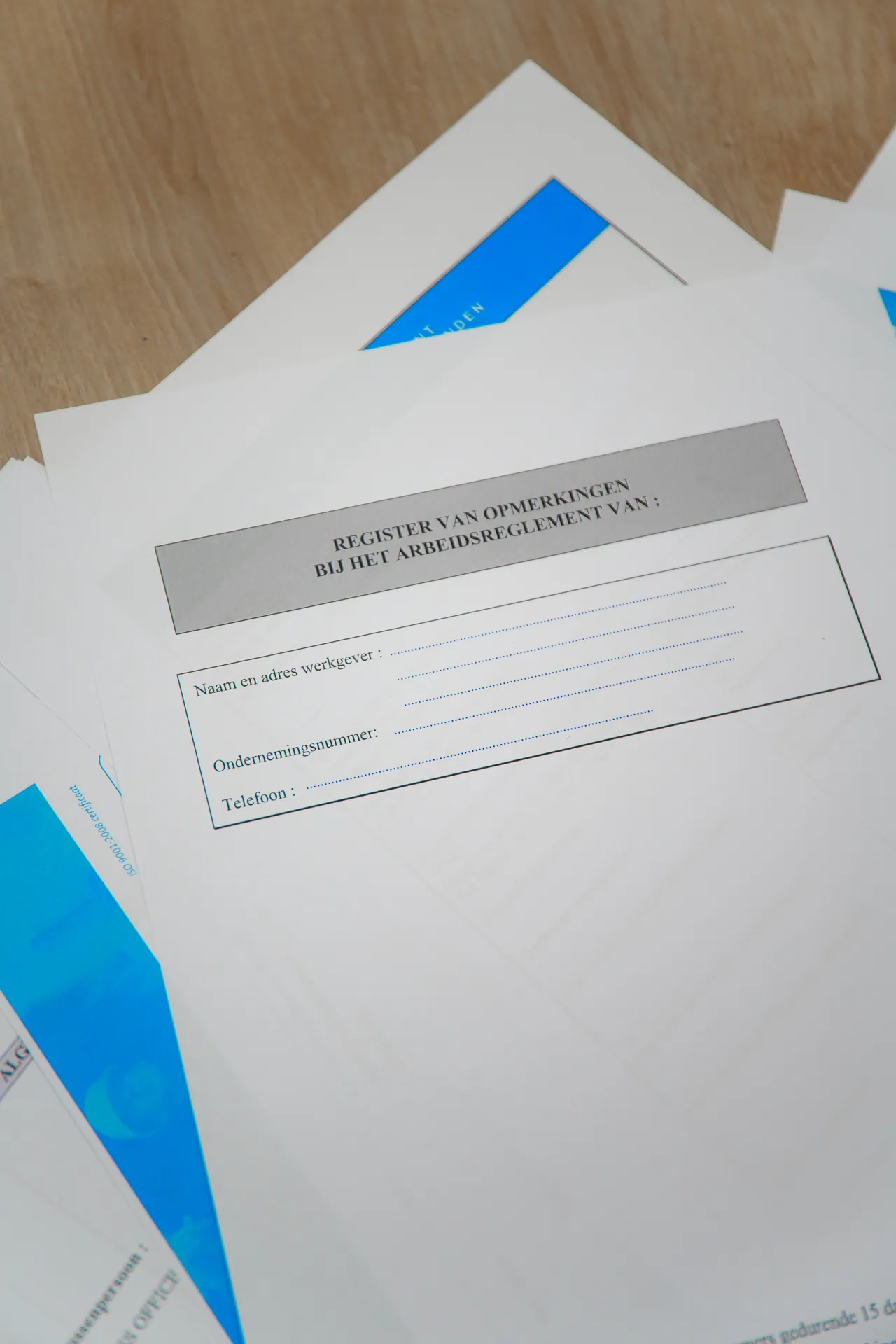
- Before the next payday, you enter it in a register with the name, date, reason and type of sanction.
If your work rules contain no sanctions, add them first through the amendment procedure, which includes 15 days for staff comments. The steps are in our guide to drawing up work rules.
Which sanctions can you impose?
| Sanction | What the law requires | When to use it |
|---|---|---|
| Verbal warning | In the work rules, on time, in the register | First minor breach, but hard to prove |
| Written warning | Same | First or second breach you want on record |
| Fine | Same, and in total no more than 20% of the daily wage per day | Repeated breach after warnings |
| Suspension without pay | Same, with the length in the work rules | Serious or repeated breach short of serious cause |
The proceeds of a fine must benefit the staff, for example through a staff fund, so they do not go into your till. With a daily wage of € 150, a fine is capped at € 30 a day.
First written warning to an employee: how to handle it
- Establish the facts. What happened, when, who saw it and what evidence you have: time clock, rota, photo of the damage, a colleague's statement.
- Find the article in your work rules. Is the breach listed and do the rules provide for a warning? If not, you cannot impose a sanction now.
- Talk to the employee. The law does not require a prior meeting unless your sector or work rules do. Still, it lets you hear his side and avoids a sanction based on a misunderstanding.
- Write the warning and hand it over in time. By the 1st working day after the day you established the breach. In practice, the same day or the next.
- Have him sign for receipt. If he refuses, have a colleague confirm the handover and send a registered letter the same day.
- Enter the sanction in the register. Before the next payday.
- Keep a copy in the personnel file. Together with the evidence of the facts.
Template: a written warning letter to an employee
A template for a warehouse worker who arrived late without notice. Adapt the facts and article numbers to your work rules.
[Company name], [address], [company number]
[Place], [date]
To [employee name], [job title]
Subject: written warning
On [date] your shift started at 6.00 am. You arrived at 7.40 am and did not inform your team leader in advance. This is shown by the time clock records and the rota for that day.
Article [no.] of the work rules requires every employee to inform their manager before the start of the shift if they will be late. Article [no.] provides for a written warning for this breach.
[If applicable:] This is the second warning for the same breach, following the one dated [date].
We expect you to start on time from now on and to inform your team leader in advance if you will be late. If the breach happens again, we may impose a heavier sanction under the work rules. This may affect our continued working relationship.
You may send your comments on this sanction in writing to [name], as provided for in article [no.] of the work rules.
[Employer's name and signature]
Received on [date]: [employee's signature]
Download this template in Word and PDF, in Dutch and French.
Three things make this letter strong: concrete facts with date and time, the reference to the article in the work rules, and the mention of earlier warnings. A letter that only says "your attitude is unacceptable" proves nothing later. If the employee did not turn up at all, first read what to do when an employee does not show up.
Unpaid disciplinary suspension: is it allowed?
Yes, as a disciplinary sanction, but only if your work rules expressly provide for it, stating its length and the breaches it covers. It follows the same rules as a warning: notify it in time and enter it in the register. The employee does not work those days and is not paid for them. Pass the days on straight away for your payroll, because they appear on the payslip and in the social security return.
A disciplinary suspension is not the same as a suspension of the contract because of illness or temporary unemployment. Do not use it to cool down a conflict when there is no breach.
How a series of warnings supports a dismissal
Dismissal with notice. After 6 months' service, the employee has the right under collective agreement no. 109 to know the concrete reasons for his dismissal. If he asks, you reply by registered letter within 2 months. A dismissal unrelated to conduct, ability or business needs, and that a normal and reasonable employer would never have decided on, is manifestly unreasonable. If you gave the reasons properly, each party must prove what it claims. Your warnings are that proof. More in our article on dismissal reasons under collective agreement 109.
Worked example. A warehouse worker earns € 3,000 gross a month. His weekly pay is € 3,000 × 3 / 13 = € 692.31.
| Risk | Calculation | Amount |
|---|---|---|
| Manifestly unreasonable dismissal, minimum | 3 x € 692.31 | € 2,076.93 |
| Manifestly unreasonable dismissal, maximum | 17 x € 692.31 | € 11,769.27 |
| Fine if you do not give the reasons properly | 2 x € 692.31 | € 1,384.62 |
In the worst case, a poorly supported dismissal costs € 13,153.89 on top of the notice. Three dated warnings for the same breach make that risk much smaller.
Dismissal for serious cause. Here the last fact counts. You dismiss within 3 working days of learning of the fact, and you notify the fact within 3 working days of the dismissal. Earlier warnings for similar facts can help show how serious it is. They never replace a new fact within the deadline. All the deadlines are in our guide to dismissal for serious cause.
Mistakes employers make
- Imposing a sanction that is not in the work rules. It is then invalid, however justified.
- Notifying too late. Discussing it internally first and handing over the letter a week later voids the sanction.
- Asking for a signature "for agreement". The employee refuses and you lose time. Ask for a signature for receipt.
- Vague facts. "Often late" without dates proves nothing.
- No register. The sanctions register is mandatory and the inspectorate can ask to see it.
What Business Centrum does for you
We check that your work rules contain the sanctions you need and add them through the amendment procedure. For a fine or a suspension, we process the deduction or the unpaid days correctly in the payroll, together with Acerta. And before you dismiss someone, we check whether your warnings support it.