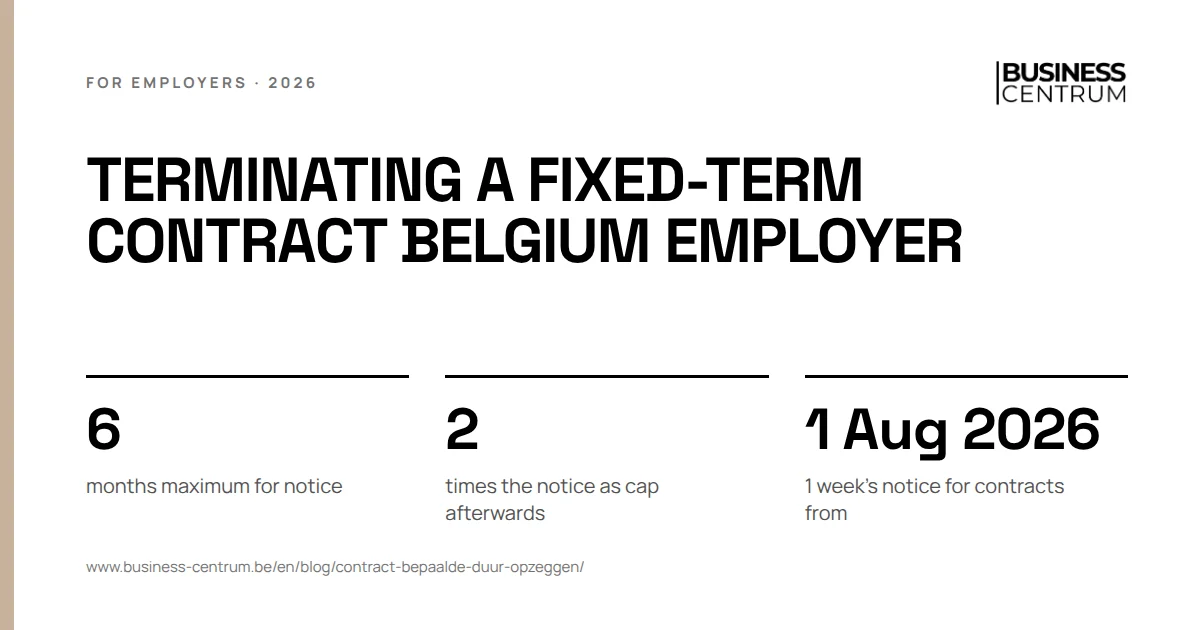
An employer can end a fixed-term contract early. In the first half of the term, up to a maximum of 6 months, you give ordinary notice. For contracts starting from 1 August 2026, that is normally 1 week. After that you pay the wages up to the end date, capped at 2 times the notice for an open-ended contract.
Terminating a fixed-term contract as an employer: the two periods
A fixed-term contract must in principle run to its end. The law makes an exception in two stages:
| Period | What can you do? | What does it cost? |
|---|---|---|
| First half, up to 6 months | Give notice | The notice, or a payment equal to the wages for that notice |
| Second half up to the end date | End it without serious misconduct | Wages up to the end date, at most 2 times the wages for open-ended notice |
The first half is counted from the start date. A four-month contract can be ended with notice during the first two months. For an eighteen-month contract, the window is limited to the first 6.
A fixed-term contract not put in writing before work starts is not a fixed-term contract. It is then treated as open-ended, with the ordinary employer's notice period.
Notice period for a fixed-term contract in the first half
In the first half you use the same notice table as for an open-ended contract. For a contract that started from 1 August 2026, that means 1 week's notice while the employee has less than six months' service. Because notice is only possible in the first six months, it is almost always one week for new contracts. For a contract that started earlier, the old table applies: for example 3 weeks at three to four months' service.
The formal rules are those of ordinary notice. You post a registered letter, which takes effect on the 3rd working day after posting. Notice starts on the following Monday. The letter states the start date and the length.
Early termination of a fixed-term contract in the second half
After the first half you can no longer give notice. If you still want to stop, you end the contract and pay compensation. It equals the wages up to the end date, but never more than 2 times the wages for the notice that would apply to an open-ended contract with the same seniority. You pay the lower of the two amounts.
Worked example
Three contracts worked out
Weekly pay is always the monthly salary × 3 / 13. We calculate on the fixed monthly salary; benefits under the contract, such as an end-of-year bonus, also count towards the compensation and come on top.
Contract 1: six months, from 1 September 2026 to 28 February 2027, € 2,900 a month. The first half runs to the end of November. You post the letter on Monday 5 October 2026 and notice starts on Monday 12 October. The contract started after 1 August 2026, so notice is 1 week: the contract ends on Sunday 18 October. To stop immediately, you pay one week's wages: € 2,900 x 3 / 13 = € 669.23.
Contract 2: two years, from 1 January 2026 to 31 December 2027, € 3,000 a month. Notice was only possible until 30 June 2026. You end the contract on 1 October 2026. Wages to the end date cover 15 months, or € 45,000. The cap: with 9 months' seniority, open-ended notice would be 7 weeks, times 2 gives 14 weeks. 14 x € 692.31 = € 9,692.31. You pay € 9,692.31.
Contract 3: nine months, from 1 March 2026 to 30 November 2026, € 2,800 a month. You end the contract on 1 October 2026. Remaining wages cover 2 months, or € 5,600. The cap: 7 months' seniority gives 6 weeks, times 2 is 12 weeks, or € 7,753.85. The remaining wages are lower, so you pay € 5,600.
With every termination, remember leaving holiday pay and any pro rata end-of-year bonus for the months worked. They come on top of the compensation.
Template letter: notice in the first half
[Employer name, address, company number]
Registered post to [employee name, address]
[Place], [date of posting]
Re: notice of termination of your fixed-term employment contract
Dear [name],
We are terminating your fixed-term employment contract from [start date] to [end date] under Article 40, §2, of the Act of 3 July 1978. The notice period is [number] week(s). It starts on Monday [date] and, barring suspension, ends on [date].
Yours sincerely,
[Name and signature of the authorised person]
Download this template in Word and PDF, in Dutch and French.
Draft the actual letter in the language of your workplace, Dutch or French. More versions, including one for termination with a payment, are in our template dismissal letter.
Why only the first contract can be ended with notice
If you use successive fixed-term contracts, only the first one can be ended with notice in its first half. The second, third or fourth contract can only be ended with the payment up to the end date, subject to the cap. Without justification you may conclude at most 4 contracts of at least 3 months each, totalling no more than 2 years. With approval from the labour inspectorate, these become contracts of at least 6 months, totalling at most 3 years. Go beyond that and you have an open-ended contract. More in our piece on successive fixed-term contracts.
Fixed-term contracts under 3 months and sickness
Two specific rules apply to sickness:
- Contract shorter than 3 months. If the employee is ill for more than 7 days and the first half has passed, you can end the contract without compensation.
- Contract of at least 3 months. If the sickness lasts more than 6 months, you can end the contract with compensation equal to the remaining wages, at most 3 months' pay, minus what you have paid since the sickness began.
Alternatives: serious misconduct, mutual agreement, medical force majeure
- Serious misconduct. For a serious fault you end the contract immediately, without compensation. You dismiss within 3 working days of knowing the facts with certainty, notify the facts in writing within 3 working days after that, and you must prove the fault. Both can go in one registered letter.
- Mutual agreement. You agree an end date together. No notice, no compulsory payment. See termination by mutual agreement.
- Medical force majeure. If the employee can permanently no longer do the agreed work, the contract can end through the medical force majeure procedure, without compensation.
For every fixed-term contract, Business Centrum checks that the written contract was signed in time, works out the first-half window and the right notice or payment, and processes the exit in your payroll, together with Acerta. If you often use temporary contracts, we set up a sequence that stays within the legal limits through our employment contracts service.