
Without approval, you can conclude at most 4 successive fixed-term contracts in Belgium, each lasting at least 3 months and together at most 2 years. With prior approval from the inspectorate, contracts must last at least 6 months, together at most 3 years. Beyond that, the contract becomes permanent.
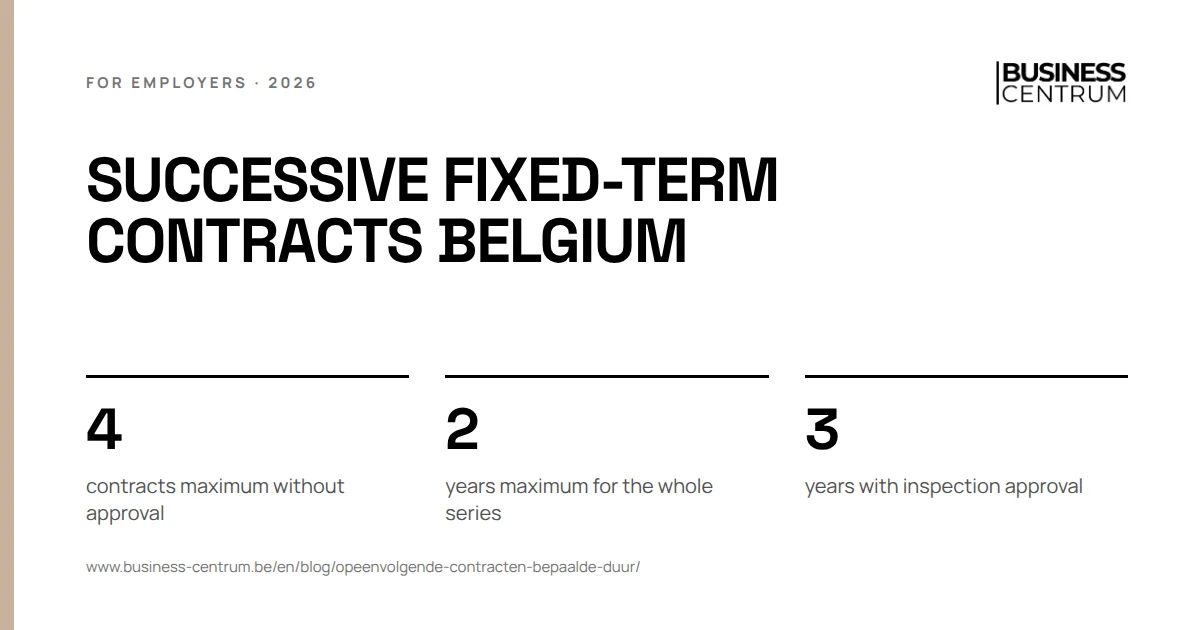
How many successive fixed-term contracts can you conclude?
The law of 3 July 1978 starts from a strict rule: if you conclude several fixed-term contracts one after another without an interruption attributable to the employee, you are presumed to have concluded an open-ended contract. There are three ways out:
| Route | Conditions | Approval needed? |
|---|---|---|
| Justification | You prove that the nature of the work (for example seasonal work) or another legitimate reason explains the series | No, but in a dispute the court decides |
| Two-year series | At most 4 contracts, each at least 3 months, together at most 2 years | No |
| Three-year series | Contracts of at least 6 months each, together at most 3 years | Yes, in advance, from the Social Legislation Inspectorate |
For the three-year series, the law sets no maximum number of contracts, only a minimum length per contract. You ask for approval before concluding the first contract of that series, not afterwards.
Each contract must be in writing and signed on the first working day at the latest. Without a written contract it counts as open-ended straight away, regardless of the series. The same happens if you let the employee keep working after the end date. Only where a collective agreement declared generally binding allows it, as for extras in hospitality, is no written contract needed.
Timeline: when does a series become an open-ended contract?
Example 1: a series that is in order.
| Contract | Period | Length |
|---|---|---|
| 1 | 1 January 2025 to 31 March 2025 | 3 months |
| 2 | 1 April 2025 to 30 September 2025 | 6 months |
| 3 | 1 October 2025 to 31 March 2026 | 6 months |
| 4 | 1 April 2026 to 31 December 2026 | 9 months |
Four contracts, each at least 3 months, together 24 months. The series is in order. If the employee is still working for you on 1 January 2027, they have an open-ended contract.
Example 2: a contract that is too short. You conclude 6 months, then 2 months for the summer peak. The second contract lasts less than 3 months, so the series falls outside the two-year rule. Only justification is left. If you cannot prove it, the series counts as open-ended from the second contract.
Example 3: the fifth contract. Four contracts totalling 18 months are in order. A fifth contract of 3 months stays under two years, but exceeds the maximum of 4 contracts. From that fifth contract, the employee has a permanent contract.
Example 4: with approval. With the inspectorate's approval, you conclude six contracts of 6 months. Together that is 36 months, exactly 3 years. A seventh contract or a one-month extension makes it open-ended.
Successive fixed-term contracts with a break
The law treats contracts as successive as long as there is no interruption attributable to the employee. That means:
- A break that comes from you does not end the series. A weekend, two weeks in summer or a month without work because you had no orders: the contracts remain successive.
- An interruption that comes from the employee can end the series. For example if they chose to travel for three months. If they worked elsewhere in between, the court looks at why: if you had no work for them, the break is usually not attributed to them.
- How long is long enough? The law does not say. The court looks at the facts. An artificial pause to reset the counter rarely convinces.
So do not plan breaks to get round the rules. If you want to keep someone after two years, offer a permanent contract.
Replacement contracts and temp work in the series
Replacement contract. If someone replaces an employee whose contract is suspended, for example through illness or pregnancy, you can conclude a replacement contract. It lasts at most 2 years, even if you conclude several replacement contracts in a row. Since 8 May 2023, a limit also applies to a mixed series: fixed-term and replacement contracts together may not exceed 2 years. One exception: if a replacement contract follows a series justified by the nature of the work, that one replacement contract does not count, as long as the whole does not exceed 3 years.
Temp work. If someone first worked for you as a temp, the agency was their employer. That period is not a fixed-term contract with you and does not count in your series. It does count for seniority if you later give notice: up to 1 year, if you hire them straight afterwards in the same job. A break of 7 days or less between assignments counts as employment for this. What temp work costs you is set out in the cost of a temp agency.
Notice period with successive fixed-term contracts
Within a valid series, only the first contract can be ended with notice, during its first half and for at most the first 6 months. Any later contract can be ended early with a payment: wages until the end date, capped at 2 times the open-ended notice period. All rules and worked examples are in terminating a fixed-term contract.
If the series has turned into an open-ended contract, seniority counts from the first day of the first contract. The end date of the last contract then no longer ends anything. You must give notice according to the employer's notice period.
Worked example. A warehouse worker started on 1 September 2024 with a first fixed-term contract. After five contracts, the employer wants to stop and lets the last contract run out on 4 October 2026. Because the fifth contract tipped the series over, the employee already had a permanent contract. On 5 October 2026 he has 2 years and 1 month of seniority: that gives 12 weeks' notice. Had he stopped between 1 June and 31 August 2026, just under two years' seniority, it would have been 11 weeks.
- Monthly pay € 2,800, weekly pay € 2,800 x 3 / 13 = € 646.15.
- Pay in lieu of notice on the fixed salary: 12 x € 2,800 x 3 / 13 = € 7,753.85.
Mistakes employers make
- Slipping in a short contract for a peak, shorter than 3 months.
- Giving a fifth contract because the two years are not yet up.
- Asking the inspectorate for approval only once the series has started.
- Using temp work or a break to reset the counter.
- Signing the contract only after the start, which makes it open-ended at once.
Business Centrum tracks the full series for every employee on a fixed-term contract: number, length, breaks and replacements. Through our employment contracts service we draft each contract on time, request the inspectorate's approval where needed and tell you in advance when the next step must be a permanent contract.