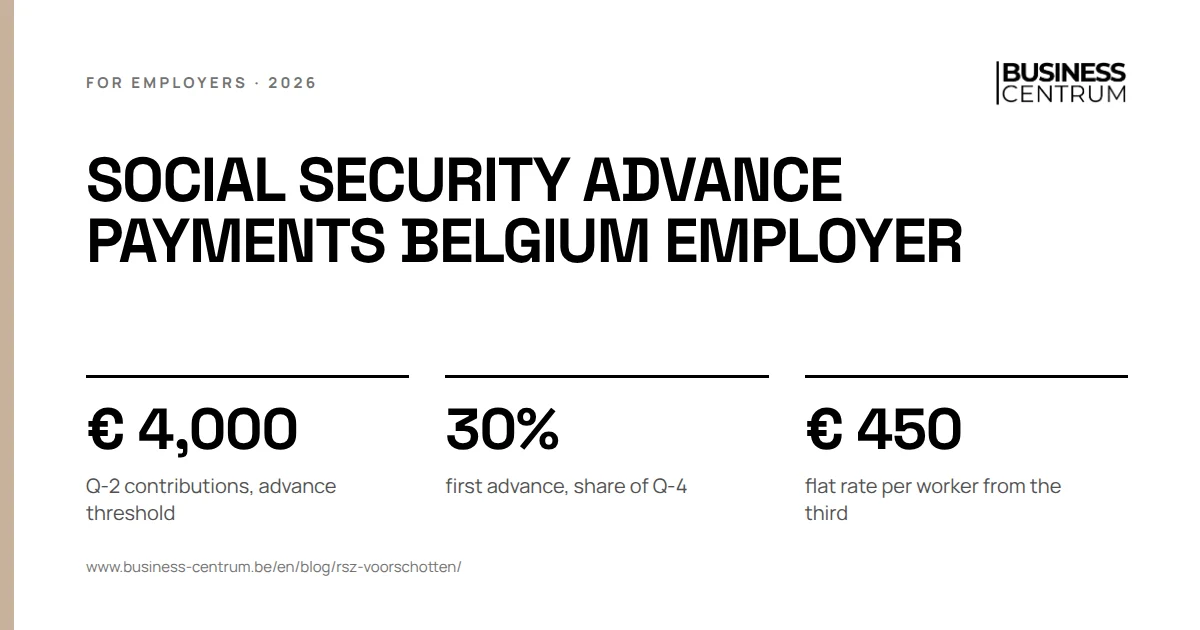
As a Belgian employer, you pay NSSO advances once contributions for the quarter before last exceeded € 4,000. Each month, by the 5th, you pay part of last year's contributions for the same quarter: 30%, 30% and 25%. If you had no contributions in the quarter before last, or no comparable quarter last year, you pay a flat € 450 per worker from the third.
What are social security advance payments for a Belgian employer?
NSSO contributions are due per quarter. They must reach the NSSO by the last day of the month after the quarter. Most employers already pay monthly advances during the quarter. On the due date, only the balance remains.
Contributions cover everything the NSSO collects: social security contributions, but also subsistence security contributions, the Company Closure Fund and the contribution on double holiday pay. Annual amounts, such as the debit notice for manual workers' holidays, do not count.
The NSSO calculates the advance and notifies you or your social secretariat. If you are not affiliated with an accredited social secretariat, you receive a monthly letter with the calculation and a structured reference to be used for that advance only.
Are NSSO advances mandatory? The three situations
For each quarter, the NSSO looks at two quarters: the quarter before last (Q-2) and the same quarter of the previous year (Q-4).
| Situation | What you pay |
|---|---|
| Q-2 contributions, but no higher than € 4,000 | no advances, everything in one payment on the due date |
| Q-2 contributions above € 4,000, and contributions in Q-4 | percentage advances |
| No contributions in Q-2, or Q-2 contributions above € 4,000 but none in Q-4 | flat-rate advances |
The flat rate is € 450 per worker from worker number 3, counted at the end of the month before last. Students and early retirees do not count. A new employer pays no advance for the first 2 months.
Which percentage and due dates apply to NSSO advances in 2026?
| Quarter | 1st advance | 2nd advance | 3rd advance | Balance |
|---|---|---|---|---|
| Q1 | 30% by 5 February | 30% by 5 March | 25% by 5 April | 30 April 2026 |
| Q2 | 30% by 5 May | 30% by 5 June | 25% by 5 July | 31 July 2026 |
| Q3 | 30% by 5 August | 30% by 5 September | 25% by 5 October | 31 October 2026 |
| Q4 | 30% by 5 November | 35% by 5 December | 15% by 5 January | 31 January 2027 |
The percentage applies to the contributions for the same quarter of the previous year. Flat-rate advances are paid every month by the 5th.
Calculating NSSO advance payments: a worked example
A Ghent brasserie paid € 21,000 in contributions for the third quarter of 2025. For the first quarter of 2026 it was € 18,400, more than € 4,000. For the third quarter of 2026, it therefore pays percentage advances.
- By 5 August: 30% x € 21,000 = € 6,300
- By 5 September: € 6,300
- By 5 October: 25% x € 21,000 = € 5,250
- Total € 17,850. Actual contributions for the third quarter are € 22,600, so the balance is € 4,750, payable by 31 October 2026.
In the fourth quarter of 2025, the brasserie paid € 24,000. The advances for the fourth quarter of 2026 are therefore € 7,200, € 8,400 and € 3,600.
Two flat-rate examples:
- A young haulage company with no contributions in Q-2 has six workers at the end of the month before last. The advance is (6 - 2) x € 450 = € 1,800 per month.
- A construction company with five manual workers pays (5 - 2) x € 700 = € 2,100 per month.
Can you pay lower advances?
Yes, at your own risk. If you expect the contributions for the current quarter to be lower than last year, for example because of temporary unemployment or a quiet season, you may calculate the advance on your expected contributions, with the same percentage. If you pay flat-rate advances, you may stop once the expected final amount has been reached. If you underestimate, the penalty below applies.
Where do NSSO advance payments go wrong?
We regularly see four mistakes at SMEs:
- The wrong reference quarter. The percentage applies to the same quarter of last year, not the previous quarter. A brasserie that peaks in summer therefore pays third-quarter advances based on last year's summer.
- Underestimating December. In the fourth quarter, the second advance is the largest, 35%, in the very month of the end-of-year bonus. Build it into your cash planning in November.
- The wrong reference. The structured reference in the NSSO's letter is for that advance only, not for the balance or arrears.
- Too much flat rate. Employers paying flat-rate advances may stop once the expected final amount for the quarter is reached. Many keep paying and so lend the NSSO money.
What does a missed or low NSSO advance cost?
If you do not pay your advances, or pay too little, the NSSO charges a flat-rate penalty per quarter. The amount depends on the contributions you declare for that quarter:
| Contributions declared for the quarter | Flat-rate penalty |
|---|---|
| up to € 18,592.03 | € 123.95 |
| up to € 24,789.37 | € 185.92 |
| up to € 37,184.04 | € 247.89 |
| up to € 49,578.72 | € 371.84 |
| more than € 1,239,467.62 | € 12,394.68 |
There are ten more bands between the fourth and the highest. For the brasserie with € 22,600 in contributions, a missed advance costs € 185.92. If the balance is also late, a contribution surcharge of 10% and late-payment interest of 7% a year come on top.
If you prove force majeure, the penalty is cancelled in full. In exceptional circumstances, it can be reduced by up to 50%, provided you first pay all contributions due.
What Business Centrum does for you
Your social secretariat receives the advance amount from the NSSO. We put the amounts and due dates for each quarter in a payment calendar and flag when a lower advance is justified, for example during temporary unemployment or a seasonal dip. That way you do not overpay and you avoid penalties. More on your payroll and on what a social secretariat costs. Your payroll runs through Business Centrum, together with Acerta.