
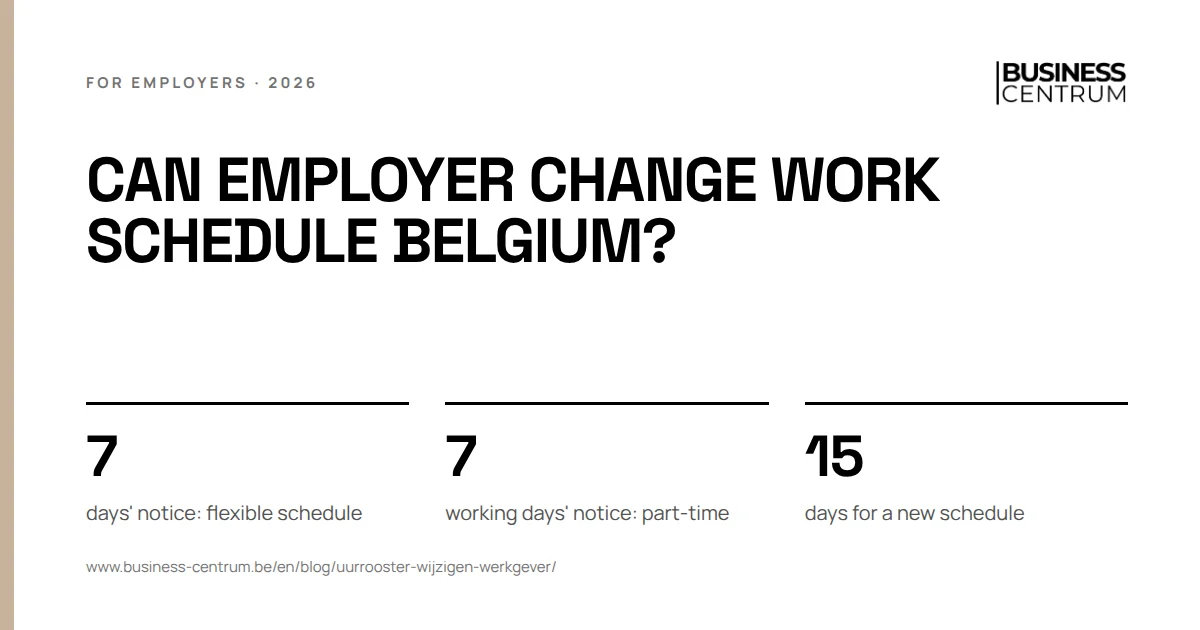
An employer may only change a work schedule alone within what the work rules already provide. Switching to another flexible schedule takes 7 days' notice, a variable part-time schedule 7 working days. A new schedule requires a change to the work rules, unless it fits within a framework of normal working time already in the rules. If the schedule is in the contract, you need the employee's agreement.
Can an employer change the work schedule in Belgium? Three levels
Where the schedule is laid down decides what you may do alone:
| What you want to change | Alone? | How | Notice |
|---|---|---|---|
| Switch between flexible schedules already in the work rules | Yes | Post a dated notice | 7 days ahead |
| Variable part-time schedule within the framework of the rules | Yes | Written notice | 7 working days, at least 3 via sector agreement |
| Temporarily move start and end times under a statutory exception | Yes | Post a notice | 24 hours ahead |
| Introduce a new schedule that is not in the rules and not within the working time framework | Through a procedure | Change to the work rules | 15 days for comments |
| Materially change a schedule set in the contract | No | Addendum with agreement | From signature |
With flexible schedules the timetable moves between peak and off-peak, by at most 2 hours more or less a day and 5 hours a week, and never above 9 hours a day or 45 hours a week. The average must hold over 12 months. Every alternative schedule must already be in the rules.
How far can an employer change the employment contract unilaterally?
The law is short: a clause in which the employer reserves the right to change the terms of the contract unilaterally is void (article 25 of the Employment Contracts Act). A clause saying "the employer may adjust hours as needed" therefore does not help you.
Within your authority you may organise the work. The line is drawn at what is essential:
- Usually essential: pay, job, working hours, and a schedule that was expressly agreed, such as a part-time schedule or day work only.
- Usually not essential: a small shift in start or end times within the schedules of the rules, or another workplace nearby if the contract says nothing about it.
If you change an essential element unilaterally and significantly, the employee can treat it as an implied dismissal. That is not in the statute but follows from settled case law. He stops working and claims payment in lieu of notice, as if you had dismissed him. If the court finds the change was not significant, the employee is deemed to have ended the contract himself. What that costs is in our guide to the employer's notice period. The employee must react quickly though: someone who keeps working for months under the new terms without protest may be deemed to have accepted them.
Changing the schedule through the work rules: the steps
- Write out the new schedule, with start, end, breaks and the days it applies.
- Post the draft, if you have no works council. Employees can record comments in a register for 15 days.
- Without comments the change takes effect on the 15th day after posting. With a works council it takes effect 15 days after agreement.
- With comments the inspector tries to reconcile, then the joint committee. For a new schedule or an extension of the working time framework, the vote of one employer and one employee organisation is enough since 1 June 2026.
- Send a copy to the inspectorate within 8 days, online via arbeidsreglement.belgie.be.
- Give every employee a copy of the change. Without a copy he is not bound by it.
Since 1 June 2026 you can also set a framework of normal working time in the rules: the time slots in which work takes place. Full-time and fixed part-time schedules within that framework no longer need to be listed separately. A template is in our guide to drawing up work rules.
Changing schedules in transport, construction and hospitality
- Construction. In summer or periods of intense activity the limits can go to 9.50 hours a day and 47.50 hours a week, with the union delegation's approval or a notice to the chair of the joint committee. The changed schedule is posted 24 hours ahead.
- Transport and logistics. Transport, loading and unloading work has its own exception (article 24 of the Labour Act) if a royal decree allows it for your sector. Otherwise an unforeseen peak, such as an extra run or a late delivery, falls under an exceptional increase in work: you post the changed schedule 24 hours ahead, with permission from the inspectorate and the union delegation's approval if you have one. For drivers, working time is determined by its own rules.
- Hospitality. Many staff work part-time on a variable schedule. The notice is 7 working days, unless a generally binding sector agreement sets a shorter period, with a minimum of 3 working days. The schedule must fit within the framework in the work rules.
More on part-time contracts and variable schedules in our guide to the part-time employment contract.
Changing an employment contract during sick leave
During incapacity for work the contract is suspended. You cannot change anything alone. If the employee returns with restrictions, you agree adapted work, fewer hours or another schedule in an addendum. In a reintegration process this is based on the occupational physician's advice. If the employee does not agree, the original contract continues to apply.
Drafting an employment contract addendum: a template
An addendum is a written change signed by both parties. An example:
Addendum to the employment contract of [date] between [employer] and [employee]
- From [date], the employee's schedule is: [days and hours].
- The weekly working time is [number] hours. The gross salary becomes [amount] a month.
- This change applies [indefinitely / until and including date].
- All other provisions of the employment contract remain unchanged.
Drawn up in two copies at [place] on [date]. Signature of employer, signature of employee.
Download this template in Word and PDF, in Dutch and French.
If the working hours of a part-time employee change, the addendum also states the new part-time schedule, and you adjust payroll.
Mistakes employers make
- Applying a new schedule before the work rules have changed. Staff then work outside the schedules, and a fine follows.
- Treating a flexibility clause in the contract as a blank cheque. That clause is void.
- Announcing a variable part-time schedule too late, or only verbally.
- Moving from day work to evening or night work without agreement, while the contract states day work.
- Not drawing up an addendum for different hours or a different salary.
What Business Centrum does for you
We check whether your change fits within the work rules or needs an addendum, draft the addendum or the new employment contract and guide the work rules procedure. Then we adjust your payroll, together with Acerta.