
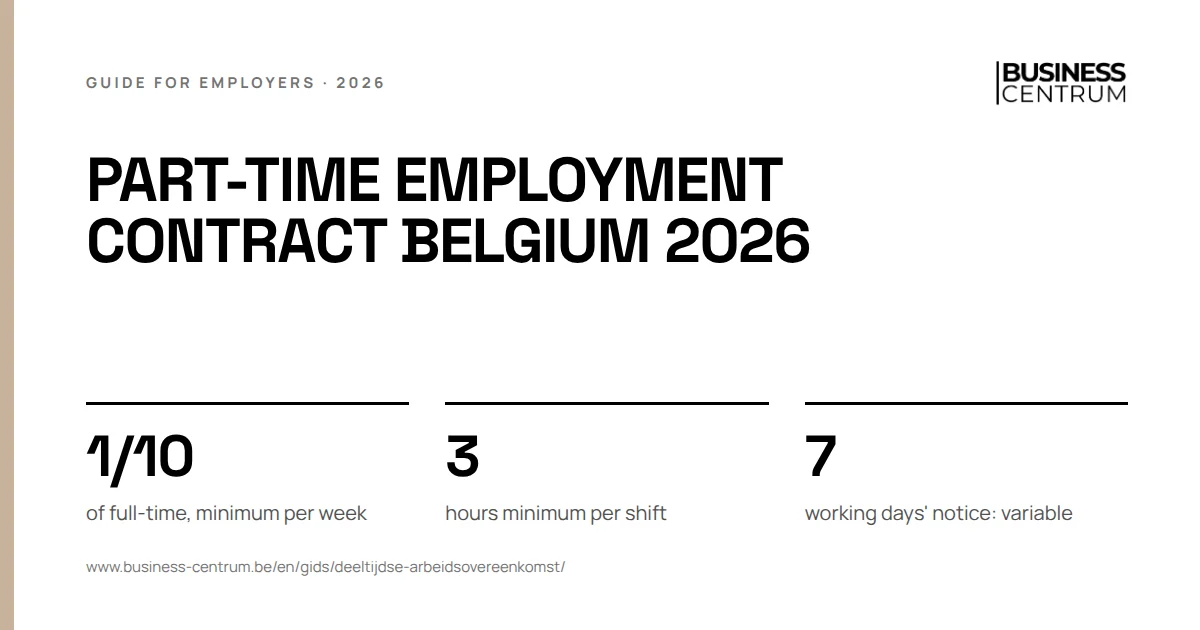
A part-time employment contract in Belgium is put in writing for each employee, at the latest on the first working day, with the weekly hours and the work schedule. Since 1 June 2026, those hours must be at least 1/10 of a full-time week, instead of 1/3. Each shift lasts at least 3 hours in principle.
The mandatory clauses in a part-time employment contract
The law asks for little, but it is strict about what it asks. The contract must be recorded in writing for each part-time employee separately, at the latest when they start work. A contract signed a week later is too late.
Two things must be in it:
- The working arrangement. These are the weekly hours: fixed (for example 20 hours a week) or variable (an average of 20 hours a week over a reference period).
- The work schedule. These are the days and hours of work. With a fixed schedule, they appear in the contract itself. With a variable schedule, the contract states that the schedule is set according to the rules in the work rules.
The usual terms of any employment contract, such as job, pay and place of work, belong in it too. But only a missing working arrangement or a missing schedule gives the employee the right to choose described below.
Keep a copy of the contract, or an extract with the schedule, the employee's identity and both signatures, where the work rules can be consulted. Paper or digital is fine, as long as an inspector can see it straight away.
What if the contract is missing or incomplete?
The employee does not automatically become full-time. The law gives them a right to choose: they may pick the most favourable part-time arrangement and schedule from the part-time arrangements used in your business. If a colleague works 30 hours a week part-time, they can choose those 30 hours, with the pay that goes with them. The risk of full-time pay comes mainly from the presumption of full-time work, if the schedule was also not published or deviations were not recorded (see below).
The minimum hours for a part-time contract since June 2026
The law of 18 May 2026 lowered the minimum weekly hours of a part-time employee. Until 31 May 2026 the minimum was 1/3 of full-time hours. Since 1 June 2026, it is 1/10. You calculate from the full-time week of employees in the same category in your business. If you have no full-timers in that category, use the working hours of your sector.
| Full-time week | Minimum until 31 May 2026 | Minimum since 1 June 2026 |
|---|---|---|
| 38 hours | 12 hours 40 minutes | 3 hours 48 minutes |
The sum: 38 divided by 10 is 3.8 hours, or 3 hours 48 minutes. Before, it was 38 divided by 3, or 12 hours 40 minutes.
Two limits still apply:
- At least 3 hours per shift. A two-hour shift is not allowed in principle. A royal decree or collective agreement can deviate.
- Your sector can deviate. The law allows exceptions to that minimum by royal decree, sector agreement, or company agreement approved by the joint committee. Always check the agreements of your joint committee (JC) before offering a small contract.
If the contract sets fewer hours than allowed, it remains valid, but you pay wages based on the minimum.
Fixed or variable part-time schedule: which to choose?
| Fixed schedule | Variable schedule | |
|---|---|---|
| In the contract | Hours per week and the exact days and times | Hours per week (fixed or average) and a reference to the work rules |
| Work rules | Only if the schedule falls outside the full-time schedules or the framework of normal working time | Always a separate framework for variable part-time schedules |
| Publication | Copy of the contract kept with the work rules | Copy of the contract and a dated notice for each schedule |
| Credit without premium | 12 hours per calendar month | 12 hours a month with fixed hours, otherwise 3 hours 14 minutes per week |
A fixed schedule may also follow a cycle of more than one week, such as 15 hours in week 1 and 20 hours in week 2. It must then be possible to tell at any moment when the cycle starts. If not, the rules for variable schedules apply.
With variable weekly hours, the employee must reach the agreed hours on average over a reference period of at most 3 months. A collective agreement or, failing that, the work rules can extend that period to 1 year.
Variable part-time schedule: how to publish it
A variable schedule is useful in hospitality, retail and logistics, but publication is the first thing the inspectorate checks. Follow these steps:
- Set a framework in your work rules. It covers the daily time band in which work can take place, the days of the week, the minimum and maximum daily hours (and weekly hours if the arrangement is variable), and how and when schedules are communicated. More in drawing up work rules.
- State the variable schedule in the contract. The contract gives the weekly or average hours and the reference period, and says the schedule is set according to the work rules.
- Communicate each schedule in writing and dated. Per employee, in a reliable and accessible way, such as a scheduling app or a notice on the board. The deadline is at least 7 working days in advance. A sector agreement declared generally binding can shorten that, but not below 3 working days.
- Keep the notice with the work rules. While the schedule runs, the notice or a copy stays where the work rules can be consulted. After that, you keep it for another 1 year.
- Record every deviation. If the part-timer works outside the published schedule, you record it (see below).
Two employee rights cost money if you forget them. They may refuse, without being penalised, a shift that is not in a schedule communicated on time or that falls outside the time band in the work rules. If you cancel a planned shift too late, you pay for it as if it had been worked.
Extra hours and overtime premium for part-timers
When a part-timer works more than their schedule but less than the full-time limit, these are extra hours. Without a sector agreement, these rules apply:
- Extra hours requested by the employer need the employee's agreement.
- If you exceed the schedule for a quarter by at least one hour a week on average, the employee can ask for the contract to be adjusted.
- Extra hours are paid at the normal rate. Beyond the credit, a premium of 50% is added, or 100% on a Sunday or public holiday.
The credit depends on the working arrangement. With fixed hours, the first 12 extra hours per calendar month carry no premium. With variable hours, the credit is 3 hours and 14 minutes times the number of weeks in the reference period, up to 168 hours.
Worked example. A shop assistant works 20 hours a week on a fixed schedule at € 16 an hour. In October she works 18 hours outside her schedule, 2 of them on a Sunday.
- Credit: 12 hours without premium. That leaves 6 hours with a premium. The Sunday hours stay among them, as in the example from the Federal Public Service Employment.
- Normal pay for the 18 hours: 18 x € 16 = € 288.
- Premium: 4 hours x € 16 x 50% = € 32, plus 2 hours x € 16 x 100% = € 32.
- Total for the extra hours: € 352.
Once the employee goes above the company's full-time limit, it is real overtime, with an overtime premium and time off in lieu. For voluntary overtime, part-timers face extra conditions since 1 April 2026: a temporary increase in work and at least 3 years of part-time work without a full-time break. More in paying overtime and voluntary overtime in 2026.
Recording deviations from the schedule
Every shift outside the published schedule must be recorded. There are two ways:
- A reliable time-tracking system. It records each day the start and end of work and of breaks, at the moment they happen. A classic punch clock is fine, so is an app. You keep the data for 5 years.
- A deviations document. Only if you have no system. You note the deviation at the start and end of the shift, following the model in the royal decree of 8 March 1990. This document is also kept for 5 years.
Filling it in afterwards does not count. Writing down the whole week's hours on Friday is not a valid record.
A part-time employment contract without a written schedule: the risk
This is the biggest risk of a part-time employment contract in Belgium. If the schedule was not published, or deviations were not recorded, your part-timers are presumed to work full-time. That presumption also applies for the NSSO. You can prove otherwise, but the burden of proof lies with you.
On top of that come the fines of the Social Criminal Code:
| Offence | Level | Administrative fine per employee |
|---|---|---|
| Variable schedule not communicated, or too late | 3 | € 1,000 to € 10,000 |
| Work outside the schedule without a record | 3 | € 1,000 to € 10,000 |
| No copy of the contract kept with the work rules | 2 | € 250 to € 2,500 |
Worked example. A shop employs three white-collar staff at 19 hours a week on variable schedules, earning € 1,400 a month. Full-time colleagues earn € 2,800. For a whole year, no dated schedule was posted. The inspectorate establishes the presumption of full-time work and the shop cannot prove otherwise.
- Difference with full-time: € 1,400 x 12 months x 3 employees = € 50,400.
- Employer contribution 25%: € 12,600.
- Employee contribution 13.07%, not recoverable: € 6,587.28.
- Surcharge 10%: € 1,918.73.
- Level 3 fine at the minimum, three employees: 3 x € 1,000 = € 3,000.
- Total € 24,106.01, before late-payment interest of 7% a year.
Posting a schedule every week in the app and on the board takes fifteen minutes.
Model clause: fixed part-time schedule
Use it as a starting point and have it checked against your joint committee's rules.
Article 3. Working arrangement and schedule
The employee works a part-time arrangement of 20 hours per week, on the following fixed schedule:
Monday Tuesday Wednesday Thursday Friday Saturday Sunday 9:00 to 14:00 9:00 to 14:00 9:00 to 14:00 9:00 to 14:00 A copy of this contract is kept with the work rules. Extra hours are worked only with the employee's agreement and are recorded in the company's time-tracking system.
Model clause: part-time employment contract with a variable schedule
Article 3. Working arrangement and schedule
The employee works a part-time arrangement of an average of 20 hours per week, to be met over a reference period of three months. The schedule is variable and is set in accordance with article 5 of the work rules. The employee receives their individual schedule by a written and dated notice, within the period set in the work rules.
Download both model clauses in Word and PDF, in Dutch and French.
Have every contract signed before the first shift, not during it.
Hospitality and retail: what is different?
Hospitality (JC 302). For the joint committee for the hotel industry, the law itself sets a shorter notice period for variable schedules: 3 working days in advance. The joint committee can impose a longer period through a collective agreement declared generally binding. The new 1/10 rule lets you offer smaller contracts than before, but each shift still lasts 3 hours in principle. For short peaks, a flexi-job is often simpler than a small part-time contract; see hiring flexi-job workers and our page on staff in hospitality.
Retail (JC 201 and 202). Many shops work with variable part-time schedules and Saturday work. If in JC 201 you increase a part-time employee's hours with a new open-ended contract, Social Fund 201 pays a bonus of € 75 per extra hour, for up to 15 hours. Going from 20 to 30 hours a week therefore brings in € 750.
Mistakes employers make with part-time contracts
- Having the contract signed after the first working day. The employee then already has the right to choose.
- A variable schedule without a framework in the work rules. There is then no valid basis for communicating schedules.
- Passing on schedules verbally or in an undated group chat. A notice must be written, dated and individual.
- Not recording extra hours. That opens the presumption of full-time work, even if the employee really worked only 19 hours.
- Applying the credit wrongly. The first 12 hours are premium-free per month, not per week.
- Forgetting the sector agreement. A sector minimum or specific rules on extra hours take precedence over the general rule.
Business Centrum drafts your part-time contracts with the right schedule, adjusts the framework for variable schedules in your work rules and processes extra hours correctly in your payroll, together with Acerta. Through our employment contracts service we also check existing contracts before an inspector does.