
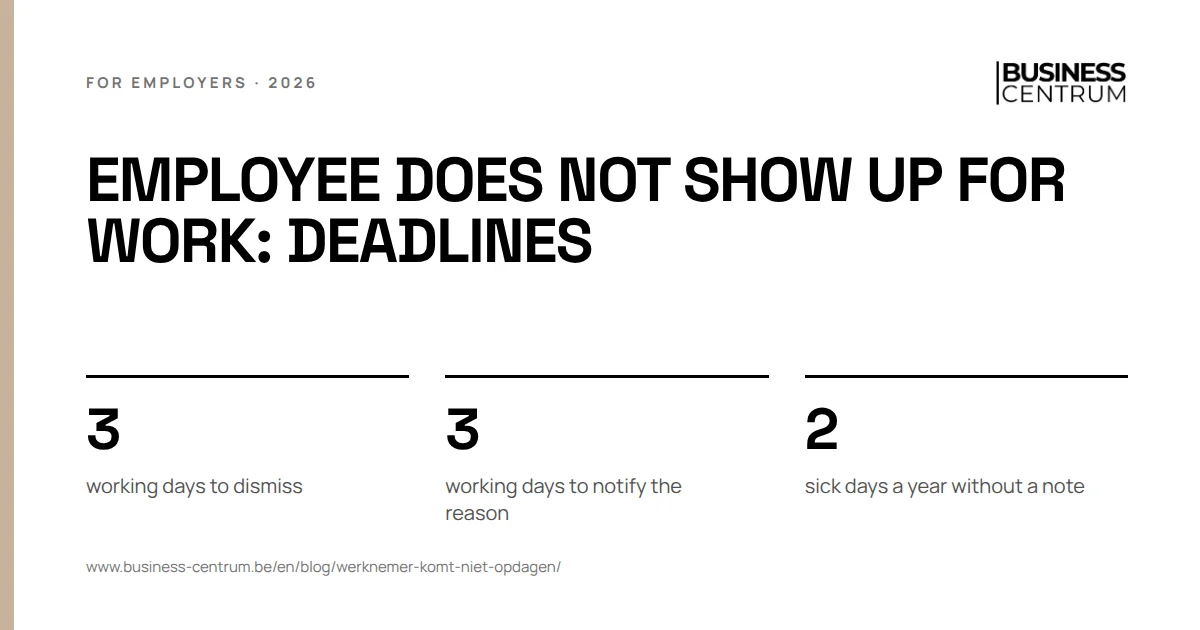
If an employee in Belgium does not show up for work and sends no word, you pay no wages for those days. First try to reach him, then send two written formal notices with a clear deadline. If he stays away, you can dismiss him for serious cause within 3 working days after the last deadline has passed.
When an employee does not show up for work: the day-by-day plan
An employee who stays away without notice puts you in an awkward position: you do not know whether he is ill, something has happened to him or he no longer wants to come. Work to a fixed plan, so you can later show what you did and when.
| When | What you do |
|---|---|
| Day 1, morning | Call, text and email. Ask colleagues and the team leader if anyone knows anything. Check whether leave was requested or illness reported. Note every attempt with the time. |
| Day 1 or 2 | First formal notice by email and by registered letter: return to work or justify the absence by a specific date. |
| A few days later | No reply: second and final notice, by registered letter, with a new date and the consequence if he does not respond. |
| After the last deadline | Decide within 3 working days. If you choose dismissal for serious cause, set out the facts in the same registered letter. |
| Working day after dismissal | Dimona OUT. |
| Payroll | The absent days without pay, then the final settlement and the social documents. |
Working days here means every day except Sundays and public holidays. A Saturday therefore counts.
If the employee is absent and unreachable: the two formal notices
Even if the employee cannot be reached, you send the notices. Use the address in your personnel file and send each letter both by registered post and by email. If the letter comes back, keep the envelope unopened: it proves you tried.
A formal notice for unauthorised absence does two things. It gives the employee the chance to explain what is going on, and it makes clear you do not accept the absence. A court will later look at exactly those two points.
First notice
Subject: your absence since [date]
Dear [name],
You have not come to work since [date] and you have not told us why. We tried to reach you without success on [date and time].
We ask you to return to work on [date] or to send us a valid justification by that day at the latest, for example a medical certificate. Until then, we regard your absence as unauthorised. We do not pay wages for these days.
Kind regards, [name, position, signature]
Second and final notice
Subject: formal notice, unauthorised absence
Dear [name],
On [date] we sent you a first notice. You did not respond and you are still absent without justification.
We hereby give you formal notice. Return to work by [date] at [time] at the latest or send us a valid justification by then. If you do not, we will regard your continued absence as serious cause and end your employment contract without notice or compensation.
Kind regards, [name, position, signature]
Download both formal notices in Word and PDF, in Dutch and French.
In each letter, allow enough time for the registered letter to arrive. A deadline that has passed before the postman calls does not help you.
Unauthorised absence or illness?
An employee who is ill must inform you immediately, except in case of force majeure. That always applies, even when he does not have to provide a certificate. Since 1 January 2026, he may stay away 2 times per calendar year on the first day of illness without a certificate, but he must still call in sick that morning. Companies with fewer than 50 employees can exclude these certificate-free days through their work rules.
The difference with unauthorised absence therefore lies in the notification:
- Notified and ill. Authorised absence. You pay guaranteed pay and, if you ask for a certificate, it must reach you within 2 working days, unless your work rules say otherwise.
- Not notified, certificate later. The certificate shows he was ill, but for the days before he informed you or handed in the certificate, you may refuse guaranteed pay. Dismissal for serious cause then becomes difficult.
- Not notified, no certificate, no reaction. Unauthorised absence. This is the case the plan is meant for.
Force majeure does exist: a hospital admission after an accident, for example. That is why the first notice always starts from the question of what happened, not from an accusation. The rules on certificates are explained in our blog on the sick note and the employer.
Unauthorised absence: pay, Dimona and sanctions
Pay. You pay no wages for days of unauthorised absence. In the DmfA, the quarterly NSSO return, these days go under code 30, the residual category for days without pay. If a public holiday falls just before or after the absence, take care: an employee who was absent without justification on the normal working day before or after a public holiday is not entitled to pay for that holiday.
Dimona. As long as the contract runs, nothing changes. An absence is not a departure, so no Dimona OUT. Only after dismissal do you file the Dimona OUT, at the latest on the working day after the dismissal. If a new employee does not turn up on his first day, you can cancel the Dimona declaration until the end of that calendar day. Your Dimona management has to act quickly that day.
Sanctions. If you do not want to dismiss straight away, your work rules can provide for sanctions, such as a warning or a fine. Fines imposed on a single day may together not exceed 20% of the daily wage and must be set out in the work rules. How to draw up a written warning is explained in our blog on giving an employee a warning.
Dismissal for serious cause after unauthorised absence
Labour courts recognise unjustified absence as serious cause, but only if it is serious enough and you can prove it. One day of absence is rarely enough. If the employee stays away after two formal notices, courts usually do accept serious cause.
The procedure is strict:
- You dismiss within 3 working days after you know the facts with certainty. For absence, in practice that is the moment the last deadline in your formal notice expires. Count the working days from the day after.
- You notify the facts within 3 working days after the dismissal, by registered letter, bailiff's writ or hand delivery against signature. Do it straight away in the dismissal letter.
- You describe the facts concretely: since which day, which attempts, which letters, which deadlines.
If in doubt, an ordinary dismissal with notice or compensation in lieu remains possible. It costs more, but without the risk of a contested serious cause. All conditions and examples are in our guide to dismissal for serious cause.
What Business Centrum does for you
Business Centrum processes the absence in your payroll, together with Acerta: the days without pay, the right DmfA code, the public holiday rule and a timely Dimona OUT. After the dismissal we prepare the final settlement and the social documents. If you send us the letters you sent, we check that the dates and deadlines are right before you dismiss. Absences are handled by our leave and absence service.