
The minimum wage in Belgium in 2026 has been € 2,233.61 gross per month since 1 July 2026 for a full-time employee aged 18 or over, or € 13.56 an hour in a 38-hour week. That amount is called the GGMMI, the guaranteed average minimum monthly income. Young workers and students receive a percentage of it, and in almost every sector the pay scale of the joint committee is higher. That scale then takes precedence.
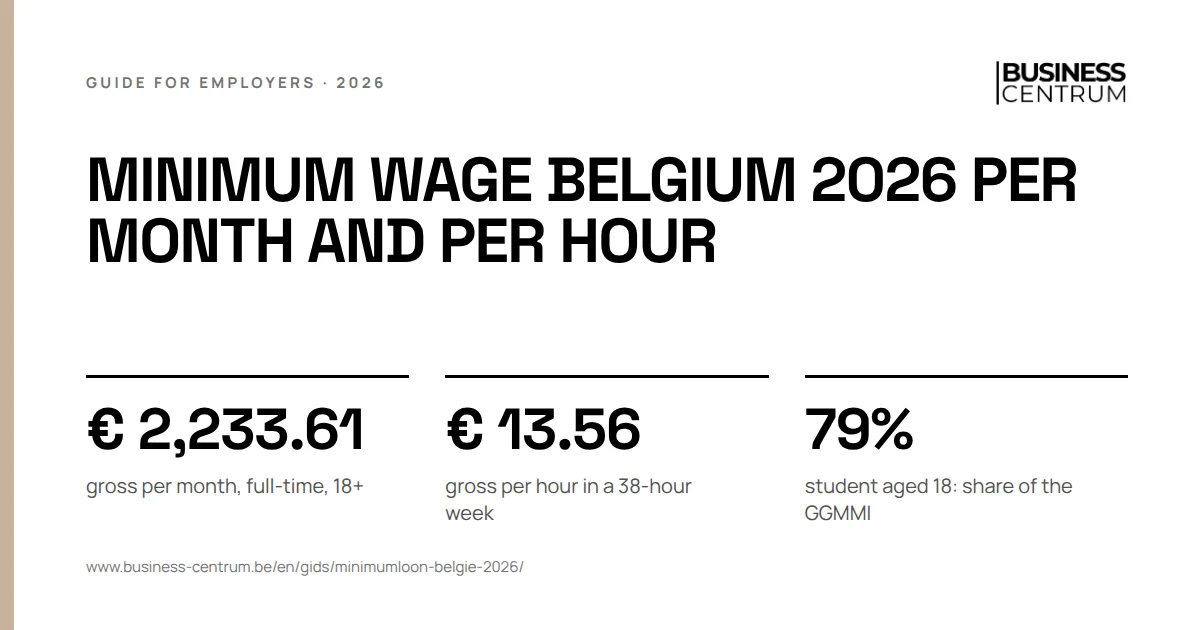
Minimum wage Belgium 2026 at a glance
| Situation | Minimum wage since 1 July 2026 |
|---|---|
| Full-time, per month, aged 18 or over | € 2,233.61 |
| Per hour in a 38-hour week | € 13.56 |
| Per hour in a 40-hour week | € 12.89 |
| Half-time, per month | € 1,116.81 |
| Twelve months at this amount | € 26,803.32 |
The GGMMI is a floor for all sectors. It comes from collective agreement no. 43 of the National Labour Council and applies to anyone who normally works full-time. A part-time employee receives it in proportion to his working hours. The annual amount above is a calculation aid: it includes no end-of-year bonus or holiday pay, and in 2026 itself the GGMMI was lower until the end of June.
The minimum wage rose three times in 2026: in January through indexation, in April by € 35.70 under the social agreement and in July again through indexation. How those steps went and what they meant for your payroll is covered in our news item on the GGMMI 2026.
Calculating the minimum wage per month and per hour
The GGMMI is a monthly amount. If you pay by the hour, you convert it with the standard formula for a monthly wage: monthly amount x 3 / (13 x hours per week). Three months add up to thirteen weeks.
- 38 hours a week: € 2,233.61 x 3 / (13 x 38) = € 13.56 an hour.
- 40 hours a week: € 2,233.61 x 3 / (13 x 40) = € 12.89 an hour.
A shorter full-time week therefore raises the minimum per hour. So always look at the working arrangement stated in the employment contract and the work rules.
For a part-time employee, the proportion counts. A half-time employee earns at least € 1,116.81 gross per month. Someone who works four fifths earns at least four fifths of the full-time amount.
Minimum wage for an 18 year old and over: white-collar or blue-collar
From age 18, the same GGMMI of € 2,233.61 applies to white-collar and blue-collar staff. The status does not change the minimum, only the way you check it. A white-collar employee usually has a fixed monthly salary that you compare directly with the GGMMI. A blue-collar worker is often paid by the hour: convert that to a monthly wage with hourly wage x hours per week x 13 / 3 and compare the result with the GGMMI.
For the employee, the difference is mainly visible in net pay. A blue-collar worker pays his NSSO contribution on 108% of his gross pay, a white-collar employee on 100%. On the minimum wage this makes no difference to the NSSO contribution, as the table further on shows, because the work bonus cancels out the contribution in both cases.
Minimum wage for young workers and students in 2026
The GGMMI of collective agreement no. 43 applies from age 18, but not to students aged 18 to 20 on a student employment contract. For younger employees and for those students, a percentage of the amount for age 18 applies:
| Employee | Share of the GGMMI | Per month, full-time | Per hour, 38-hour week |
|---|---|---|---|
| 16 or younger | 67% | € 1,496.52 | € 9.09 |
| 17 | 73% | € 1,630.54 | € 9.90 |
| Student aged 18 | 79% | € 1,764.55 | € 10.72 |
| Student aged 19 | 85% | € 1,898.57 | € 11.53 |
| Student aged 20 | 90% | € 2,010.25 | € 12.21 |
| Employee or student aged 21 or over | 100% | € 2,233.61 | € 13.56 |
An employee aged 18, 19 or 20 without a student employment contract receives the full GGMMI. The lower percentage is therefore tied to the student contract, not to age alone.
A student worker usually works in a sector with its own pay scale. Some committees, such as hospitality and independent retail, have their own student pay. If it is higher than the amounts above, you pay that. What else you arrange for a student, such as the hours under the solidarity contribution and the Dimona, is on our page about employing students.
Minimum wage Belgium net: what the employee takes home
The minimum wage is a gross amount. There is no statutory net minimum wage, because net pay depends on withholding tax and the family situation. Part of the calculation is fixed, though.
On the GGMMI, a full-time employee in practice pays no personal NSSO contribution. That contribution of 13.07% is cancelled out entirely by the work bonus, which reduces the employee contribution on low pay:
| White-collar | Blue-collar | |
|---|---|---|
| NSSO on the GGMMI, before the work bonus | € 291.93 (13.07% on 100%) | € 315.29 (13.07% on 108%) |
| Maximum work bonus, part A plus part B | € 299.53 | € 323.49 |
| Personal NSSO after the work bonus | € 0 | € 0 |
A white-collar employee with a reference monthly wage up to € 2,300.62 receives both parts of the work bonus in full: € 127.54 in part A and € 171.99 in part B. For a blue-collar worker these are € 137.74 and € 185.75. The GGMMI is below that threshold, so on the minimum wage both parts are at their maximum.
The work bonus may never exceed the personal contribution, so the NSSO contribution drops to zero and no lower. What remains is withholding tax, possibly reduced by the tax work bonus, and the special social security contribution. How the work bonus changed in 2026 is explained in our article on the work bonus 2026.
Minimum wage per sector: your committee's pay scale comes first
The GGMMI is the minimum for the whole private sector. Almost every joint committee has its own pay scale above it, by job, experience or age. You always pay the higher of the two. Some examples of the lowest sector minimum:
| Sector | Lowest minimum in the pay scale |
|---|---|
| JC 200, white-collar, class A, 0 years of experience | € 2,242.80 a month |
| JC 140.03, road haulage, driving staff level 1 | € 14.93 an hour |
| JC 302, hospitality, category I | € 15.21 an hour |
| JC 124, construction, category I | € 18.75 an hour |
In JC 200 the lowest pay scale is barely above the GGMMI. Pay below the scale there and you quickly fall below the minimum wage as well. In construction and road haulage the sector minimum per hour is well above € 13.56.
The full pay scale per committee is in our overview of the pay scales per joint committee, with the amounts as the FPS Employment publishes them and the date on which they took effect. If you do not know which committee your employee falls under, see how to find your joint committee in Belgium.
Flexi-job and student job: which minimum wage applies?
A flexi-jobber also has a minimum wage, but it follows its own rules. In hospitality the minimum flexi wage is € 12.11 an hour, with flexi holiday pay on top. In the other sectors the minimum is the pay scale of the job, or the GGMMI converted to an hourly wage if there is no scale. The flexi base wage there may be at most 150% of that minimum. All the rules are in our guide to the flexi-job in 2026.
For a student worker, the percentage from the table above applies, or the student pay of his sector if that is higher. The minimum per hour therefore depends on his age and on the committee.
What counts towards the minimum wage?
The GGMMI is an average. It counts pay for normal work, not only the fixed monthly salary.
- Counts: fixed and variable pay, in cash or in kind, and bonuses for normal work.
- Does not count: overtime premiums, single and double holiday pay and expense allowances.
- Bonuses covering more than a month: an end-of-year bonus counts for the period it covers, if you pay it within 12 months. If the total stays below the GGMMI for that period, you pay the difference.
A monthly wage below the GGMMI is therefore only in order if a bonus covers the gap over the period and you settle it.
What do you risk below the minimum wage?
Paying too little is a level 3 offence under the Social Penal Code. The administrative fine is € 1,000 to € 10,000, per employee concerned. The pay you underpaid remains due, with interest. The short answer to whether the minimum wage is compulsory, with the source, is at is the minimum wage compulsory?.
What to check now
- Compare every full-time monthly wage of an employee aged 18 or over with € 2,233.61, and every part-time wage with the share that matches his working hours.
- Look up the pay scale of each committee and pay the higher of the scale and the GGMMI.
- Check the pay of young workers and students against the percentages above and against the sector's student pay.
- If you rely on an end-of-year bonus to reach the minimum, draw up the settlement per period when you pay it.
- Check again at every indexation: the GGMMI rises by 2% each time the pivot index is exceeded.
What Business Centrum does for you
Business Centrum processes your payroll together with Acerta and compares every wage with the GGMMI and the pay scale of your joint committee. At every indexation we adjust the wages and flag who is at risk of dropping below the minimum. You have one fixed contact person in Ghent who knows your file. Would you like us to check your wages against the minimum? Request a call back.