
Your joint committee in Belgium follows from the actual main activity of your company: it depends on what your business really does in Belgium, not on the NACE code in the Crossroads Bank for Enterprises and not on a choice by the employer. You compare that activity with the scope of each committee published by the FPS Employment, separately for blue-collar and white-collar staff. If you already employ people, the committee applied is shown in the individual account and the DmfA. If in doubt, the FPS Employment can give an opinion.
What a joint committee is and what it governs is explained in joint committee: what it means for your business. This guide answers one question: which committee is yours, and how do you show it.
Which joint committee applies: the rule
The basis is the Act of 5 December 1968 on collective labour agreements and joint committees. Article 35 lets the King set up the committees and determine which persons, sectors or businesses belong to each one. This is done in a royal decree per committee: the scope. Article 31 makes a generally binding collective agreement binding on all employers and employees within that scope. Your committee is therefore neither a choice nor a membership. It follows from the law, as soon as your activity falls within a scope.
The FPS Employment works this rule out in four principles:
- The employer counts, as a legal entity. The committee belongs to the natural or legal person the employee works for, not to a brand or a site.
- The real activity in Belgium decides. That is the activity that explains the existence and nature of the business. Transport within a building materials trade is not an activity of its own, but support for the trade. What you subcontract does not count.
- The secondary follows the main. An employer in principle falls under one committee. The main activity is the one that takes up most working hours or employs most staff.
- The employee's job does not count. A salesperson in a metal manufacturing company falls under the metal committee, not the trade committee.
To determine the activity, the FPS looks at what the business itself does, where the staff work, and at objective criteria: the manufacturing processes, the tools used, the nature and destination of the products, and how turnover is split between trade, manufacturing, assembly, maintenance or transport. Expressly not relevant are the corporate purpose, the type of employment contract or the training of the employee, membership of an employers' federation, the activity declared in the trade register, the NSSO code and the provisions of collective agreements.
There are exceptions. Many sectors have one committee for blue-collar workers and another for white-collar employees, so one company falls under two committees. For some committees a normal activity that is not the main activity is enough, as in construction (JC 124), or even a secondary activity, as in the entertainment sector. Two unrelated activities, in separate premises and with their own staff, can each have their own committee. And a few committees follow the occupation or contract of the employee, such as the committee for paid sportspeople or the one for domestic staff.
Find your joint committee in five steps
- Describe what your company actually does. Not what the articles of association say, but where most hours and people go. Do you make, sell, repair, transport for others or provide a service?
- Look up the scope. The FPS Employment publishes the consolidated texts of all scopes, with a search engine by number or name. The FPS also publishes non-binding administrative interpretations for certain activities.
- Do it separately for blue-collar and white-collar staff. Read in the text who the committee covers: workers doing mainly manual work, those doing mainly intellectual work, or employees in general.
- No committee of your own? Look at the supplementary committees. Blue-collar workers without their own committee fall under JC 100, white-collar employees without their own committee under JC 200, unless the supplementary committee for the non-profit sector is competent.
- Record your choice and have it checked if in doubt. An opinion from the FPS Employment or the view of a lawyer or social secretariat helps you back it up.
Which joint committee does my company have: the guide by activity
The guide below shows, per activity, the committee named in the scope of the FPS Employment, with links to our committee guide, the pay scale and the official text. It covers a selection of activities, not a complete list. It is an indication: always read the full text of the scope, which contains exceptions that a short line cannot carry.
Guide by activity
Which joint committee fits your activity?
Blue- and white-collar staff
JC302
Joint Committee for the hotel industry
According to the scope: Hotels, restaurants and cafés, and according to the scope also caterers, canteens, bars, snack bars and banqueting rooms not attached to a pastry shop.
Note: Blue-collar and white-collar staff fall under JC 302 together.
An indication, not a decision: the actual activity decides.
If in doubt, the FPS Employment gives non-binding advice. Only the labour court decides with binding effect. How we present official data.
Unsure about your committee? Request a call back
All activities at a glance
| Activity | Blue-collar staff | White-collar staff |
|---|---|---|
| Hospitality: hotel, restaurant, café | JC 302 | JC 302 |
| Construction, renovation, finishing, demolition | JC 124 | JC 200* |
| Haulage and logistics for third parties | JC 140.03 | JC 226 |
| Shop, independent retail | ? | JC 201 |
| Food trade: supermarket, butcher, drinks trade | JC 119 | JC 202 |
| Large store or department store, 50 staff or more | JC 311 | JC 311 |
| Cleaning for clients | JC 121 | JC 200* |
| Metalworking and machine building | JC 111 | JC 209 |
| Electrical installation | JC 149.01 | JC 200* |
| Garage, car wash, tyre centre | JC 112 | JC 200* |
| Food production: bakery, brewery, dairy | JC 118 | JC 220 |
| Horticulture, landscaping and grounds maintenance | JC 145 | JC 145 |
| Hairdresser, beauty salon, fitness | JC 314 | JC 314 |
| Service voucher company | JC 322.01 | JC 322.01 |
| Temporary work agency | JC 322 | JC 322 |
| Healthcare: care home, home nursing, practice | JC 330 | JC 330 |
| Office, consultancy, IT, with no own committee | JC 100* | JC 200* |
* Supplementary committee: only if no other committee is competent.
Two examples of how it goes wrong. A building materials wholesaler with its own lorries is not a transport company: the transport supports the trade, and the scope of JC 124 expressly names the wholesale of building materials. A haulage company working for third parties, on the other hand, has two committees: JC 140.03 for the drivers and warehouse staff, JC 226 for the white-collar employees. More per sector in our guides for hospitality, transport and independent retail.
Joint committee lookup with the VAT or enterprise number
A joint committee is not recorded in the Crossroads Bank for Enterprises. In the public CBE search, the enterprise number does show the NACE-BEL codes (version 2025) recorded for VAT and for the NSSO, and whether the business is known to the NSSO as an employer. If you only have a VAT number, that works too: the VAT identification is the same number as the enterprise number, preceded by BE.
What that NACE code tells you:
- Yes: an indication of the activity as recorded in the CBE. If it shows a construction activity, the scope of JC 124 is a logical first place to read.
- No: the committee itself. A NACE code comes from a classification of economic activities, not from a scope. The FPS Employment expressly calls the activity declared in the trade register and the NSSO code not relevant: the actual activity decides. A NACE code that no longer matches what you do therefore does not change your committee.
The NSSO employer directory shows the public data of an employer in its public version. The employer categories are visible only to the employer or its agent, in the secure version.
Where is the committee shown for an existing employer?
If you already have staff, you already apply a committee. You will find it in these places:
| Document | What it shows |
|---|---|
| Individual account | Must state the name of the competent joint committee and, where relevant, subcommittee (Article 14 of the Royal Decree of 8 August 1980 on keeping social documents) |
| DmfA | The number of the committee or subcommittee per employment line, or 999 if the employee falls under no committee |
| Work rules | The competent joint body in which the collective agreements concluded outside the company were made (Article 6 of the Work Rules Act) |
| Dimona | A mandatory number for a few sectors only; for the other committees XXX is enough |
| Payslip | May name the committee, but the standard entries listed by the FPS Employment do not require it; some committees set their own entries |
The DmfA is the most precise source: it shows, per employee, the committee under which you declared them. In the Dimona the number is only mandatory for, among others, blue-collar workers in construction and transport, electricians, temporary agency work and casual work in agriculture, horticulture and hospitality. More on these declarations in what is DmfA and the Dimona declaration guide.
Note: all these documents show what the employer applies, not what is correct. If your social secretariat works with the committee you gave at the start, every document repeats that choice. An early mistake therefore shows up everywhere. A committee named in the employment contract also only proves what was agreed, not which committee is competent.
What NSSO registration does and does not do
Anyone hiring staff for the first time is identified as an employer with the NSSO through the online service WIDE. You then receive a message with your NSSO number, the NACE code of your activity and the employer categories the NSSO assigns to you. The NSSO does not assign a joint committee. You state it, and according to the NSSO you notify its Identification Department as soon as you fall under a different committee than the one you first gave.
So the NSSO records what you declare. According to the FPS Employment, the committee also usually determines the contributions to a subsistence security fund, either directly or through the NSSO. A committee being in the NSSO data does not make it correct. Just starting out? Read becoming an employer too.
If in doubt: the opinion of the FPS Employment
According to the FPS Employment, every employer is deemed to know its committee. It can get help from its social secretariat or legal adviser, consult the scopes and interpretations on the FPS website, or ask the Directorate-General for Collective Labour Relations for an opinion. This is how that opinion works:
- Who asks: the employer, its agent, an employee, a trade union or another party. There is no form.
- How: by email to coa@werk.belgie.be, with the name, address, enterprise number and NSSO number of the employer, the capacity of the applicant and a short description of the activity and the issue.
- Investigation: the Social Laws Inspectorate examines the activity on site.
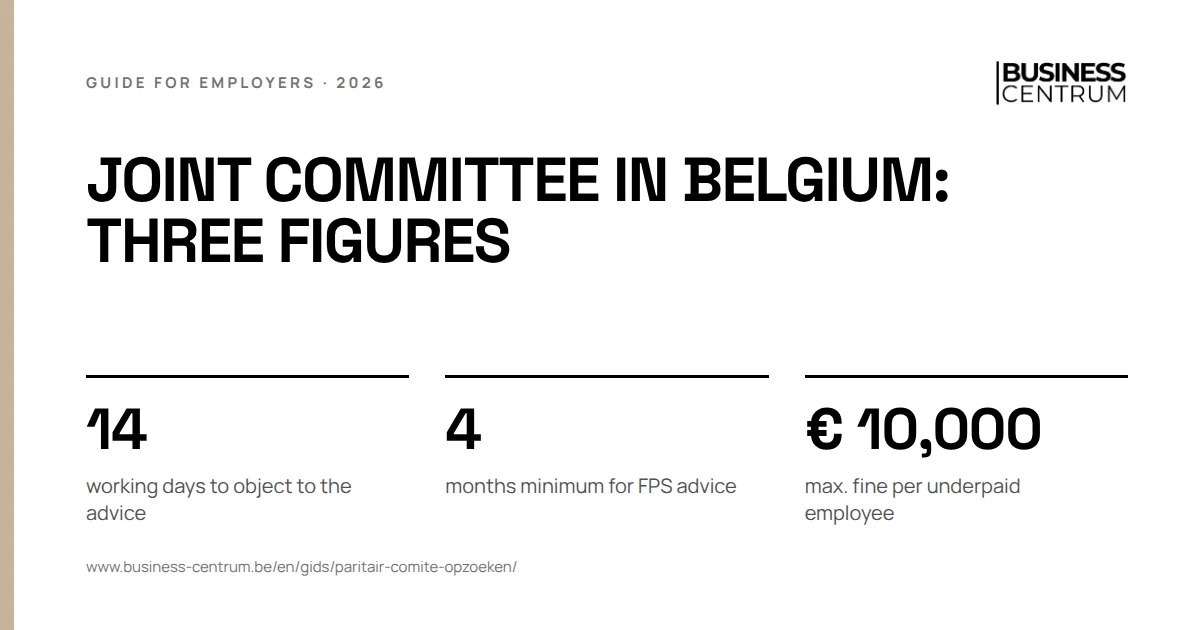
- Opinion and objection: the opinion is emailed to the employer, who has 14 working days to lodge a reasoned objection. The opinion is then confirmed or replaced.
- Forwarding: a final opinion is sent for information to the inspectorate, the NSSO and the National Annual Holiday Office.
Allow at least 4 months. The opinion is not binding, has no legal effect and is not an administrative decision. You are also not obliged to request it before changing your committee. Only the labour court decides with binding effect, and only in an individual dispute, for example between employer and employee over a sector agreement, or with the NSSO or a fund over contributions. Such a judgment applies to those parties, not to the whole sector.
Consequences of the wrong joint committee
A wrong committee affects every payroll calculation. What demonstrably follows:
- Wage arrears. The generally binding agreements of the right committee apply even if you did not apply them. If you paid a lower scale or no sector bonus, the employee can claim the difference. Claims under the employment contract are time-barred 1 year after the contract ends or 5 years after the event, but never later than 1 year after the end (Article 15 of the Employment Contracts Act).
- Inspection and fine. Not paying wages, or not paying them in full, on the due date is a level 3 offence under Article 162 of the Social Criminal Code: an administrative fine of € 1,000 to € 10,000, multiplied by the number of employees concerned. Not paying the sector minimum wage while committing other offences risks level 4. Another breach of a generally binding agreement is level 1 under Article 189: € 100 to € 1,000 per employee.
- Corrected declarations. If an investigation shows you declared the wrong committee, the quarters concerned in the DmfA must be amended. Because sector contributions and benefits from sector funds depend on the committee, the NSSO limits the retroactive effect to the quarter in which you knew the committee was being questioned.
What makes a collective agreement binding: see is a collective agreement mandatory.
Can an employer choose its joint committee?
No. You apply the committee your actual activity falls under, and it only changes when that activity changes or when the first committee was wrong. The short answer with the legal text is in can an employer choose or change its joint committee.
Your committee in payroll
The joint committee is the starting point of every payroll calculation: the pay scale, indexation, bonuses, sector contributions and the rules on short leave and commuting all depend on it. In the payroll administration Business Centrum provides together with Acerta, with a dedicated contact person, we start from the committee that matches your activity. Unsure about your committee? Request a call back and tell us what your company does.