
Under the flexi-job rules in Belgium for 2026, a flexi-job is a side job with its own status: the employee worked at least 4/5 for another employer three quarters earlier, or he is legally retired. He receives a flexi wage that is tax-free up to € 18,440 a year, and you only pay a special employer contribution of 28%. Since 1 July 2026 a flexi-job has been possible in almost all sectors.
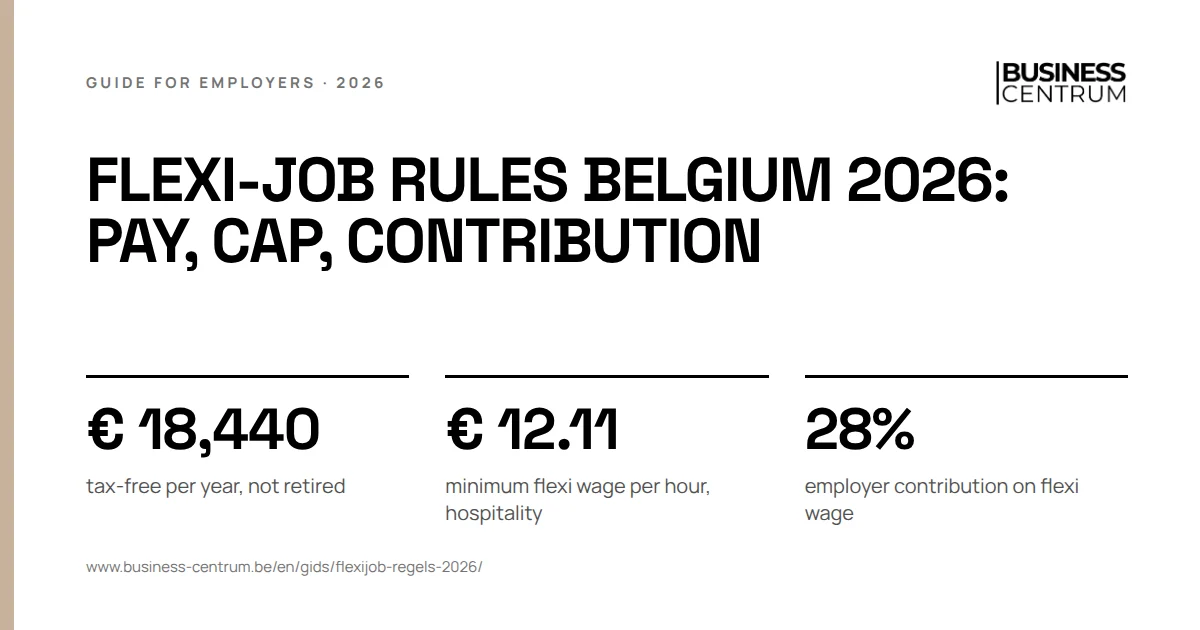
Flexi-job rules Belgium 2026 at a glance
| Rule | What applies in 2026 |
|---|---|
| Who qualifies | anyone who worked at least 4/5 elsewhere in quarter T-3, or is legally retired |
| Minimum flexi wage, hospitality | € 12.11 an hour since 1 September 2026, plus € 0.93 flexi holiday pay |
| Minimum flexi wage, other sectors | the pay scale of the job, or the GGMMI converted to an hourly wage if there is no scale |
| Maximum | hospitality € 21 an hour, elsewhere 150% of the minimum base wage |
| Flexi holiday pay | 7.67%, with every payment of wages |
| Tax-free up to | € 18,440 a year; no ceiling for legally retired people |
| Employer contribution | 28% on flexi wage plus flexi holiday pay |
| Personal NSSO contribution | none |
| Contract | a written framework agreement, and within it a flexi employment contract each time |
| Declaration | Dimona type FLX, per quarter, before the start |
Flexi-job requirements Belgium 2026: who can do a flexi-job?
The main condition concerns the work the flexi-jobber does elsewhere. In the reference quarter T-3, three quarters before the flexi-job, he worked for one or more other employers at least 4/5 of a full-time job, or 80% of the working volume. Anyone who wants to do a flexi-job in the second quarter of 2027 must therefore have worked enough in the third quarter of 2026.
Not all work counts towards that 4/5. Student work under the solidarity contribution does not count, and neither does work as a young person up to the end of the year in which he turns 18. A student worker therefore cannot become a flexi-jobber on the basis of his student job. That is what the student employment contract is for.
Pensioners fall outside the 4/5 condition. Since 1 July 2026 the NSSO looks at whether the employee is retired in the quarter of the flexi-job itself. Someone who receives a transition allowance does not count as retired.
Not with the same employer. A flexi-job is not possible with an employer for whom the employee already works under another employment relationship in the same quarter. So a permanent employee cannot help out at your business at the weekend as a flexi-jobber. It is also not possible in a company affiliated with a company where he works 4/5 or more, unless he works full-time elsewhere.
Dropping from full-time to 4/5. Anyone who cuts back from full-time in T-4 to 4/5 in T-3 may not do a flexi-job for 2 quarters: in quarter T and the following quarter.
Flexi-job salary in Belgium: the minimum and the maximum
Minimum. In hospitality a fixed minimum flexi wage of € 12.11 an hour applies since 1 September 2026. On top of that comes € 0.93 flexi holiday pay, together at least € 13.04 an hour. In the other sectors the minimum is the pay scale of the job, or the GGMMI converted to an hourly wage if there is no scale. Since July that GGMMI has been € 2,233.61 a month for a full-time employee; how to convert it to an hourly wage is in our guide to the minimum wage in Belgium.
Maximum. In hospitality the flexi hourly wage may not exceed € 21, or € 22.61 with flexi holiday pay. In the other sectors the flexi base wage may be at most 150% of the minimum base wage of the job. Since 1 July 2026 that limit only applies to the base wage: bonuses and supplements from a law or collective agreement, such as an end-of-year bonus, may come on top.
Worked example, hospitality. A flexi-jobber works 20 hours at the minimum. He receives 20 x € 13.04 = € 260.80, flexi holiday pay included, and within the ceiling that amount is net for him. On it you pay a contribution of 28%: 260.80 x 1.28 = € 333.82 in total.
Flexi holiday pay. With every payment of wages you pay 7.67% flexi holiday pay. So there is no separate holiday pay in May or June: flexi work does give entitlement to holiday days, but the flexi holiday pay has already been paid together with the wage. How holiday pay works for your other employees is explained in our guide to holiday pay in 2026.
Social rights. Flexi-job work is declared in the same way as that of regular employees and in principle counts towards building up social rights. The flexi-jobber therefore builds up rights, even though he pays no NSSO contribution himself. That is why every period of work must be correctly recorded in the Dimona and the DmfA.
Flexi-job tax free: the ceiling of 18,440 euros
For the employee, the flexi wage is free of personal NSSO contributions. For tax purposes it is exempt up to a ceiling of € 18,440 a year in 2026. Anything above it is taxed as normal professional income. For legally retired people there is no ceiling.
The ceiling counts across all of the employee's flexi-jobs together, with all employers. Exceeding it changes nothing about the flexi status for the NSSO: you still pay the contribution of 28%. The employee keeps track of his own flexi income. For that, the NSSO gives him the flexi@work system, which lets him see his situation in mycareer; the compulsory data transfer through flexi@work has been running since 1 January 2025. Ask a new flexi-jobber at the start whether he has other flexi-jobs, so he knows where he stands against the ceiling.
Flexi-jobs in Belgium in 2026: in which sectors?
Since 1 July 2026 the flexi-job has in principle been open to the whole private and public sector. Only what a royal decree excludes stays closed. The royal decree of 30 August 2026 excludes, among others, domestic workers and agriculture, and part of horticulture. In Flemish childcare flexi-jobs may make up at most 20% of the annual working volume, and in service vouchers a flexi-job is only possible 3 months after the first Dimona.
In construction, the joint committee concluded a collective agreement on 16 July 2026 that restricts flexi-jobs as a blue-collar worker on site, until 30 June 2027. Retirees with at least 5 years of site experience in the last 10 years may do that work. The royal decree did not adopt that restriction; in the workshop, warehouse or office the collective agreement allows flexi-jobs. A further royal decree with changes to the exclusions takes effect on 1 January 2027. The position per joint committee is in our news item on flexi-jobs in all sectors.
For hospitality, where the flexi-job started, the practice around pay, the framework agreement and the Dimona is covered in our article on the flexi-job in hospitality.
What a flexi-job costs the employer
You pay the flexi wage, the flexi holiday pay of 7.67% and on top of that a special employer contribution of 28%. There are no normal employer contributions and the employee pays no personal NSSO contribution. For comparison: for a regular employee the employer's basic contribution is 25%, and the employee pays 13.07% himself.
A full worked example per hour, with the difference compared with a regular employee and a student, is in our guide to what a flexi-job costs the employer.
Framework agreement and Dimona FLX
For a flexi-job you conclude two kinds of contract: a written framework agreement, and within it a flexi employment contract each time. The framework agreement sets out, among other things, the jobs and the agreed pay. Each specific assignment after that is a separate flexi employment contract.
Before the start you file a Dimona of type FLX, per quarter. You can file it at the earliest 1 month before the start of the quarter. Exactly how that works, also with a verbal agreement, is in the answer to do I need to file a Dimona for a flexi-jobber?.
Flexi-job, student job or ordinary part-time job?
A flexi-job is not the only way to cover peaks. Which formula fits depends on who you deploy.
| Flexi-job | Student job | Ordinary part-time job | |
|---|---|---|---|
| For whom | anyone who works 4/5 elsewhere, or is retired | a student, within 650 hours a year | anyone |
| Employer contribution | 28% | solidarity contribution of 5.42% | basic contribution of 25%, minus reductions |
| Employee contribution | none | 2.71% | 13.07% |
| Contract | framework agreement plus flexi employment contract | student employment contract | ordinary employment contract |
A flexi-jobber is therefore mainly worthwhile for someone who already has a main job or is retired, and whom you want to call in flexibly. For a student, the student employment contract remains the way to go, because his student work does not count towards the flexi conditions.
Flexi-job through a temporary employment agency
Since 1 July 2026 the rules for temporary agency workers have been relaxed. Someone who works through a temporary employment agency can also do a flexi-job through that same agency, as long as the agency does not deploy him with the same user company both as an agency worker and as a flexi-jobber. For you as the user company, this means: an agency worker who works for you cannot at the same time come to you through the agency as a flexi-jobber.
What you risk if the conditions are not met
If you declare a flexi-job in the DmfA while the conditions are not met, the flexi wage is increased by 125%. A missing Dimona is a level 4 offence under the Social Penal Code: an administrative fine of € 3,000 to € 35,000, per employee concerned.
What you check as an employer
- Check whether the employee worked at least 4/5 elsewhere in T-3, or is retired.
- Check that your joint committee is not excluded, and check again after 1 January 2027.
- Conclude a written framework agreement and file the Dimona FLX before the start.
- Pay at least the minimum flexi wage and no more than the maximum, plus 7.67% flexi holiday pay.
- Do not let a permanent employee work for you as a flexi-jobber in the same quarter.
What else you arrange as an employer of flexi-jobbers is on our page about deploying flexi-jobbers.
What Business Centrum does for you
Business Centrum handles the Dimona FLX, the framework agreement and the payroll processing of your flexi-jobbers together with Acerta. We check the minimum and maximum flexi wage and declare the flexi holiday pay correctly. You have one fixed contact person who knows your file. Request a call back.