
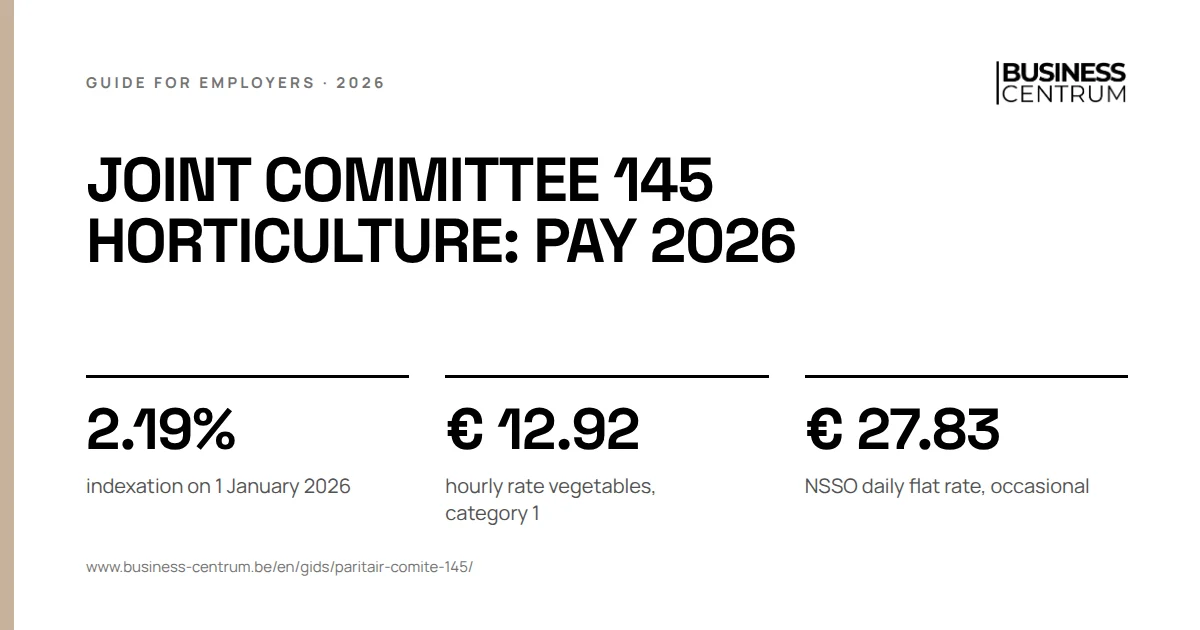
Joint committee 145 covers horticulture in Belgium: vegetables, fruit, flowers, tree nurseries and landscaping. On 1 January 2026 wages rose by 2.19%. A regular worker in vegetable growing now earns at least € 12.92 an hour. For an occasional worker you pay NSSO contributions on a daily flat rate of € 27.83, not on the actual wage.
Who falls under joint committee 145 for horticulture in Belgium?
JC 145 covers employers and their staff in horticulture. The royal decree that set up the committee lists the activities:
- vegetable growing, including chicory and mushrooms;
- fruit growing, including grapes, peaches and strawberries;
- flowers and ornamental plants, all specialities included;
- tree nurseries, including roses and ornamental shrubs;
- growing horticultural seeds;
- laying out and maintaining parks, gardens, sports grounds, green areas and cemeteries, also in-house when the workers mainly do that work;
- sorting horticultural produce, manual harvesting, producing potting compost, growing turf, renting out and maintaining plants at third parties, and pruning fruit trees for third parties.
Since 1 January 2023 JC 145 has also covered the white-collar staff of these businesses. Before that date they fell under JC 200. They took their professional experience with them into the new scale. If you still declare office staff under JC 200, you are applying the wrong scale. Their former committee is described on our page about JC 200.
JC 145 has sub-committees, such as 145.01 for floriculture, 145.03 for tree nurseries, 145.04 for parks and gardens, 145.05 for fruit growing, 145.06 for vegetable growing and 145.07 for mushroom growing. Since the same date their pay scales sit in the main committee. You look up the scale for your crop in JC 145 itself, even if your NSSO declaration mentions a sub-committee.
JC 145 or JC 144: horticulture or agriculture?
The boundary with agriculture (JC 144) decides more than the pay scale. It also sets how many days you may use occasional workers and which flat rate applies.
| JC 145 horticulture | JC 144 agriculture | |
|---|---|---|
| Activity | vegetables, fruit, flowers, tree nurseries, landscaping | arable and grassland farming, livestock, mixed farms, flax and hemp |
| Occasional work per year | 100 days, all employers together | 50 days, only on the employer's own land |
| Flexi-jobs | excluded, except landscaping | excluded |
| Machine work for third parties | JC 132 (technical agricultural and horticultural work) | JC 132 |
A mixed farm follows its main activity. If you mainly grow potatoes and grain and a smaller share of strawberries, you stay in JC 144. An occasional worker who actually works on both activities may combine both quotas. A contractor doing purely machine work for others, such as ploughing or harvesting, falls under neither.
Joint committee 145 pay scale for blue-collar workers in 2026
JC 145 pay scales are hourly rates for a working week of 38 hours. They vary by crop and by job category. The table shows the minimum hourly rates for regular workers aged 18 or over since 1 January 2026, for the crops employers search for most.
| Category | Floriculture (145.01) | Tree nurseries (145.03) | Fruit growing (145.05) | Vegetable growing (145.06) |
|---|---|---|---|---|
| 1 | € 13.89 | € 15.66 | € 13.38 | € 12.92 |
| 2 | € 14.21 | € 16.36 | € 14.33 | € 13.60 |
| 3 | € 14.41 | € 16.73 | € 15.47 | € 14.25 |
| 4 | € 15.13 | € 17.43 | € 16.15 | € 14.92 |
| 5 | € 15.82 |
Category 5 only exists in businesses with more than 50 employees that introduced it themselves.
Seniority. On top of the minimum hourly rate you pay a supplement based on seniority in your business: 0.50% after 5 years, then another half per cent for every 5 years, up to 4% after 40 years. The supplement starts on the first day of the month after the worker reaches the required seniority.
Young workers. A worker aged 17 receives 85% of the scale, a worker aged 15 or 16 70%. In floriculture that gives € 11.80 an hour for category 1 at age 17.
The scales for forestry nurseries, fruit sorting businesses and mushroom growing, and the youth rates per crop, are in the minimum wage database of the Federal Public Service Employment. In mushroom growing category 1 starts at € 12.51 an hour.
JC 145.04: pay in landscaping and grounds maintenance
The laying out and upkeep of parks and gardens has its own pay scale. It depends on the working-time arrangement the business chose.
| Category | 38 hours without compensation days, or with unpaid days | 39 hours with 6 paid compensation days |
|---|---|---|
| 1 | € 16.37 | € 16 |
| 2 | € 16.88 | € 16.48 |
| 3 | € 17.92 | € 17.49 |
| 4 | € 18.36 | € 17.92 |
| 5 | € 19.34 | € 18.87 |
The first column also applies to a week of 39 hours with 6 unpaid compensation days, or of 40 hours with 12 unpaid days. The lower hourly rate in the second column only applies if you pay the compensation days.
Three rules are specific to landscaping:
- No occasional work at a flat rate. The scheme for occasional workers applies in horticulture, but not in the laying out and upkeep of parks and gardens. A temporary worker there is an ordinary blue-collar worker.
- Mobility, meal and separation allowances. A collective agreement of 24 May 2023 sets an allowance for travel to the sites, a meal allowance and an allowance when the worker has to stay elsewhere overnight for the job.
- Loyalty bonus through the social fund. A worker with at least 6 months of seniority in the sector receives 6% of his gross pay over the reference year, 7% after 5 years and 8.50% after 15 years of continuous service. The reference year runs from July to June.
Seasonal and occasional workers in joint committee 145
For harvest and planting season you choose between two statuses. The difference lies mainly in the NSSO contributions.
- Seasonal worker. An ordinary blue-collar worker on a fixed-term contract. He receives the scale of his category, falls under the holiday scheme, and you pay normal NSSO contributions on his full wage.
- Occasional worker. A worker under article 8bis of the royal decree of 28 November 1969. He works at most 100 days a year in horticulture, across all employers together. You pay NSSO contributions on a fixed daily flat rate.
The minimum hourly rate for an occasional worker is set in a separate collective agreement and equals category 1 for regular workers:
| Crop | Regular worker, category 1 | Occasional worker |
|---|---|---|
| Floriculture | € 13.89 | € 13.89 |
| Tree nurseries | € 15.66 | € 15.66 |
| Fruit growing | € 13.38 | € 13.38 |
| Vegetable growing | € 12.92 | € 12.92 |
An occasional worker under 18 earns no less than a regular worker of the same age, and no more than an adult occasional worker.
The bonuses for occasional workers run largely through the guarantee and social fund:
- Year-end and purchasing power bonus: together € 240.71, for anyone with at least 50 days on the picking card in the calendar year.
- Loyalty bonus: € 0.50 per day worked, from 30 days on the picking card.
- Separation allowance: since 1 June 2026 you pay € 2 net per working day started. It also applies to anyone who, alongside occasional work, gets a contract of at most 6 weeks.
Occasional workers do not receive meal vouchers: the collective agreement on meal vouchers explicitly excludes them.
Occasional workers in Belgian agriculture and horticulture: the NSSO scheme
For an occasional worker who stays within the quota, the NSSO does not calculate on the real wage. You declare a flat rate per day worked, however many hours that day. The amounts since 1 April 2026:
| Sector | Daily flat rate | Personal contribution per day |
|---|---|---|
| Horticulture, including chicory and mushrooms | € 27.83 | € 3.64 |
| Fruit growing | € 24.54 | € 3.21 |
| Floriculture | € 17.65 | € 2.31 |
The flat rate is not raised to 108%, because occasional workers fall outside the holiday scheme. You also pay no holiday contribution and no wage moderation contribution. The special contributions, such as the one for the Fund for Business Closures, remain due. The personal contribution is 13.07% of the flat rate, but thanks to the work bonus you usually do not have to withhold it.
Worked example. A fruit picker works an 8-hour day at € 13.38, so 8 x 13.38 = €107.04 gross.
| Ordinary worker | Occasional worker | |
|---|---|---|
| NSSO base | 107.04 x 1.08 = €115.60 | € 24.54 |
| Personal contribution | 13.07% = €15.11 | € 3.21, usually zero thanks to the work bonus |
| Employer contributions | on €115.60 | on € 24.54, without holiday and wage moderation contributions |
Over a 40-day harvest the difference runs to several hundred euros in contributions per picker. That is why the NSSO checks the conditions closely:
- Dimona in advance. You file a Dimona for occasional work for each day, with start and end time. See what Dimona is.
- Occasional work form. The worker keeps a form with his days. You initial it once a week.
- Check the quota. With the worker's consent, the Green@work online service shows how many of his 100 days are already used or reserved.
- The 180-day rule. Anyone who worked in the same business under another status in the previous 180 days is not an occasional worker. A contract of at most 6 consecutive weeks does not count.
- Mushroom growing. There you may only use occasional workers during a period of intense activity of 156 days per calendar year, unless the joint committee grants your business its own arrangement.
If the occasional worker comes through a temp agency, the same quotas apply. See JC 322 for temporary agency work.
JC 145 indexation in 2026
JC 145 indexes once a year, on 1 January. Minimum and actual wages rise together, for blue-collar workers, white-collar staff and occasional workers. If you pay above the scale, you index that higher wage too.
| Indexation on 1 January | Percentage |
|---|---|
| 2026 | 2.19% |
| 2025 | 3.57% |
| 2024 | 1.83% |
| 2023 | 10.96% |
The next indexation falls on 1 January 2027. It will be the first under the cent index, in force since 1 June 2026: for a reference wage above € 4,000 a month, indexation is capped. No JC 145 scale comes close. The highest minimum salary for white-collar staff is € 3,734.30. The rule only affects staff paid well above the scale. More in our piece on wage indexation in 2026.
Joint committee 145 pay scale for white-collar staff
White-collar staff have a scale with four classes, A to D, that rises with professional experience. Scale I applies from the start of employment, scale II to staff with at least one year of service in the same business. Minimum monthly salaries for a full-time employee without experience:
| Class | Scale I | Scale II |
|---|---|---|
| A | € 2,249.89 | € 2,317.59 |
| B | € 2,343.63 | € 2,420.70 |
| C | € 2,376.79 | € 2,440.93 |
| D | € 2,563.79 | € 2,650.41 |
The scale rises with years of experience. In class D, scale II, it reaches € 3,734.30 after 25 years. The full year-by-year table is in the minimum wage database.
Joint committee 145 year-end bonus
For blue-collar workers you do not pay the year-end bonus yourself; the sector fund does. You finance it through your employer contribution, which the NSSO collects with your ordinary contributions.
| Crop | Year-end bonus, blue-collar | Paid by |
|---|---|---|
| Tree nurseries | 8.33% of gross pay | Guarantee and social fund |
| Vegetables, fruit and mushrooms | 7.55% of gross pay | Guarantee and social fund |
| Floriculture | own scheme | Guarantee and social fund, floriculture sector |
| Parks and gardens | loyalty bonus, see above | Parks and gardens social fund |
The bonus is calculated on gross pay in the reference year, from July of the previous year to June inclusive, and paid in December. Anyone who leaves during the reference year keeps the right: on retirement or early retirement with company top-up, on dismissal by you or by mutual agreement, at the end of a fixed-term contract and even on resignation. Only dismissal for serious misconduct cancels the bonus.
What you pay into the fund. The contribution is a percentage of the wage bill:
| Sector | Blue-collar | Of which for the year-end bonus | White-collar |
|---|---|---|---|
| Horticulture, except flowers and landscaping | 12.53% | 11.25% | 1.15% |
| Floriculture | 8.58% | 7.30% | 1.15% |
| Parks and gardens (since 1 April 2026) | 11.70% | 9.15% | 1.95% |
Worked example. A regular worker in vegetable growing, category 2, works a full reference year of 52 weeks at € 13.60 an hour. His gross pay is 13.60 x 38 x 52 = €26,873.60. In December the fund pays him 7.55%, or about €2,028.96 gross.
White-collar staff. For your office staff you pay the bonus yourself: an amount equal to the monthly salary, one twelfth per month worked or treated as worked. The first 12 months of sickness or accident count. You pay by December at the latest. How to calculate the bonus in other sectors is explained in calculating the year-end bonus.
Meal vouchers, eco-vouchers and other bonuses in JC 145
Meal vouchers since 2026. Since 1 January 2026 every employee in JC 145 is entitled to one meal voucher per day actually worked. If you did not yet give meal vouchers on 1 November 2025, the voucher is worth € 3.09: € 2 from you and € 1.09 from the employee. If you already gave them, you raise your share by € 2, up to a maximum of € 8.91. Occasional workers are excluded.
Eco-vouchers. A full-time employee with a full reference year receives € 250 in eco-vouchers a year. From three fifths employment it is € 200, from half-time € 150 and below that € 125. The reference year runs from July to June, payment follows in December. The same scheme applies in landscaping. Converting them into another benefit requires a company-level collective agreement.
Flat-rate bonus. Every blue-collar worker gets a flat-rate bonus from you each July. For a full-time worker with a full reference year it is € 74.15 in 2026, paid on 1 July 2026. A part-time worker gets a pro rata share, and each month started counts as one twelfth.
Cycling allowance. Anyone who cycles to work receives € 0.37 per kilometre since 1 February 2026.
Flexi-jobs in joint committee 145
Horticulture is excluded from flexi-jobs. Even after the extension to almost every sector on 1 July 2026, employer categories 194, 494, 594 remain outside. In vegetable, fruit or flower growing you therefore use occasional workers for peaks.
The laying out and upkeep of parks and gardens is not covered by that exclusion. A landscaping contractor in JC 145.04 may hire flexi-jobbers. The flexi wage is at least the scale for the job, plus 7.67% flexi holiday pay, and you pay a 28% special contribution. All the rules per sector are in flexi-jobs in all sectors.
Pitfalls in joint committee 145
- Dimona forgotten or late. Without a Dimona for occasional work you lose the flat rate for that day. See also late Dimona.
- Quota not checked. The 100 days apply across all employers together. A picker who already worked for another grower may have used up his days. Check in Green@work.
- Declaring a regular worker as occasional. If he worked in your business under another status in the previous 180 days, that is not allowed.
- Using the flat rate in landscaping. The scheme does not apply to parks and gardens. Every temporary worker there is an ordinary worker, or a flexi-jobber.
- Office staff still in JC 200. Since 1 January 2023 they belong in JC 145, with their own scale and their own fund contribution.
- Meal vouchers overlooked. Since 1 January 2026 every regular employee is entitled to them, even if your business never gave meal vouchers.
What Business Centrum does for you
Business Centrum handles payroll administration for growers, nurseries and landscaping contractors in East Flanders, together with Acerta. We determine the right sub-committee and scale, file the Dimona for your occasional workers on time, track their quota and apply the index in January.