
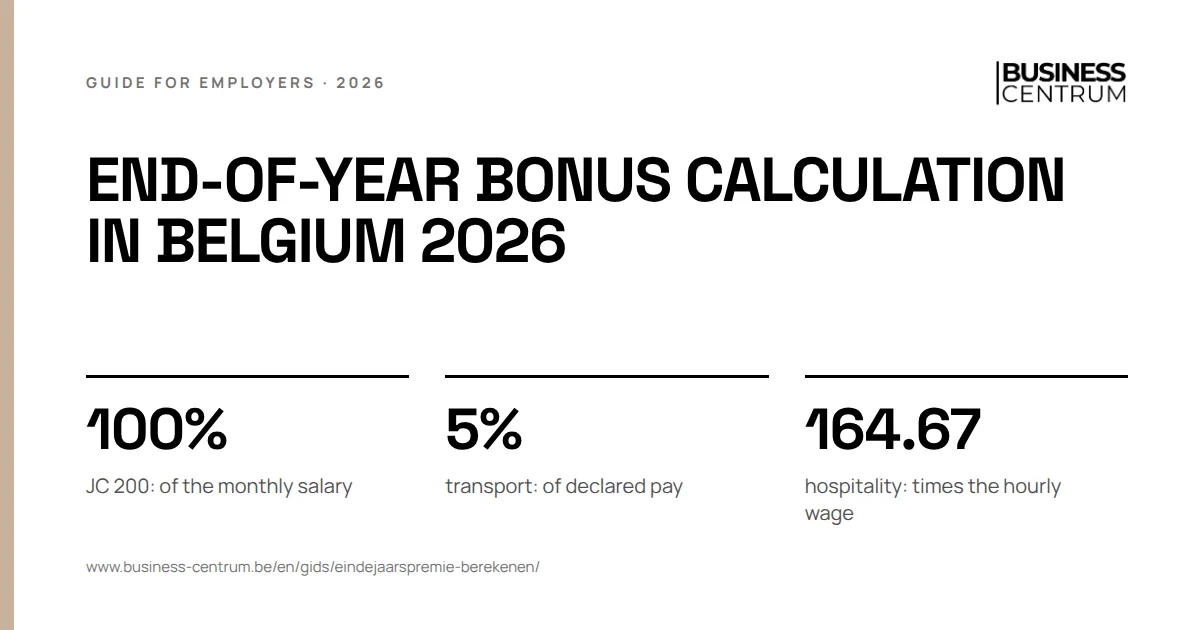
In Belgium, the end-of-year bonus calculation follows the collective agreement of the employee's joint committee, not a general law. A white-collar employee in JC 200 receives 100% of his monthly salary. In road haulage, the sector fund pays 5% of declared pay. Anyone who did not work the whole year gets a pro rata share.
Calculating the end-of-year bonus: which rule applies to your staff?
No law requires every employer to pay an end-of-year bonus. The obligation comes from a sector agreement, a company agreement, the employment contract or an established practice in your business. So the calculation always starts with the question of which joint committee the employee falls under. If in doubt, first read how to determine the right joint committee.
Among our clients we see three systems:
- You pay it yourself. The bonus is part of the December payroll, with NSSO contributions and withholding tax. This is how it works for white-collar staff in JC 200 and blue-collar workers in the food trade (JC 119).
- A fund pays, using your advances. In hospitality you pay a monthly advance to the Hospitality Guarantee and Social Fund, which pays the bonus in January.
- A fund pays from sector contributions. In road haulage (JC 140.03) the Social Fund for Transport and Logistics (SFTL) pays. In construction (JC 124) blue-collar workers get loyalty stamps instead of an end-of-year bonus.
| Joint committee | Who pays | Amount for a full year | Condition | Payment |
|---|---|---|---|---|
| 200 white-collar | employer | 100% of the monthly salary | 6 months of seniority | by December |
| 140.03 road haulage, blue-collar | SFTL | 5% of declared gross pay | at least € 2,500 declared | from 20 December 2026 |
| 124 construction, blue-collar | Social Security Fund | 9% of gross pay at 100% | pay declared in the service year | from 26 October 2026 |
| 302 hospitality | Hospitality Fund | 164.67 x the hourly wage (38 hours) | 2 months without interruption | by 31 January 2027 |
| 119 food trade, blue-collar | employer | 164.66 x the December hourly wage | 3 months of service | second half of December |
A more generous arrangement in your company always continues to apply. What you granted in writing, or consistently for years, you cannot cut back on your own.
In JC 200, white-collar staff get one month's salary as an end-of-year bonus
The JC 200 collective agreement gives the employee an annual bonus equal to his monthly salary. You pay it by December at the latest, or when the annual accounts are filed, unless an agreement in your company sets another moment. Three conditions:
- the employee is under contract at the time of payment, except in the departure cases below;
- at that moment he has at least 6 months of seniority; a previous period as a temporary agency worker in a similar job counts;
- anyone who joined after 1 January gets a bonus in proportion to the number of months worked.
For a part-time employee the monthly salary is his part-time pay, so the bonus scales automatically. A sales representative with variable pay gets the monthly average of the last twelve months, capped at the highest amount of category 4 of the pay scale.
Worked example. An employee earns € 2,600 gross a month and started on 1 March 2026. By December he has more than six months of seniority. He worked ten months of the year: 2,600 x 10/12 = € 2,166.67 gross. Had he started on 1 August, he would not reach the 6 months by December and the sector agreement would not apply.
The pay scales against which you check the monthly salary are in our guide to joint committee 200.
End-of-year bonus for blue-collar workers: transport, construction, hospitality and food trade
Road haulage (JC 140.03): the SFTL pays
For drivers and other staff in 140.03, the Social Fund for Transport and Logistics pays the bonus, not you. It amounts to 5% of the full gross pay you declared to the NSSO in the reference period. For the 2026 bonus that period runs from 1 July 2025 to 30 June 2026. The worker must have at least € 2,500 of gross pay declared. The fund pays from 20 December 2026 directly into his account and itself withholds NSSO and 23.22% withholding tax.
If you declared € 31,000 of gross pay for a driver in that period, he receives 31,000 x 5% = € 1,550 gross from the fund. A long illness lowers the bonus automatically, because the fund only calculates on the pay you declared. Pay and allowances in the sector are covered in our guide to joint committee 140.
Construction (JC 124): loyalty stamps instead of an end-of-year bonus
Construction workers receive loyalty stamps worth 9% of their gross pay at 100%. For this you pay a contribution of 9.12% every quarter through the DmfA, management costs included. The service year runs from 1 July 2025 to 30 June 2026. The worker receives his document by the end of October at the latest and is paid from 26 October 2026.
A worker with € 40,000 of gross pay in the service year receives stamps worth € 3,600. You paid 40,000 x 9.12% = € 3,648 in contributions for this, spread over four quarters. All construction funds are explained in our guide to joint committee 124.
Hospitality (JC 302): the Hospitality Fund pays, using your advances
In hospitality the bonus is at most 4.33 weeks' pay, which in a 38-hour week means 164.67 times the December hourly wage. Employees are entitled after at least 2 months of uninterrupted employment in the calendar year. For each block of 21.67 days of actual or assimilated presence, the employee gets one twelfth, in a five-day week.
Every month you pay an advance of 12% on the previous month's gross payroll, at 108% for blue-collar workers. By 10 January 2027 at the latest you declare the gross bonus per employee, and the fund pays the net bonus by 31 January 2027 at the latest.
Worked example. A restaurant waiter in category V with no years in the job earns € 16.88 an hour. His maximum is 164.67 x 16.8849 = € 2,780.44. He started on 1 March and has ten full blocks of presence: 2,780.44 x 10/12 = € 2,317.03 gross. All hospitality rules are in our guide to joint committee 302.
Food trade (JC 119): you pay it yourself
In JC 119 the employer pays the bonus himself: 164.66 times the December hourly wage, after at least 3 months of service, in proportion to days worked and assimilated. An order picker in category 2 with five years of service, in a company with 10 to 49 employees, earns € 16.19 an hour. His bonus for a full year is 164.66 x 16.19 = € 2,665.85 gross. As a blue-collar worker his NSSO is calculated on 108%: he pays 2,665.85 x 1.08 x 13.07% = € 376.30 in NSSO. More in our guide to joint committee 119.
Other committees
| Committee | Rule |
|---|---|
| 111 metalworking, blue-collar | per the provincial agreement, paid by the employer: 164.67 hours of pay at 38 hours a week in East and West Flanders, at least 165 hours in Antwerp and Limburg |
| 121 cleaning | 9% of gross pay, through the social fund |
| 314 hairdressing and beauty care | 9.50% of gross pay, through the fund |
Sector details are in our guides to JC 111, JC 121 and JC 314.
End-of-year bonus and assimilated days: which absences count?
An absence only reduces the bonus if the collective agreement does not treat it as days worked. The list differs per sector.
| JC 200 white-collar | JC 302 hospitality | |
|---|---|---|
| Sickness or accident | 60 days a year | 7 calendar days a year with a certificate |
| Long illness | not beyond 60 days | from six months without interruption: up to 6 months, at 50% |
| Temporary unemployment | 5 days a year | in full |
| Workplace accident, occupational disease | in full | the first twelve months of partial incapacity after total incapacity, at a rate of at least 66% |
| Holidays, public holidays, short leave, educational leave | in full | in full |
| Maternity leave | in full | in full |
In JC 200 the new assimilation of temporary unemployment applies since 1 January 2026. An employee who was sick for ninety days in 2026 has sixty assimilated days. You may reduce the bonus for the thirty days above that. Counted in calendar days, that is 2,600 x 30/365 = € 213.70, leaving a bonus of € 2,386.30.
In transport and construction the bonus follows declared pay. There the question is not which day is assimilated, but whether you put the right pay and the right days in the DmfA.
Who gets a share of the end-of-year bonus on dismissal?
When someone leaves during the year, you pay the bonus pro rata in the final settlement, if the collective agreement provides for it. The JC 200 rules:
| Situation | Right to a pro rata bonus |
|---|---|
| Dismissal by the employer, except for serious misconduct | yes, from 6 months of seniority |
| Retirement, unemployment with company supplement, medical force majeure | yes, from 6 months of seniority |
| Resignation or mutual agreement | yes, from 3 years of seniority (since 2026) |
| End of a fixed-term contract of at least 6 months | yes |
| Dismissal for serious misconduct | no |
An employee on € 2,600 whom you dismiss and who leaves on 30 September after two years of service gets 2,600 x 9/12 = € 1,950 gross. If he resigns with the same seniority, the sector agreement gives him no right. With four years of seniority he does: again € 1,950.
The bonus goes into the final settlement together with the leaving holiday pay, and onto the social documents on dismissal.
From gross to net: what do you withhold from the end-of-year bonus?
On a bonus you pay yourself, you withhold two things:
- NSSO: 13.07%, on 108% of the bonus for blue-collar workers. Up to the amount of the reference monthly wage, the bonus does not count for the work bonus: that month's work bonus stays the one for the normal wage, it neither falls nor rises.
- Withholding tax: a fixed percentage from the scale for exceptional payments. It depends on the employee's normal annual pay. Up to € 10,675 it is zero; above € 59,900 it reaches 53.50%.
Worked example. The employee on € 2,600 receives a full bonus in December. He has no dependent children and his normal annual pay is between € 26,340 and € 31,830, so the rate is 40.38%.
| Amount | |
|---|---|
| Gross bonus | € 2,600.00 |
| NSSO 13.07% | - € 339.82 |
| Taxable | € 2,260.18 |
| Withholding tax 40.38% | - € 912.66 |
| Net | € 1,347.52 |
About half of the gross bonus remains as net pay. Employees are surprised by this every year, so explain it in advance. If a fund pays the bonus, it withholds 23.22%, without any reduction for dependent children. The difference is settled later in personal income tax.
For low wages the bonus also counts towards the minimum wage: an end-of-year bonus is taken into account in the guaranteed minimum income for the period it covers, with a settlement when it is paid. Our article on the minimum wage in Belgium in 2026 explains how.
What does an end-of-year bonus cost you as an employer?
On top of the gross bonus you pay employer contributions. The base contribution for most white-collar and blue-collar staff in the private sector is 25%, wage moderation included. For the employee in the example:
- gross bonus: € 2,600
- employer contributions 25%: € 650
- total cost: € 3,250
For a blue-collar worker the NSSO is calculated on 108% of the bonus, so the cost is higher. Your actual percentage depends on your sector contributions and on the structural reduction for low wages.
Mistakes we see employers make
- Deducting sickness too quickly. In JC 200 the first sixty days of sickness per year count as worked. Deducting every sick day means paying too little and risking a claim.
- Paying twice in transport. Your own bonus on top of the SFTL bonus, without deduction, costs you the full amount plus contributions.
- Forgetting the leaver. A dismissed employee with six months of seniority is entitled to his share. Forget it in the final settlement and the social documents will need correcting.
- Using the wrong wage. In JC 119 and hospitality it is the December hourly wage that counts, or the wage at the time of leaving. Not the average for the year.
- No advances in hospitality. If you do not pay the monthly advances, the fund charges late-payment interest and starts proceedings.
What Business Centrum does for you
Business Centrum calculates each employee's end-of-year bonus under your sector's collective agreement, together with Acerta, as part of your payroll administration. We track the assimilated days, include the bonus in the final settlement when someone leaves and send you an estimate of the total cost in the autumn, so December holds no surprises.