
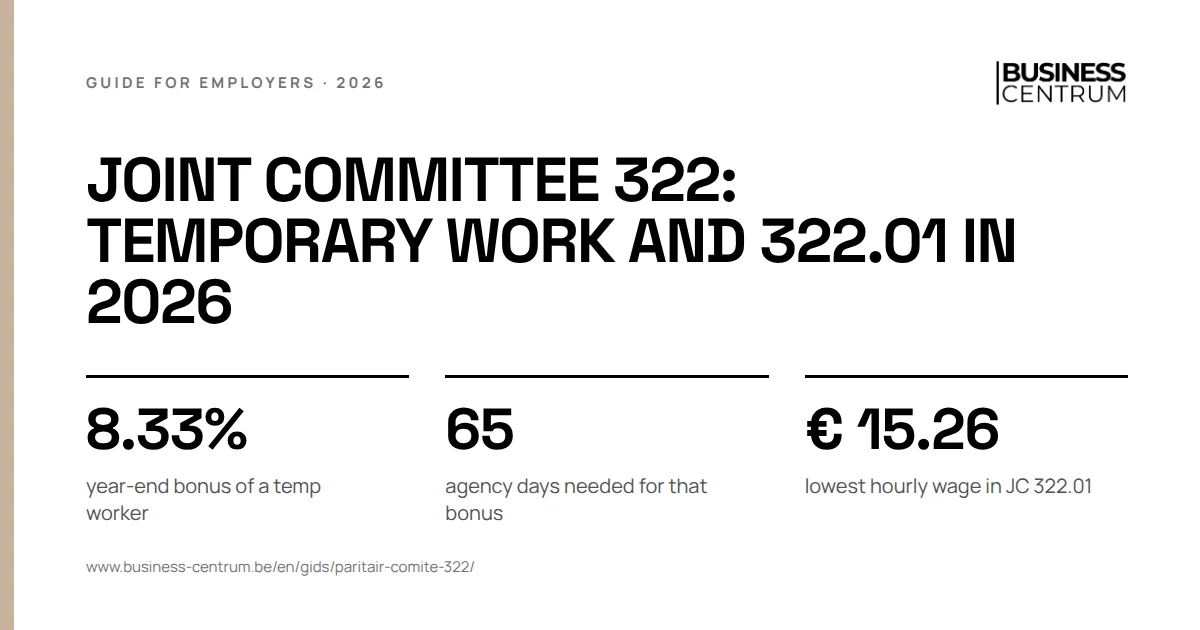
Joint committee 322 covers temporary agency work in Belgium and, through sub-committee 322.01, the service voucher companies. A temporary agency worker has no sector pay scale of his own: he receives the pay of your permanent staff. The Social Fund pays him a year-end bonus of 8.33% of his gross pay. In JC 322.01 the pay scale starts at € 15.26 an hour.
Who falls under joint committee 322?
JC 322 covers temporary work agencies and their temporary agency workers, blue-collar and white-collar, whatever sector they work in. A temp in your warehouse therefore falls under JC 322, not under your committee, even though he receives your pay. Sub-committee 322.01 covers approved companies that provide local jobs and services: the service voucher companies and their domestic helpers.
| Situation | Committee |
|---|---|
| Temporary agency worker, blue- or white-collar, through an approved agency | JC 322 |
| Your permanent staff working next to that temp | your own committee, e.g. JC 119, JC 124 or JC 200 |
| Domestic helper working for households that pay with service vouchers | JSC 322.01 |
| Cleaning for businesses, without service vouchers | JC 121 |
| Your own employee lent to another company | not temporary agency work: hiring out staff is prohibited in principle |
If your company cleans offices for businesses, the cleaning committee, JC 121 applies, not JC 322.01.
Temp agency or user company: who is the employer?
Temporary agency work involves three parties. The agency signs the temporary agency employment contract and is the legal employer. You are the user company: the temp works in your business and under your authority, and you pay the agency an invoice under a commercial agreement.
| Task | Temp agency | User company |
|---|---|---|
| Employment contract, pay and payslip | yes | no |
| Dimona and NSSO return | yes | no |
| Work instructions, schedule, working time, public holidays and night work | no | yes |
| Safety at the workplace and workstation sheet | passes the information on | yes |
| Passing on the pay and benefits of your permanent staff | no | yes |
| NSSO contribution on consecutive day contracts | no | yes |
| Year-end bonus | through the Social Fund | no |
Article 19 of the Act of 24 July 1987 makes you responsible for the rules that apply at the workplace: working time, public holidays, Sunday rest, night work, work rules and wellbeing. The agency pays, you organise the work. In the workstation sheet you describe the job, the risks and the required qualification, so the agency sends the right person and briefs him in advance.
Is there a pay scale in joint committee 322?
No. Since 1 October 2009 no collective agreement on minimum wages has applied in JC 322. Article 10 of the Act makes one unnecessary: a temp's pay may not be lower than what he would have received had you hired him on the same terms as a permanent employee. He therefore follows the pay scale, seniority rules and allowances of your committee and your company. If you pay your permanent warehouse staff above the scale, that higher pay also applies to him.
| User company's committee | Job | Minimum hourly wage |
|---|---|---|
| JC 119, food trade | category 2, company with 10 to 49 employees | € 16.03 |
| JSC 140.03, road haulage and logistics | non-driving staff, class 1 | € 15.65 |
| JC 124, construction | category I, since 1 October 2026 | € 18.75 |
| JC 302, hospitality | category II, no years in the job | € 15.21 |
The full pay scales are in our guides to JC 119, JC 140, JC 124 and JC 302. The absolute floor is the guaranteed average minimum monthly income: € 2,233.61 full time, since 1 July 2026.
Equal pay goes beyond the hourly rate: the bonuses and benefits of your permanent staff count too. For eco vouchers, a JC 322 agreement says so explicitly: temps receive them on the same terms and for the same value as at the user company. If your sector stops them, they stop for the temp as well. In construction, the sector eco vouchers ended on 31 March 2026.
Indexation in joint committee 322 in 2026
JC 322 has no indexation of its own. The temp's pay rises on the same day and by the same percentage as that of your permanent staff:
| User company's committee | Indexation 2026 |
|---|---|
| JC 119, food trade | 2.21% on 1 January 2026 |
| JSC 140.03, road haulage and logistics | 2.18% on 1 January 2026 |
| JC 302, hospitality | 2.19% on 1 January 2026 |
| JC 200, white-collar employees | 2.21% on 1 January 2026 |
| JC 124, construction | every quarter, most recently on 1 October 2026 |
| JSC 322.01, service vouchers | 2% each time the pivot index is exceeded, most recently on 1 September 2026 |
The agency only indexes once it knows your wages have gone up. If you do not pass on an indexation, the agency pays the difference later and as a rule recharges it on your invoice. Since 1 June 2026 the cents index also applies: above a reference wage of € 4,000 a month, indexation during two moderation periods is limited to 2% on that ceiling. For most temps it makes no difference. More in wage indexation in 2026.
Year-end bonus in joint committee 322
A temp's year-end bonus comes from the Social Fund for Temporary Agency Workers, not from you. It fully replaces the bonus of your permanent staff. A temp in JC 119 therefore does not receive 164.66 times his hourly wage like a permanent blue-collar worker, but a percentage of what he earned.
- Amount: 8.33% of the gross pay earned as a temp in the reference period.
- Reference period: from 1 July 2025 to 30 June 2026 for the December 2026 bonus.
- Condition: at least 65 days as a temp (78 in a six-day week), or 494 hours. At most 5 days of unemployment count.
- Permanent hire: if the user company hires him in that period, 60 days (72 in a six-day week) or 456 hours are enough.
- Payment and limitation: in December; an unpaid bonus lapses after 3 years.
Worked example. An order picker works from January to June 2026 through an agency at a food wholesaler in JC 119, category 2, with 10 to 49 employees. His hourly wage is € 16.03, for 38 hours a week. Over 26 weeks he earns 26 x 38 x 16.03 = € 15,837.64 gross. His year-end bonus in December is 8.33% of that: € 1,319.28. If he just reaches the 494 hours, 13 weeks of 38 hours, it is 494 x 16.03 x 8.33% = € 659.64.
8.33% is one twelfth: over a full year it comes to roughly one month's pay, just as for a permanent blue-collar worker. If you hire the temp permanently, you follow your own committee's rules for that period, see calculating the year-end bonus.
Other benefits: unemployment, sickness, pension and training
Three JC 322 agreements run from 1 July 2026 to 30 June 2027. The agency or the Social Fund pays them, not you. The agency does build them into its rate.
- Temporary unemployment: € 5 per working day not worked, until the end of the current contract. Not for blue-collar temps of agencies approved for construction (JC 124).
- Long-term sickness: 40% of the gross benefit from the health insurance fund, from the second month of sickness and for at most 3 months. Condition: 2 months of seniority in the sector over 4 months.
- Pension premium: in sectors with a sector pension scheme, the agency increases the gross pay, shown separately on the payslip. For blue-collar workers in construction it is 1.25%, in JSC 140.03 1.17% and for blue-collar workers in hospitality 0.76%. JC 119 and JC 200 are not on the list. Students under the solidarity contribution do not receive the premium.
- Training: at least 3.50 training days per full-time temp in 2026, and 4 from 2027. The agency pays 0.40% of pay to the Social Fund for this.
A warehouse worker in JSC 140.03, class 1, earns € 15.65 an hour, or 15.6465 x 38 x 13 / 3 = € 2,576.46 a month. His pension premium of 1.17% comes on top: € 30.14 a month.
Commuting costs in joint committee 322
The temp first follows the scheme of your sector or your company. If you have no scheme for private transport, the agency pays, under a supplementary JC 322 agreement, an allowance based on a fixed scale, from a one-way distance of 2 kilometres and whatever the means of transport. For public transport it is at least 80% of the season ticket. Your third-party payer scheme for the train also applies to temps.
When may you use a temporary agency worker?
Temporary agency work is only allowed for a reason the law permits, each with a maximum duration:
| Reason | Maximum duration |
|---|---|
| Replacement during a suspension (sickness, leave) | as long as the suspension lasts |
| Replacement after a permanent employee's contract ends | 6 months, extendable by 6 months |
| Temporary increase in work, without a union delegation | 6 months, extendable twice, at most 18 months in total |
| Exceptional work | as a rule 3 months; stocktaking and balance sheets 7 days a year |
| Recruitment (filling a permanent post) | 1 week to 6 months per attempt, at most 3 attempts and 9 months per vacancy |
| Construction, temporary increase in work | at most 6 months at the same construction company |
With a union delegation, you need its prior agreement for replacement after a dismissal and for a temporary increase in work. Without one, the second extension for a temporary increase goes through the Good Offices Committee: the unions have 3 weeks to respond, and silence counts as consent.
The commercial agreement must be in writing within 7 working days of the start. It states, among other things, your joint committee, the reason, the working arrangements and the pay of a permanent employee with the same qualification. The temp receives these details within 2 working days.
Consecutive day contracts: what do they cost the user company?
Consecutive day contracts are contracts of one day each at the same user company that follow each other without a break. They are only allowed if you prove a need for flexibility, with figures on your activity and the alternatives you examined. If you cannot, the agency owes the temp 2 weeks' extra pay. Day contracts are prohibited for recruitment and in construction.
The NSSO charges you, as the user company, a special contribution per half-year (January to June, July to December) and per temp through the same agency. Once a threshold is reached, the amount applies to every day contract in that half-year:
| Consecutive day contracts per half-year | Contribution per day contract |
|---|---|
| from 40 | € 10 |
| from 60 | € 15 |
| from 80 | € 30 |
| from 100 | € 40 |
A student with 45 day contracts in a half-year costs you 45 x € 10 = € 450, and with 110 contracts 110 x € 40 = € 4,400. Pensioners, flexi-jobbers and casual workers at user companies in JC 144, 145 and 302 are not counted.
Probation, seniority and permanent hire by the user company
Unless agreed otherwise, the first 3 working days of a temporary agency contract are a trial period. Successive trial periods for the same job at the same user company are prohibited. For seniority with the agency, assignments are added together if they are interrupted only by 1 week of inactivity or less.
If you hire a temp permanently for the same job straight after his assignment, his time as a temp counts towards seniority, up to 1 year. That matters for any later notice period. When a permanent hire becomes cheaper than agency work, we work out in what a temp agency really costs.
Flexi-jobs and students in joint committee 322
Since 1 July 2026 flexi-jobs are in principle open to the whole private and public sector. Since 1 July 2026 a temp may also work as a flexi-jobber through the agency where he is already a temp, as long as the agency does not place him at the same user company in both roles. The usual conditions remain:
- work at least 4/5 of a full-time job elsewhere in the reference quarter; work for that same agency does not count;
- 7.67% flexi holiday pay on top of the flexi wage;
- a special employer contribution of 28%;
- through a temp agency, no framework agreement is needed.
In construction, a JC 124 agreement of 16 July 2026 rules out flexi work as a blue-collar worker on site. With service vouchers, a flexi-job is only possible during the first 3 months after the first Dimona at the company. See also flexi-job costs for the employer.
Students working through an agency have a quota of 650 hours per calendar year under the solidarity contribution, across all employers. Their agency contract also contains the particulars of a student employment contract. More on hiring students.
Joint committee 322.01: pay scale and indexation 2026 for service vouchers
JSC 322.01 does have its own pay scale, for 38 hours a week. There is no user company: the service voucher company is the employer and the household is the customer. The hourly wage depends only on seniority in the sector.
| Seniority in the sector | Since 1 September 2026 | Before that, since 1 March 2026 |
|---|---|---|
| Less than 1 year | € 15.26 | € 14.96 |
| At least 1 year | € 15.81 | € 15.50 |
| At least 2 years | € 15.99 | € 15.68 |
| At least 3 years | € 16.16 | € 15.84 |
Indexation in JC 322.01. Each time the pivot index is exceeded, minimum and actual wages rise by 2%, from the first day of the second month after. That happened on 1 January 2024, 1 June 2024, 1 March 2025, 1 March 2026 and 1 September 2026. On 1 July 2025 a rise of € 0.77 gross an hour came on top. The rhythm follows inflation, not the calendar.
Seniority. It counts from the first contract with a JC 322.01 employer, including at another service voucher company and including successive fixed-term contracts. Ask about sector experience and proof when hiring. If you put a domestic helper with three years' experience on the starting wage, you pay € 15.26 instead of € 16.16 an hour, and she can claim the difference.
Year-end bonus in joint committee 322.01
Here too a fund pays: the Social Fund for Service Vouchers, in December.
- Amount: 4.50% of gross pay in the reference period, for the December 2026 bonus from 1 July 2025 to 30 June 2026.
- Condition: at least 30 working days in the sector in that period, and an employment contract in the sector during the current calendar year.
- Treated as worked: maternity leave, and temporary unemployment for economic reasons up to 26 days.
Worked example. A part-time domestic helper, 19 hours a week, has at least two years' seniority throughout the reference period. Until 1 March 2026 she earned € 15.37 an hour, then € 15.68. Per month that is 15.37 x 19 x 13 / 3 = € 1,265.46, then € 1,290.99. Over the reference period: 8 x € 1,265.46 + 4 x € 1,290.99 = € 15,287.64. Her year-end bonus is 4.50% of that: € 687.94.
What do you pass on to the temp agency as the user company?
The agency can only pay correctly if you pass on the right information:
- Your joint committee, the job and the pay category a permanent employee would get.
- The actual pay of a permanent colleague with the same qualification, with seniority and allowances.
- Meal vouchers, eco vouchers and other benefits. In JC 119, for example, the employer's share of meal vouchers rose on 1 April 2026 by € 1.50, except at companies with fewer than 20 blue-collar workers on 31 March 2026.
- The schedule, the working arrangements and the workstation sheet.
- The reason, the expected duration and whether you have a union delegation.
- Every indexation or pay rise during the assignment, on the day it takes effect.
Mistakes we often see in JC 322
- Passing on only the pay scale. Equal pay means the pay of your permanent colleague, not the sector minimum.
- Forgetting the index. The temp stays on the old wage while your permanent team has already been indexed.
- Day contracts out of habit. From 40 per half-year, the NSSO contribution climbs fast.
- Exceeding the permitted duration. You then risk an open-ended contract with the temp.
- In JC 322.01, ignoring seniority from a previous company. That is a pay shortfall from day one.
What Business Centrum does for you
If you work with temps, we prepare with you the information the agency needs: your committee, the right pay scale, the bonuses of your permanent staff and every indexation. We work out when a permanent hire becomes cheaper than agency work and set up the contract and payroll administration when you take over a temp. For service voucher companies we track the JC 322.01 pay scale and each domestic helper's seniority. Business Centrum does this as a social bureau, in partnership with Acerta.