
A social bureau handles your staff administration without being a social secretariat itself. It is your fixed contact, collects your hours and follows up payroll, Dimona and contracts. For the returns and the collection of NSSO contributions it works with one of the 25 recognised social secretariats, or it acts as a service provider itself.
What is a social bureau?
In Belgium the word has three meanings, which causes confusion.
A local office that takes over your administration. That is the meaning used in this guide. A social bureau is an office near you that does the monthly work around your staff: collecting hours worked and absences, having the pay calculated, filing Dimona declarations, drawing up contracts, following up leave and sickness, and answering your employees' questions. You call or email one fixed person who knows your business.
An office of a large social secretariat. In everyday Flemish, the local office of a secretariat in your town is often called the sociaal bureau as well. Anyone searching for sociaal bureau Acerta or sociaal bureau Securex usually means that office.
An old name that stuck. Liantis writes on its website that ADMB Sociaal Bureau was founded in 1942 and has been part of Liantis since 10 September 2018, as Liantis social secretariat. Anyone searching for sociaal bureau Liantis today ends up at the social secretariat of Liantis.
The name also turns up for services for artists and temporary workers. Those work differently and fall outside this guide.
Social bureau or social secretariat: what is the difference?
The NSSO recognises two kinds of agents that may file your social security returns. This is set out in the NSSO administrative instructions, the reference work for every employer.
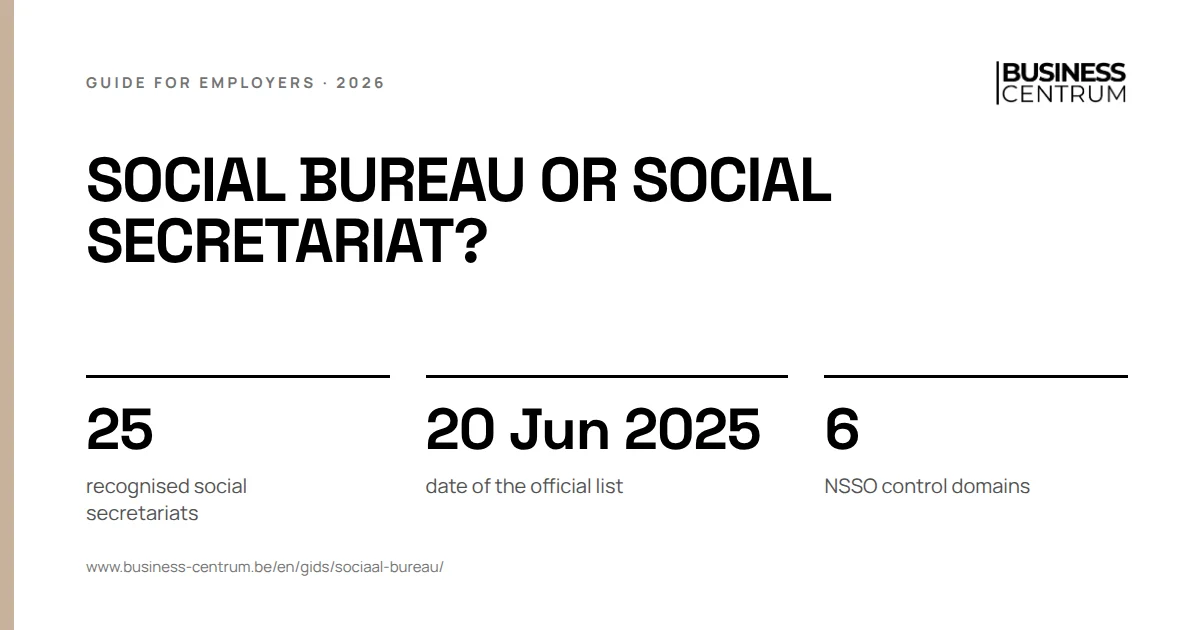
The recognised social secretariat. This is a non-profit association recognised by the Minister of Social Affairs. The official list of 20 June 2025 counts 25 with an active head office. To be recognised, a secretariat groups at least 300 employers, or at least 100 employers with together at least 5,000 employees. Recognition gives the exclusive right to collect and pay over the social contributions of the affiliated employers. It also brings controls: the NSSO inspectorate measures quality with a barometer covering 6 control domains.
The social service provider. It is not recognised. It may file returns as your agent, but it may not use the title social secretariat or collect the contributions the way a recognised secretariat does. Since 20 February 2017, the NSSO can also include service providers in its quality barometer, except for the financial control.
A social bureau is not a third type in that scheme. It chooses one of two ways of working:
- Together with a recognised secretariat. The secretariat is your agent with the NSSO. It calculates the pay, files the Dimona and the DmfA and collects the contributions. The bureau is your contact and does the work needed for that. This is how Business Centrum works, with Acerta.
- As a service provider. The bureau files the returns itself. You then pay the contributions to the NSSO yourself, on time and for the right amount.
So ask every bureau first: which secretariat do you work with, and under which recognition number? Or are you a service provider yourself? The answer decides who collects the contributions and whom you hold to account for an error. What recognition means legally is explained in our guide which social secretariat to choose.
Three ways to handle your payroll administration
| Do it yourself | Directly with a social secretariat | Through a social bureau | |
|---|---|---|---|
| Who calculates the pay? | you, with your own software | the secretariat, based on what you enter | the secretariat or the bureau, based on what you send |
| Who passes on the hours? | you | you, through the secretariat's portal or app | the bureau, with your data sent by email or form |
| Who files Dimona and DmfA? | you | the secretariat | the secretariat behind the bureau, or the bureau as a service provider |
| Who collects the NSSO contributions? | you pay yourself | the secretariat | the secretariat, or you pay yourself |
| Who is your contact? | nobody | a case manager at the secretariat | one fixed person at the bureau, close to you |
| What does it cost? | your own time and software | a quotation from the secretariat | a quotation from the bureau |
Doing it yourself is possible, but it takes time and knowledge. You follow every rule of your joint committee, every indexation and every new bonus yourself. An error in a return remains your responsibility.
Directly with a secretariat, you get a strong payroll engine and a portal. The work on your side stays: you enter the hours, approve leave, set up new employees and follow up what comes back.
Through a social bureau, you hand that work over. You send the hours worked, overtime and absences, and the bureau does the rest. For an SME with a handful of employees and no HR department, that is often the calmest choice.
What does a social bureau do for your SME?
A good social bureau takes over the things that cost you time and worry every month today:
- The hours. You send the hours and absences, the bureau turns them into a correct pay calculation.
- The Dimona. A new employee, a student or a flexi-jobber: the bureau makes sure the declaration goes out on time.
- Contracts and documents. Employment contracts, extensions, social documents when someone leaves.
- Your joint committee. Pay scales, indexations, bonuses and hours according to your sector.
- Your questions. About a payslip, a contract, sickness or a new rule. You call one fixed person who knows your file, and who also carries out the answer.
The difference with a portal is simple: with a portal you do the work yourself, with help. With a social bureau someone else does the work, and you check it. See how that works with us for your payroll administration.
When does a social bureau fit?
A social bureau fits especially if you recognise one of these:
- You have no HR employee, and the payroll ends up with you or your partner.
- You work with variable hours, students, flexi-jobs or shifts, so something changes every month.
- You want one fixed person who knows your business, without explaining your situation over and over.
- You want someone nearby, where you can drop in with a contract or a letter from the NSSO.
- You are leaving another secretariat and want someone to arrange that switch for you.
If you have your own HR team that likes working in a portal, going directly to a secretariat is often logical. If you want that work off your plate, a bureau is the better match.
How do the costs of a social bureau work?
A social bureau works on quotation. So do not compare only the price per payslip, but everything you pay per year and everything you still do yourself.
- One invoice or two. If the bureau works with a secretariat, ask whether that secretariat's fees are included in the quotation or billed separately.
- What is included. Contracts, Dimona, students, certificates and advice: ask which services are in the price and which come on top.
- An NSSO contribution. If you are affiliated with a social secretariat and claim a target group reduction for your first employee, the NSSO contributes € 36.45 per quarter towards the affiliation fees.
- Your own time. Every hour you no longer spend on hours, Dimona filings and questions is an hour for your customers.
How the price of a social secretariat itself is built up, with a joining fee, a price per pay calculation and extra services, is explained in our guide on the costs of a social secretariat.
Acerta directly or through a social bureau
You can join Acerta in two ways. You join directly, or you go through a bureau that works with Acerta. In both cases Acerta, recognition number 250, is your social secretariat.
Directly, according to Acerta itself, you work in its client portal. In Acerta Connect you pass on the hours, approve leave days, enter absences and add new employees. You request a Dimona through the portal. Acerta highlights a fixed regional payroll advisor.
Through Business Centrum, you send the hours to us, by email or with a simple form. We process them, handle Dimona, contracts and leave, and follow everything up with Acerta. Acerta files the returns and collects the contributions. You do not need to log in to get your payroll done.
What differs per task is set out side by side in Acerta or Business Centrum.
Switching to a social bureau
If you are with another secretariat today, the switch works like any change of secretariat:
- Check your contract. It sets the notice period and the form of notice, usually a registered letter.
- Choose the start of a quarter. A mandate with the NSSO only passes over at the start of a new quarter. Your new partner can still register it for that quarter up to 1 month after the quarter starts.
- Agree on the last DmfA. Usually your previous secretariat still files the DmfA for its last quarter, within 1 month after that quarter.
- Have the file transferred. Staff data, contracts, leave balances and the individual account.
At Business Centrum we arrange that switch: we contact your current social secretariat and organise the transfer of the files. You sign a single mandate. Everything else is in changing social secretariat. Coming from one of the big names? Also read an alternative to SD Worx, Securex, Liantis or Partena.
Business Centrum: a social bureau in Ghent
Not sure whether a social bureau suits your business? Business Centrum looks at it with you, in Ghent or by phone, and tells you honestly what you gain and what you keep doing yourself.