
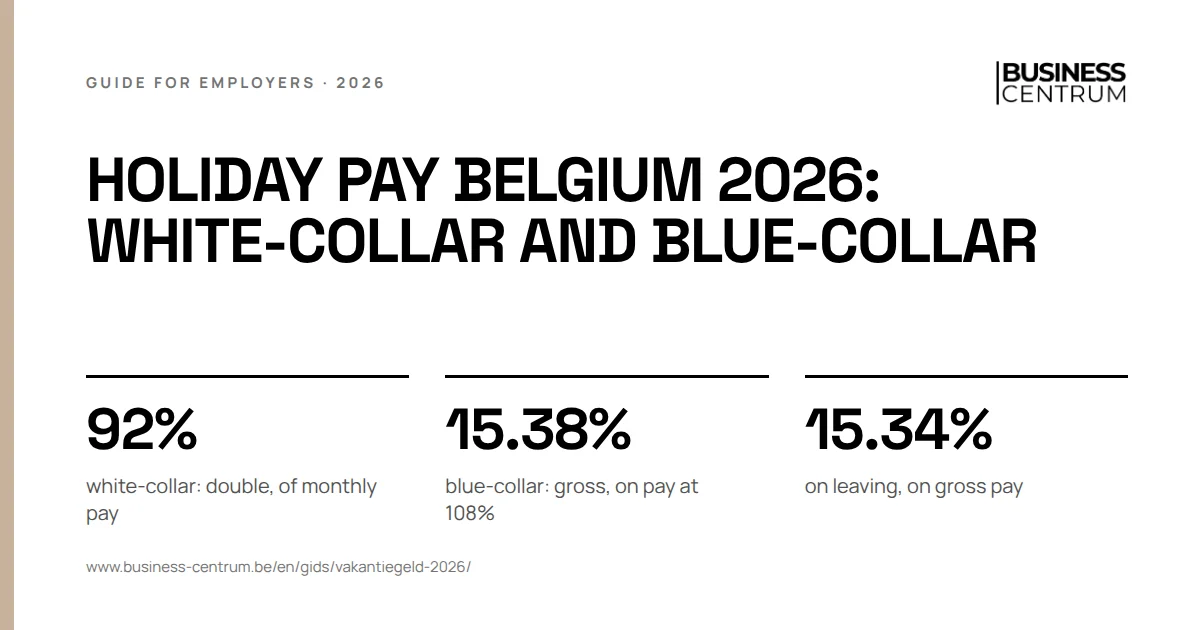
Holiday pay in Belgium for 2026 is the money an employee receives in 2026 for his holiday, calculated on what he worked in 2025. A white-collar employee receives it from his employer: his normal salary during the holiday days plus double holiday pay of 92% of his gross monthly pay. A blue-collar worker receives it from the holiday fund: 15.38% of his gross pay for the previous year, calculated at 108%.
Holiday pay Belgium 2026: who pays what?
Holiday pay has two parts. Single holiday pay is the pay for the holiday days themselves. Double holiday pay is an extra amount on top of that pay. Who pays it and how it is calculated depends on the employee's status.
| White-collar | Blue-collar | |
|---|---|---|
| Who pays | the employer | the RJV or the sector's holiday fund |
| Single holiday pay | normal salary continues during the holiday days | 8% of last year's pay at 108% |
| Double holiday pay | 92% of gross monthly pay | 7.38% of last year's pay at 108% |
| When | at the main holiday | between 2 May and 30 June, on a date that depends on the sector |
| On leaving | leaving holiday pay of 15.34% | no payment by the employer |
An employee who worked the whole of the previous year is entitled to 20 holiday days in a five-day week. The holiday pay goes with those days.
Holiday pay Belgium 2026 and holiday pay 2027: which year counts?
Holiday pay always follows the year before. The year in which the employee builds up his rights is called the holiday service year. The year in which he takes holiday and receives holiday pay is the holiday year.
| Holiday pay | Calculated on work done in | Paid in |
|---|---|---|
| Holiday pay 2026 | 2025 | 2026 |
| Holiday pay 2027 | 2026 | 2027 |
Anyone who wants to estimate his 2027 holiday pay now, in the autumn of 2026, therefore looks at what he works this year. For a blue-collar worker the holiday fund pays the 2027 holiday pay between 2 May 2027 and 30 June 2027. For a white-collar employee the date depends on when he takes his main holiday in 2027.
Assimilated days count as if the employee had worked. The main one is sickness or an accident, up to the first 12 months of the absence. Maternity leave, birth leave and temporary unemployment for economic reasons are also assimilated. Parental leave, time credit and unpaid leave are not: those months reduce the following year's holiday pay.
When is holiday pay paid?
For a white-collar employee, the timing is set in the royal decree on annual holiday: the employer pays double holiday pay at the main holiday, and single holiday pay on the normal payday. Single holiday pay therefore simply runs with the month's salary, and double holiday pay comes when the white-collar employee takes his main holiday. If a white-collar employee only takes his main holiday in August, you pay the double holiday pay in August.
For a blue-collar worker, it is not the employer who pays but the holiday fund. The law says that he receives it when he takes his holiday, and at the earliest on 2 May of the holiday year. In practice the RJV or the fund pays between 2 May and 30 June, on a date that depends on the sector. A blue-collar worker can see the status of his holiday pay in the RJV's online service My holiday account (Mijn vakantierekening).
| Employee | When holiday pay 2026 | When holiday pay 2027 |
|---|---|---|
| White-collar | at the main holiday in 2026 | at the main holiday in 2027 |
| Blue-collar | between 2 May and 30 June 2026 | between 2 May 2027 and 30 June 2027 |
Holiday pay white-collar: how much and how is it calculated?
A white-collar employee receives two things. During his holiday days you keep paying his normal salary: that is single holiday pay. On top of that you pay double holiday pay: for each month worked or assimilated in the previous year, one twelfth of 92% of the gross pay for the month in which the holiday starts. For the full amount, 12 months are needed.
A white-collar employee on a gross salary of € 3,000 who worked all of 2025 therefore receives 3,000 x 92% = € 2,760 gross double holiday pay in 2026. If he only joined on 1 April 2025, he counts nine months: 2,760 x 9/12 = € 2,070 gross. For the months with his previous employer, he already received leaving holiday pay there.
The full calculation, with variable pay, part-time work, a change of working arrangement and the settlement with a new employer, is in our guide to calculating double holiday pay.
Holiday pay blue-collar: how much and who pays?
A blue-collar worker does not receive his holiday pay from you, but from the National Annual Holiday Office (RJV) or his sector's holiday fund. It amounts to 15.38% of his gross pay for the previous year, calculated at 108%: 8% single and 7.38% double holiday pay.
A blue-collar worker who earned € 30,000 gross in 2025 has a pay base of 30,000 x 108% = € 32,400. His gross holiday pay in 2026 is 32,400 x 15.38% = € 4,983.12.
You fund that holiday pay in advance, through a holiday contribution of 15.84% on pay at 108%. Of that, 5.57% goes with the NSSO declaration every quarter, and you pay 10.27% once a year on an NSSO debit notice. So never pay holiday pay to a blue-collar worker yourself: declare the right pay, because that is what the fund calculates on.
Holiday pay net: what remains after the deductions
Holiday pay is subject to different deductions from normal pay.
- White-collar, double holiday pay: no normal NSSO contribution, but a special contribution of 13.07%, calculated on 85% of monthly pay. Then withholding tax under the scale for holiday pay: for normal annual pay between € 26,340 and € 31,830 the rate is 36.34%.
- White-collar, single holiday pay: this is normal pay, with the normal deductions.
- Blue-collar: the fund withholds a special contribution of 13.07% on 6.80% of the pay base, a solidarity deduction of 1% and withholding tax: 17.16% up to taxable holiday pay of € 1,740, above that 23.22% on the whole amount.
Withholding tax is an advance: the final tax follows in personal income tax. What remains net on normal pay is shown in our gross-to-net calculator.
Departure holiday pay: holiday pay on dismissal or leaving
If a white-collar employee leaves, you pay him the holiday pay he built up with you when he leaves: leaving holiday pay.
- 15.34% of the gross pay he earned with you in the current year, of which 7.67% single and 7.67% double;
- and another 15.34% of last year's gross pay, if he has not yet taken this year's holiday.
This applies whenever the employment contract ends, whoever gives notice. With a new employer, the white-collar employee then receives an advance of 10% of his gross pay for his holiday days, and the settlement follows in December.
A blue-collar worker receives no holiday pay from you when he leaves. His rights sit with the holiday fund, which pays him the following year, on the pay you declared. The final settlement with all the social documents on departure is covered in our article on social documents on dismissal.
Holiday pay for a white-collar employee with a new employer
If you hire a white-collar employee who worked elsewhere last year, he already received leaving holiday pay from his previous employer when he left. That pays his holiday pay for those months, and you do not pay it again.
- Double holiday pay: you only pay for the months he worked for you last year. If he joined on 1 April 2026, you pay no double holiday pay in 2026 and nine twelfths in 2027.
- Single holiday pay: when he takes holiday, you pay an advance of 10% of his gross pay for those days. In December you draw up the settlement with what he already received from his previous employer.
So do not automatically pay a new white-collar employee the full double holiday pay. Otherwise he gets paid twice for the same months.
Holiday pay with sickness, a flexi-job and part-time work
Sickness. The first 12 months of sickness count towards the following year's holiday pay. If an employee falls ill during his holiday, he keeps those holiday days. How that works is explained in our article on sickness during the holiday.
Flexi-job. A flexi-jobber receives no separate holiday pay in May or June. With every payment of wages you pay 7.67% flexi holiday pay on top of the flexi wage. All the rules for flexi-jobs are in our guide to the flexi-job in 2026.
Part-time work. A part-time white-collar employee receives 92% of his part-time monthly pay. If the working arrangement changes between the year of build-up and the year of payment, you settle in December. This is worked out in the guide to double holiday pay.
What you arrange as an employer in 2026
- Pay your white-collar staff's double holiday pay at their main holiday, based on the months worked and assimilated in 2025.
- Withhold the special contribution on 85% of monthly pay, not on the full amount.
- For your blue-collar staff, set money aside for the debit notice for the holiday contribution: it comes once a year and is often a large amount.
- Pay leaving holiday pay whenever a white-collar employee leaves, also on last year's pay if the holiday has not yet been taken.
- Declare sickness and other assimilated days correctly, because they determine the holiday pay for 2027.
Is holiday pay actually compulsory? Yes, for every employee: a white-collar employee receives it from you, for a blue-collar worker you pay contributions and the fund pays it out. The short answer with the source is at is holiday pay compulsory?.
What Business Centrum does for you
Business Centrum calculates single and double holiday pay for your white-collar staff, leaving holiday pay and the settlement with a new employer, together with Acerta, as part of your payroll administration. We track the assimilated days and declare the right pay for your blue-collar staff's holiday fund. Not sure about an employee's holiday pay? Request a call back.