
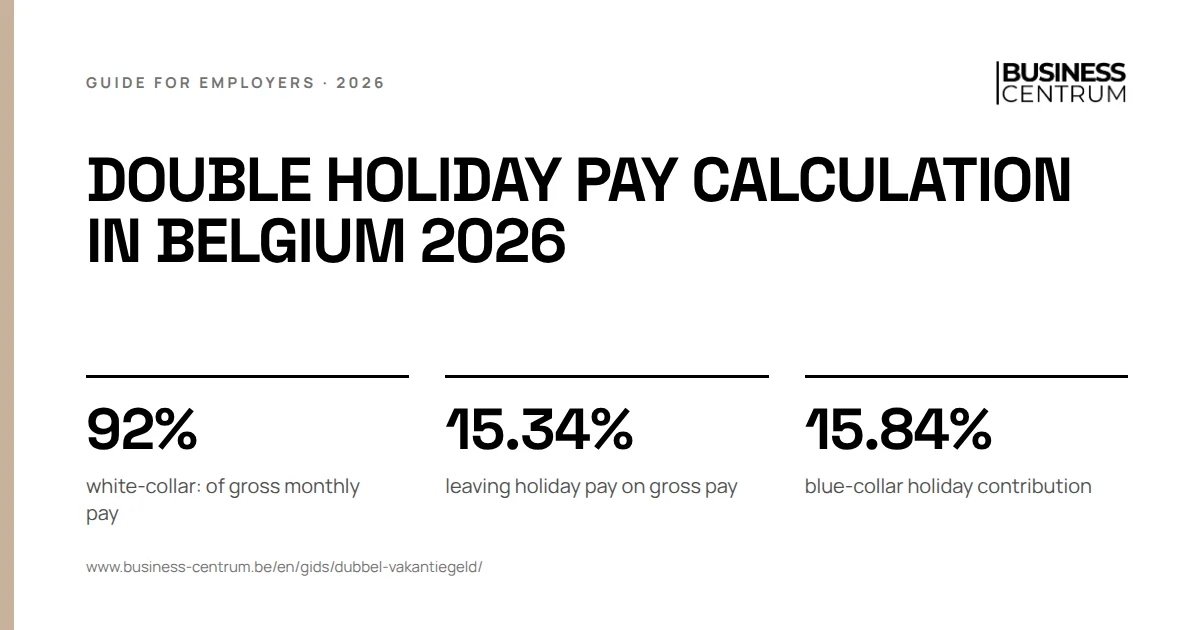
In Belgium, the double holiday pay calculation for a white-collar employee is 92% of gross monthly pay, multiplied by the months worked or assimilated last year and divided by twelve. You pay it yourself at the main holiday. For blue-collar workers the holiday fund pays, and you contribute 15.84% on their pay at 108%.
Calculating double holiday pay: who pays what?
Holiday pay has two parts. Single holiday pay is the pay for the holiday days themselves. Double holiday pay is an extra amount on top of that pay. Who pays it depends on the employee's status.
| White-collar | Blue-collar | |
|---|---|---|
| Who pays | the employer | the RJV or the sector's holiday fund |
| Single holiday pay | normal pay during the holiday days | 8% of the previous year's pay at 108% |
| Double holiday pay | 92% of monthly pay, pro rata | 7.38% of the previous year's pay at 108% |
| When | at the main holiday | between 2 May 2027 and 30 June 2027 for 2026 pay |
| Cost for the employer | the amount itself, with no employer contributions on the double part | 15.84% holiday contribution on pay at 108% |
Holiday pay in 2026 depends on work done in 2025, the holiday service year. An employee who worked a full year is entitled to 20 holiday days in a five-day week. How to plan and record leave is covered by our leave and absence service.
Double holiday pay for white-collar staff: the formula
For a white-collar employee you pay two things:
- Single holiday pay: you keep paying normal salary during the holiday days. Nothing changes on the payslip.
- Double holiday pay: for each month worked or assimilated in the previous year, one twelfth of 92% of the gross pay for the month in which the holiday starts. You pay it when the employee takes his main holiday.
The monthly pay is the fixed gross salary for that month. If the employee's pay is entirely variable, like a sales representative on commission, you use the monthly average of the previous twelve months.
Worked example. An employee earns € 2,600 gross a month and worked all of 2025. In May 2026 he takes his main holiday.
| Amount | |
|---|---|
| Double holiday pay: 2,600 x 92% | € 2,392.00 |
| Special contribution of 13.07% on 85% of monthly pay | - € 288.85 |
| Taxable | € 2,103.15 |
| Withholding tax 36.34% | - € 764.28 |
| Net | € 1,338.87 |
The employee pays a special contribution of 13.07% on double holiday pay. It is not the same as the special social security contribution. It does not apply to the part that corresponds to pay from the third day of the fourth holiday week. In practice you therefore withhold it on 85% of monthly pay instead of the full 92%. Withholding tax follows the scale for holiday pay. For normal annual pay between € 26,340 and € 31,830 the rate is 36.34%.
You pay no employer contributions on double holiday pay. Your cost is therefore the gross amount: € 2,392.
Pro rata. If the same employee joined on 1 April 2025, he counts nine months in 2025: 2,392 x 9/12 = € 1,794 gross. For January to March he received leaving holiday pay from his previous employer.
Assimilated days: sickness, accidents and other absences
A month counts if the employee worked or if the absence is assimilated. The law lists the assimilated absences, the main ones being:
- sickness or accident, up to the first 12 months of absence;
- workplace accident and occupational disease, for as long as the temporary total incapacity lasts;
- maternity leave, paternity and birth leave, adoption leave, foster care leave and prophylactic leave;
- temporary unemployment for economic reasons;
- strike, lock-out, civic duties and a trade union assignment.
Parental leave, time credit and unpaid leave, among others, are not assimilated. Those months reduce double holiday pay.
A new illness after a return to work of less than 14 days counts as a continuation of the previous one. The twelve-month period then simply continues.
Worked example. The employee on € 2,600 fell ill on 1 October 2024 and did not return in 2025. The first twelve months, up to the end of September 2025, are assimilated. So he counts nine months in 2025: 2,392 x 9/12 = € 1,794 gross. October to December 2025 do not count.
An employee who falls ill during his holiday keeps those holiday days. Our article on sickness during the holiday explains how.
Double holiday pay for part-time work and a change of working arrangement
For a part-time white-collar employee the calculation is the same: 92% of his part-time monthly pay, per month worked or assimilated. The months count in full, because the lower pay is already in the monthly salary.
It gets harder when the arrangement changes. Double holiday pay follows the monthly pay for the month in which the holiday starts, while the right was built up in the previous year.
- From full-time to part-time. An employee worked full-time throughout 2025 and goes half-time on 1 July 2026. If he takes his holiday in August, he receives holiday pay on his half-time salary. In December 2026 you pay the difference: 7.67% single and 7.67% double holiday pay on his 2025 gross pay excluding a fixed end-of-year bonus, minus what he already received. If he is still half-time in 2027, a second settlement follows in December 2027 for his full-time months of 2026.
- From part-time to full-time. If the higher arrangement leaves him with fewer than four weeks of holiday, the employee can ask for supplementary holiday. This applies if he increases his arrangement by at least 20% of a full-time arrangement and is at least 4 holiday days short.
The same goes for half-time time credit or any other reduction of hours: you settle in December, not at the start of the new arrangement.
Supplementary holiday pay for a first job or a restart
An employee who starts working, or returns after a period without work, has not built up a full holiday for his first year. If he worked at least 3 months in the same calendar year, he is entitled to supplementary holiday, also called European holiday.
For a white-collar employee you pay supplementary holiday pay for those days. It is an advance on the following year's double holiday pay: you later deduct the gross amount from it, or from the leaving holiday pay if he leaves earlier. No employer contributions are due. The employee pays the special contribution of 13.07%, as on double holiday pay: not on the part from the third day of the fourth holiday week. A blue-collar worker claims his supplementary holiday pay from his holiday fund.
Calculating leaving holiday pay on dismissal or departure
When a white-collar employee leaves your company, you pay him the holiday pay he built up with you on departure. This is leaving holiday pay:
- 15.34% of the gross pay he earned with you in the current year;
- plus another 15.34% of last year's gross pay, if he has not yet taken this year's holiday.
The amount consists of 7.67% single and 7.67% double leaving holiday pay. Assimilated days, such as sickness, count with a notional salary.
Worked example. An employee on € 3,000 leaves on 30 September 2026. He has already taken his 2026 holiday. His gross pay from January to September is € 27,000, without bonuses. If you also pay a pro rata end-of-year bonus on leaving, in practice it is included in gross pay, as in the NSSO's own example.
| Amount | |
|---|---|
| Leaving holiday pay: 27,000 x 15.34% | € 4,141.80 |
| of which single (7.67%) | € 2,070.90 |
| of which double (7.67%) | € 2,070.90 |
| Special contribution: 27,000 x 6.80% x 13.07% | - € 239.97 |
On single leaving holiday pay you pay normal NSSO contributions, as on salary. On the double part you withhold the special contribution, calculated on 6.80% of gross pay.
You also pay leaving holiday pay when an employee starts full-time time credit or a career break. If he reduces his hours, you settle in December, as explained above for part-time work.
Leaving holiday pay goes into the final settlement and onto the holiday certificate. All the documents you have to issue are listed in our article on social documents on dismissal.
Double holiday pay with a new employer
If you hire a white-collar employee who worked elsewhere last year, he has already received leaving holiday pay from his previous employer. Two rules prevent him being paid twice.
Single holiday pay. The settlement takes three steps:
- When the employee takes holiday, you pay an advance of 10% of gross pay for those days. The rest is covered by the previous employer's leaving holiday pay.
- In December, or when he leaves, you draw up the final settlement: the single holiday pay you would owe if he had worked the whole year for you, minus your advances and the previous employer's leaving holiday pay.
- You pay a positive balance in December. With a negative balance you may deduct from pay, within the limits of the wage protection act.
An employee on € 3,000 who takes 10 of his 20 holiday days in August receives an advance from you of 3,000 x 10% x 10/20 = € 150.
Double holiday pay. You only pay for the months he worked for you last year. If he joined on 1 April 2026, you pay no double holiday pay in 2026 and nine twelfths in 2027.
What employers contribute to holiday pay for blue-collar workers
A blue-collar worker does not receive his holiday pay from you but from the National Annual Holiday Office (RJV) or his sector's holiday fund. You fund it in advance, through a holiday contribution of 15.84% on gross pay at 108%:
- 5.57% every quarter through the DmfA, with the other NSSO contributions;
- 10.27% once a year, on an NSSO debit notice in March. For 2026 pay, that amount is due on 31 March 2027 and you pay it by 30 April 2027 at the latest.
The worker receives 15.38% of his previous year's pay at 108%: 8% single and 7.38% double holiday pay. Sick days up to twelve months count through a notional wage.
Worked example. A blue-collar worker earned € 33,000 gross at 100% in 2025.
| Amount | |
|---|---|
| Pay at 108% | € 35,640.00 |
| Employer holiday contribution: 15.84% | € 5,645.38 |
| of which quarterly (5.57%) | € 1,985.15 |
| of which on the debit notice (10.27%) | € 3,660.23 |
| Worker's gross holiday pay: 15.38% | € 5,481.43 |
| Deduction of 13.07% on 6.80% of pay | - € 316.75 |
| Solidarity deduction 1% | - € 54.81 |
| Withholding tax 23.22% | - € 1,186.51 |
| Net for the worker | € 3,923.36 |
The fund withholds 17.16% tax if the taxable holiday pay is at most € 1,740. If it is higher, the rate is 23.22% on the whole amount.
Mistakes we see employers make
- Paying double holiday pay twice. A new employee gets 92% for the whole year, while his previous employer already paid double leaving holiday pay.
- Withholding the special contribution on everything. Withholding 13.07% on the full 92% means withholding too much on the part from the third day of the fourth week.
- Forgetting assimilated months. Sickness up to twelve months counts. An employee who was sick for three months is entitled to the full amount.
- Forgetting last year's leaving holiday pay. If an employee leaves before taking his holiday, you also pay 15.34% on the previous year's pay.
- Paying a blue-collar worker's holiday pay yourself. That is the holiday fund's job. Your job is to declare the right pay, because the fund calculates on it.
The end-of-year bonus also belongs in the final settlement of a white-collar employee who leaves. Our guide to end-of-year bonus calculation explains how to calculate it per sector.
What Business Centrum does for you
Business Centrum calculates single and double holiday pay for your white-collar staff, leaving holiday pay and the settlement with a new employer, together with Acerta, as part of your payroll administration. We track the assimilated months and give you an estimate of the debit notice for your blue-collar staff in the autumn, so April holds no surprises.