
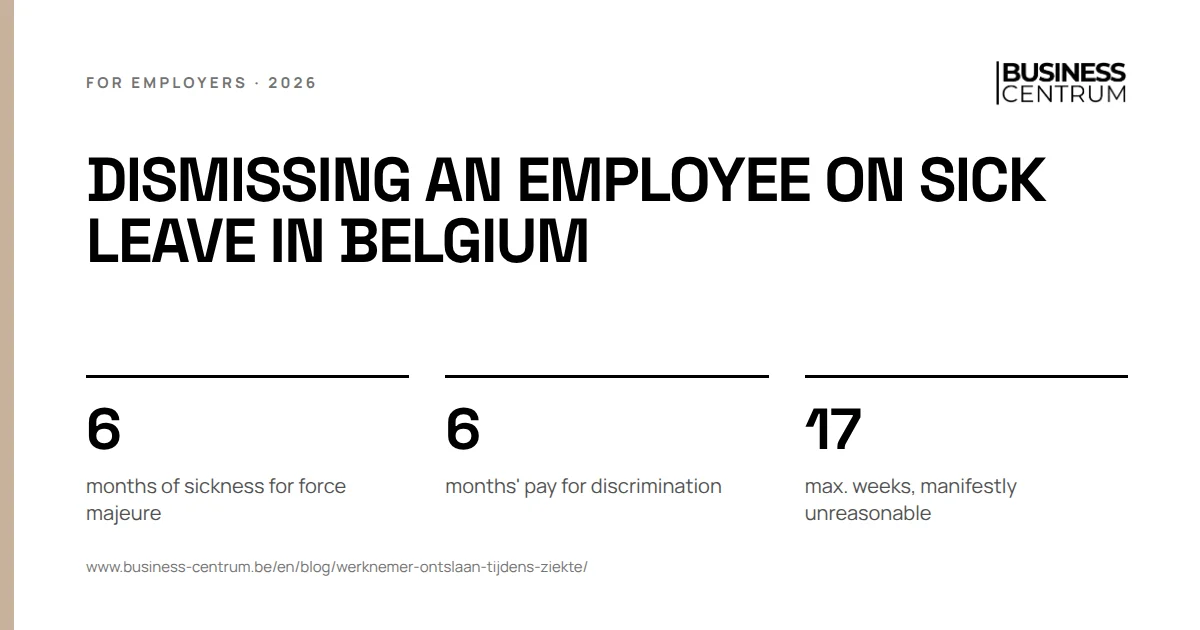
Yes, dismissing an employee on sick leave is allowed in Belgium. Sickness gives no protection against dismissal. The reason just cannot be the sickness itself: that is discrimination, with flat-rate damages of 6 months' gross pay. Medical force majeure is only possible after 6 months of uninterrupted sickness, with no pay in lieu of notice.
Can an employer dismiss an employee on sick leave in Belgium?
The law does not forbid it. You can give a sick employee notice, end the contract with pay in lieu of notice or agree an end together. Two limits apply.
The reason. State of health and disability are protected criteria under the Anti-Discrimination Act. If you dismiss someone because he is ill, he can claim flat-rate damages of 6 months' gross pay. If you prove you would also have dismissed him for other reasons, that drops to 3 months.
The explanation. If the employee has at least 6 months' service, he can ask for the concrete reasons under collective agreement (CBA) 109. If the dismissal is manifestly unreasonable, you risk 3 to 17 weeks' pay. How to give reasons is covered in our blog on dismissal reasons and CBA 109.
What you may do: dismiss because of the effects of the absences on your business. A haulier that has to cover a driver with agency staff for months, with overtime and missed runs, has a reason about how the business works. Record those effects in figures and dates, not in a sentence about the employee's health.
Three routes for dismissing an employee on sick leave
| Notice or pay in lieu | Medical force majeure | Mutual agreement | |
|---|---|---|---|
| When | Always | After 6 months of uninterrupted sickness | Always, if the employee agrees |
| Who decides | You | The occupational doctor finds permanent unfitness | You and the employee together |
| Notice or payment | In full | None | Whatever you agree |
| Other cost | Outplacement with long notice | € 1,800 to the Return to Work Fund | None |
| CBA 109 | Yes | No, it is not a dismissal | No, if the agreement is worded correctly |
| Speed | Immediate with pay in lieu | At least several months of procedure | Immediate |
Notice during sickness. If you, as employer, give notice before or during sickness, the notice period does not run while the employee is ill. The contract only ends after the last week of notice spent in good health. With a long-term sick employee that can take years. While the contract runs, you pay guaranteed salary again for the first 30 days of a new sickness, except for a relapse within 8 weeks. What happens if someone falls ill after you gave notice is in our blog on sickness during the notice period.
Pay in lieu of notice. You pay the salary for the whole notice period in one go and the contract ends the same day. For a long-term sick employee it is the only way to end things at once. The length of the notice is worked out in our guide on the employer's notice period.
Medical force majeure. Since 1 January 2026 the procedure can start after 6 months of sickness, down from 9. The occupational doctor must find that the employee can permanently no longer do his job. You pay no pay in lieu of notice, but you do pay € 1,800 to the Return to Work Fund. The full procedure with a timeline is in our guide on medical force majeure.
Mutual agreement. You agree an end date and possibly a payment together. It is fast and rules out disputes if the text includes a full and final settlement clause. A model is in our blog on termination by mutual agreement.
Worked example: dismissing an employee on long-term sick leave
A white-collar employee earns € 3,200 gross a month and has four years and three months' service. She has been ill for three months. The example only uses fixed monthly pay. In reality, benefits such as the end-of-year bonus and meal vouchers go into the pay in lieu of notice.
- Weekly pay: € 3,200 × 3 / 13 = € 738.46.
- Notice at four to five years' service: 15 weeks.
| Route | What you pay | When the contract ends |
|---|---|---|
| Notice worked | 15 weeks' pay (€ 11,076.92) for work done, only after she recovers | Uncertain: notice does not run during sickness |
| Pay in lieu of notice | 15 x € 738.46 = € 11,076.92, straight away | Today |
| Medical force majeure | € 1,800 | At the earliest after 6 months of sickness plus the procedure |
| Mutual agreement | Whatever you agree, e.g. € 5,000 | On the agreed date |
The risk on top of the pay in lieu of notice:
- manifestly unreasonable dismissal: 3 weeks (€ 2,215.38) to 17 weeks (€ 12,553.85);
- discrimination: 6 months' gross pay, or € 19,200, or 3 months (€ 9,600) if you prove another reason.
The two do not add up. Under CBA 109, compensation for manifestly unreasonable dismissal cannot be combined with other compensation owed because of the dismissal, such as damages for discrimination.
If the employee has been ill for months and the occupational doctor sees no return, medical force majeure is the cheapest route. If you want certainty quickly or there is no permanent unfitness, an agreement often costs less than the full payment.
Dismissal during sickness: the employer's step-by-step plan
- Pick the reason and build the file. Note the concrete effects of the absence: who covers, what it costs, what went wrong. Keep medical information out of the file.
- Pick the route. Compare notice, pay in lieu, agreement and medical force majeure using the example above.
- Serve notice. Send notice by registered post: it takes effect on the 3rd working day after posting. For termination with pay in lieu, a letter stating the date and the payment is enough.
- Give reasons. If the employee asks for the reasons by registered letter, you reply within 2 months. If you do not reply, you pay a penalty of 2 weeks' pay.
- Final settlement and documents. Pay the compensation, leaving holiday pay and any pro rata bonus. Hand over the C4 on the last day.
- Watch for a relapse. If the employee falls ill again while working his notice, within 8 weeks of the end of an earlier sickness, you pay no new guaranteed salary, only the balance. If a medical certificate shows it is a different illness, guaranteed salary is due again.
Mistakes when dismissing during sickness
- Naming the sickness in the letter or an email. That is exactly what a judge looks for in a discrimination case.
- Giving notice and then waiting. Notice to be worked by a long-term sick employee achieves nothing while the sickness lasts. Calculate the pay in lieu before you give notice.
- Invoking medical force majeure without the procedure. Courts usually treat an "end because of sickness" without a finding by the occupational doctor as an ordinary termination: you then still pay full pay in lieu of notice.
- Forgetting the exit. Report the end in Dimona and hand over the C4, even if the employee stays with the health insurance fund.
Fixed-term contracts and sickness
Separate rules apply to fixed-term contracts. If the contract lasts less than 3 months and the employee is ill for more than 7 days, you may end it without payment once the period in which notice was possible has passed. With a longer contract you can end it after 6 months of sickness with a payment of at most 3 months' pay, minus what you have paid since the sickness began.
What Business Centrum does for you
Business Centrum calculates the notice period, the pay in lieu and the comparison with medical force majeure or an agreement, together with Acerta. We draft the letter, process the final settlement in your payroll and hand over the C4 and the other social documents on time.