
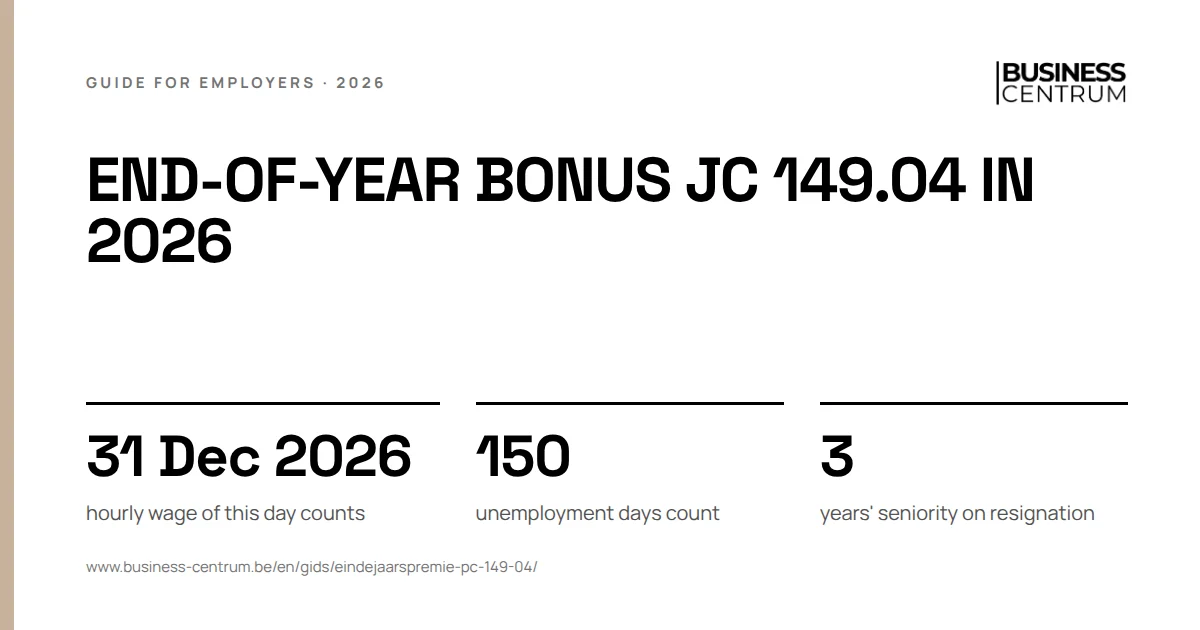
The end-of-year bonus in JC 149.04 is the hourly wage of 31 December times the weekly working hours times 52, divided by 12, and you as the employer pay it yourself, with the first pay run after 31 December. The 2026 bonus therefore arrives in January 2027. There is no longer any minimum seniority, and a worker who leaves gets a share in most cases.
Who gets the end-of-year bonus in JC 149.04?
The collective agreement applies to employers and blue-collar workers of companies under the Joint Subcommittee for the metal trade. It covers blue-collar workers only. Your office staff fall under another committee with their own rules.
There is no minimum seniority. Until the end of 2019, a worker needed at least 3 months' seniority in the company. The national agreement 2019-2020 abolished that condition from 1 January 2020, and the current agreement no longer contains it.
The agreement has applied since 1 January 2020 for an indefinite period. Later national agreements, including the one for 2025-2026, do not change the end-of-year bonus.
Calculating the end-of-year bonus in JC 149.04
The bonus is the value of a number of hours. The agreement gives the formula for that number of hours:
weekly working hours under the pay scheme x 52 weeks / 12 months
You multiply that number of hours by the hourly wage in force on 31 December of the year. For the 2026 bonus, that is the hourly wage of 31 December 2026. If a worker switches to another working-time scheme during the year, you calculate on the average annual working time. The minimum hourly wage per category is in the JC 149.04 pay scale.
For part-time workers the agreement has no separate rule. The formula uses the weekly working hours of the worker's pay scheme.
Worked example: a full-time warehouse worker
This is an example, not a calculation for your situation. A worker works 38 hours a week and earns € 18.00 gross per hour on 31 December. He worked the whole year.
38 x 52 / 12 = 164.67 hours, times € 18.00 = 18.00 x 38 x 52 / 12 = € 2,964.00 gross
When do you pay the end-of-year bonus in JC 149.04?
The reference period is the calendar year: for the 2026 bonus, from 1 January 2026 up to and including 31 December 2026. You pay the bonus with the first pay run after 31 December 2026. That differs from many other sectors, where the bonus is paid in December.
On retirement, death or leaving during the year, you pay the bonus at the latest 1 month later: in the month following the month of the event.
The bonus is pay. It goes through the normal payroll calculation, with 13.07% personal social security on the gross wage at 108% and withholding tax under the scale for exceptional payments. What the worker keeps net and what the bonus costs you on top of the basic contribution of 25% can be worked out with our explanation on calculating the end-of-year bonus.
Which absences count for the end-of-year bonus in JC 149.04?
The agreement lists the absences that count as worked:
| Absence | Counts for the bonus |
|---|---|
| Pregnancy leave, maternity leave, birth leave | fully |
| Prophylactic leave, adoption leave, foster care leave, palliative leave | fully |
| Medical assistance leave | up to 3 months per reference period |
| Sickness, accident, work accident, occupational disease, military obligations | the first 12 months from the first day of absence |
| Unemployment days under articles 26, 28 1°, 49, 50 and 51 of the Employment Contracts Act | up to 150 days per reference period |
For these absences you calculate on the hourly wage the worker would normally have received on 31 December. The agreement does not say how to reduce the bonus for absences that are not treated as worked, nor whether that happens per day or per month. Choose a method, apply it equally to all your workers and record it.
End-of-year bonus JC 149.04 on dismissal or leaving
The agreement starts from a broad rule: the worker gets a pro rata bonus however the employment contract ends. There are two exceptions, and retirement and death even give the full bonus.
| Situation | Right to a bonus |
|---|---|
| Dismissal by the employer | yes, pro rata, including the period covered by compensation in lieu of notice |
| Dismissal for serious misconduct | no |
| Resignation with less than 3 years' seniority in the company | no |
| Resignation with 3 years' seniority or more | yes, pro rata |
| End by mutual agreement, force majeure or any other way | yes, pro rata |
| Retirement during the year | yes, the full amount |
| Death during the year | yes, the full amount for the heirs |
| Fixed-term contract, clearly defined work, temporary agency contract or replacement | yes, pro rata |
The pro rata is 1/12 per month of work or period treated as worked in the reference period, and each started month counts as complete. You calculate on the hourly wage normally paid when the contract ends. On retirement or death, you calculate on the hourly wage at the time of the event.
For a fixed-term contract the normal reference period does not apply. If the contract lasts more than a year, you pay a bonus per year based on that year's work, with a final settlement on leaving.
Worked example: resignation at the end of June
This is an example, not a calculation for your situation. The worker above has four years' seniority, resigns and leaves on 30 June 2026. His hourly wage at the end of the contract is € 18.00. He has enough seniority and has six months in 2026:
18.00 x 38 x 52 / 12 x 6 / 12 = € 1,482.00 gross
You pay this amount in July 2026 at the latest. Had he had only two years' seniority, the sector agreement would have given him no bonus. The amount belongs in the final settlement and on the social documents on dismissal.
What may your company arrange itself?
The provisions of the agreement are minimum benefits. A more favourable arrangement in your company still applies in full, such as a higher bonus or broader treatment of absences. The agreement says nothing about converting the bonus into other benefits.
Mistakes we see with the end-of-year bonus in JC 149.04
- Paying the bonus in December on the November hourly wage. The hourly wage of 31 December counts.
- Making a new worker wait for three months' seniority. That condition has not existed since 2020.
- Paying a pro rata bonus on retirement. The agreement grants the full amount on retirement and death.
- Settling every resignation without bonus. With 3 years' seniority the worker gets a pro rata bonus.
- Deducting every day of sickness. Sickness and accident count for the first 12 months.
What Business Centrum does for you
Business Centrum calculates the end-of-year bonus of your metal trade workers under this agreement, together with Acerta, as part of your payroll. We use the hourly wage of 31 December, track the absences treated as worked and include the bonus in the final settlement when a worker leaves. The rules of the other committees are in our overview of the end-of-year bonus in 2026 per joint committee.