
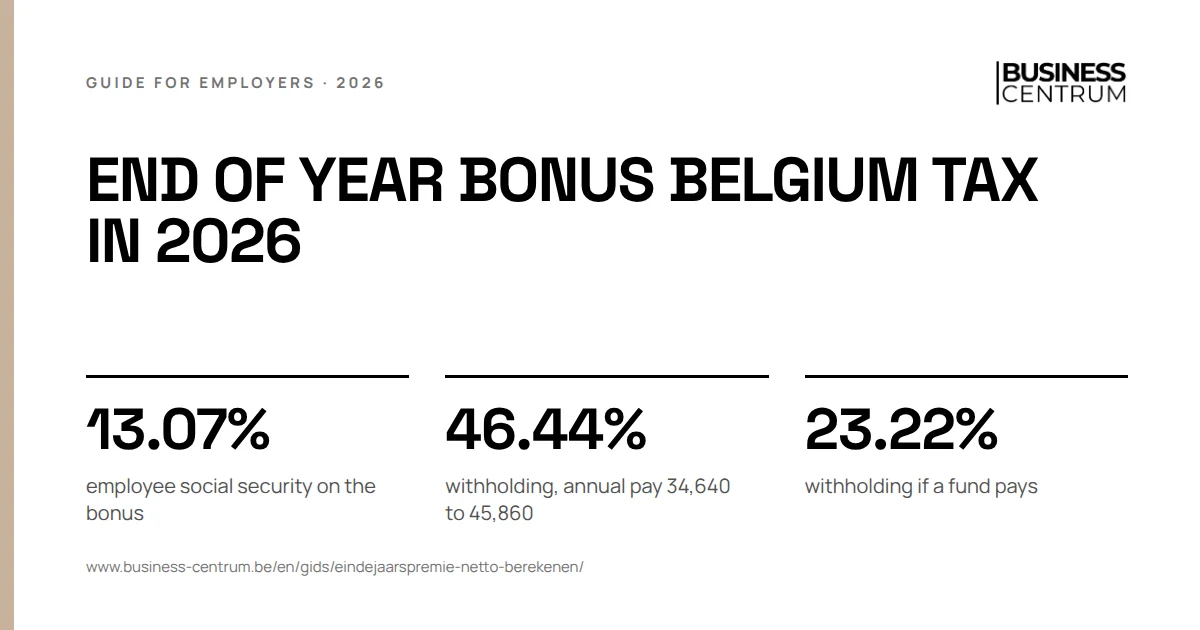
Working out the end of year bonus in Belgium after tax takes four steps: gross bonus, minus 13.07% social security, minus withholding tax under the scale for exceptional payments, and what is left is net. In 2026 that withholding is a flat percentage, from zero to 53.50%, depending on your employee's normal annual pay. If a sector fund pays the bonus, the fund withholds 23.22%. Below we calculate it for a white-collar employee and for blue-collar workers, with your cost as employer and what is already fixed for 2027.
How much gross bonus your employee receives depends on the collective agreement of the sector. Those rules per committee are in our guide end-of-year bonus calculation and in the overview by joint committee. This page starts where they stop: at the gross amount.
End of year bonus Belgium tax in four steps
- Determine the gross bonus. A white-collar employee in JC 200 receives 100% of the monthly salary, pro rata if not employed the whole year. In other committees it is a number of hours of pay or a percentage of annual pay.
- Deduct social security. The personal contribution is 13.07%. For a blue-collar worker you calculate it on 108% of the bonus, as for ordinary pay.
- Find the band. Look up the employee's normal annual pay in the scale below: ordinary pay on an annual basis, without bonuses and holiday pay. The band gives the percentage.
- Deduct withholding tax. Apply the percentage to the bonus after social security. What remains is the net amount on the payslip.
The order matters: withholding always applies to the amount after personal social security, never to the gross bonus. What withholding tax is and how it works on ordinary pay is explained in what is bedrijfsvoorheffing.
How much tax on the end-of-year bonus? The 2026 scale
For the tax authorities, an end-of-year bonus is an exceptional payment. On ordinary monthly pay you calculate withholding with the key formula, on the bonus with a fixed scale from the rules of the Federal Public Service Finance (annex III to the Royal Decree implementing the Income Tax Code, no. 53). The percentage depends on the annual amount of normal gross pay, so on ordinary pay and not on the bonus itself.
| Employee's normal annual pay | Withholding tax on the bonus |
|---|---|
| up to € 10,675 | none |
| over € 10,675 to € 13,660 | 23.22% |
| over € 13,660 to € 17,375 | 25.23% |
| over € 17,375 to € 20,840 | 30.28% |
| over € 20,840 to € 23,580 | 35.33% |
| over € 23,580 to € 26,340 | 38.36% |
| over € 26,340 to € 31,830 | 40.38% |
| over € 31,830 to € 34,640 | 43.41% |
| over € 34,640 to € 45,860 | 46.44% |
| over € 45,860 to € 59,900 | 51.48% |
| over € 59,900 | 53.50% |
The scale applies to income you pay or grant in 2026. It is one percentage on the whole bonus, not a banded rate: someone just above a threshold pays the higher percentage on the full amount. After January indexation an employee may move into a higher band. So look at annual pay at the time of payment.
Dependent children. For low annual pay, part of the bonus is exempt. The exemption applies up to annual pay of € 18,858 with one child and € 22,470 with two dependent children, for the difference between that threshold and annual pay. On top of that, withholding falls by 7.50% with one child and 20% with two children, as long as annual pay does not exceed € 28,940. For more children the thresholds are higher. You know the dependent children from the declaration the employee gave you for monthly withholding.
Piece work. An end-of-year bonus paid in one go that depends on output per piece or per task gets a flat rate of 16.15%, without exemption.
Why the work bonus does not apply to the end-of-year bonus
The work bonus reduces the personal social security of low-paid employees. Social security calculates it on the reference monthly pay, which does not include the end-of-year bonus, up to the amount of that reference pay. Two consequences:
- the December work bonus stays that of ordinary pay: the bonus does not reduce it;
- on the bonus itself you withhold the full 13.07%, without work bonus.
For a white-collar employee earning € 2,600 gross a month this means: € 121.09 social security remains on ordinary pay after the work bonus, while you withhold € 339.82 on the € 2,600 bonus. The tax work bonus, since August 63% of part B, also only reduces withholding on monthly pay. The scale for exceptional payments only knows the exemption and reduction for dependent children. That is why the bonus weighs relatively heavily for low pay. The work bonus amounts per pay level are in our news item on the work bonus in 2026.
Worked example: end-of-year bonus gross to net for a white-collar employee in JC 200
A white-collar employee in JC 200 earns € 3,500 gross a month, has worked for you for years and has no dependent children. In December he receives a full bonus of 100% of his monthly salary. His normal annual pay is 3,500 x 12 = € 42,000, still above € 34,640 after personal social security: the percentage is 46.44%.
| Amount | |
|---|---|
| Gross bonus | € 3,500.00 |
| Employee social security 13.07% | - € 457.45 |
| Taxable | € 3,042.55 |
| Withholding tax 46.44% | - € 1,412.96 |
| Net paid | € 1,629.59 |
| Employer contributions 25% | € 875.00 |
| Cost to you | € 4,375.00 |
Of every euro the bonus costs you, 37 cents reach the employee net. Had he started on 1 April, he would get nine twelfths: € 2,625 gross, with the same deductions in proportion.
End-of-year bonus net by pay level: four employees side by side
The higher the pay, the higher the band and the smaller the net share. For a white-collar employee without dependent children receiving a full month's bonus:
| Gross monthly pay | Normal annual pay | Withholding | Net bonus | Net in % | Cost to you |
|---|---|---|---|---|---|
| € 2,600 | € 31,200 | 40.38% | € 1,347.52 | 52% | € 3,250 |
| € 3,500 | € 42,000 | 46.44% | € 1,629.59 | 47% | € 4,375 |
| € 4,500 | € 54,000 | 51.48% | € 1,898.03 | 42% | € 5,625 |
| € 6,000 | € 72,000 | 53.50% | € 2,425.35 | 40% | € 7,500 |
We chose pay levels whose annual pay, even after personal social security, clearly falls in one band. If pay is close to a threshold, have the band checked in the payroll calculation. What ordinary monthly pay yields net can be seen in our gross-net calculator and in the guide gross to net.
Withholding tax is an advance. In personal income tax the bonus counts with the whole annual income, followed by a refund or an additional payment. The bonus and the tax withheld appear on the form 281.10 of the year in which you paid them.
End-of-year bonus net for a blue-collar worker: through a fund or from you
For blue-collar workers there are two routes, and the deductions differ.
A sector fund pays. In cleaning, hospitality, temporary agency work and road haulage a fund pays the bonus, not you. The fund itself withholds social security and a flat withholding tax of 23.22%, without reduction for children. That rate is lower than the scale for most pay levels, but the difference is settled in personal income tax. You do not include the bonus in your payroll.
You pay yourself. That is the case in, among others, the food trade (JC 119) and metalworking (JC 111). You then calculate social security on 108% of the bonus and withholding under the scale above.
Worked example: cleaning worker, bonus paid by the fund
A cleaner in JC 121 had € 28,000 gross pay declared in the reference period. The Social Fund pays 9% of that pay.
| Amount | |
|---|---|
| Gross bonus: 28,000 x 9% | € 2,520.00 |
| Social security 13.07% on 108%: 2,520 x 1.08 x 13.07% | - € 355.71 |
| Taxable | € 2,164.29 |
| Fund withholding 23.22% | - € 502.55 |
| Net from the fund | € 1,661.74 |
66% remains net. You do not pay this bonus in December, but through the fund contributions on your social security return. The conditions and payment calendar are on our page about the end-of-year bonus JC 121.
Worked example: food trade worker, bonus paid by you
A blue-collar worker in JC 119 earns, fictitiously, € 22 an hour, full time. His bonus for a full year is 164.66 times his hourly wage: € 3,622.52. His normal annual pay is above € 34,640, even after social security, so the percentage is 46.44%.
| Amount | |
|---|---|
| Gross bonus | € 3,622.52 |
| Social security 13.07% on 108% | - € 511.34 |
| Taxable | € 3,111.18 |
| Withholding tax 46.44% | - € 1,444.83 |
| Net | € 1,666.35 |
| Employer contributions 25% on 108% | € 978.08 |
| Cost to you | € 4,600.60 |
The rules per fund are on our pages about the bonus in road haulage, hospitality and for agency workers. How the gross bonus is calculated in JC 119 is on the page end-of-year bonus JC 119.
What the end-of-year bonus costs you as an employer
On top of the gross bonus you pay employer contributions. The basic contribution for most private-sector employees is 25%, including wage moderation. For a blue-collar worker, social security also calculates that contribution on 108% of the bonus.
Three things change that amount in practice:
- Sector contributions. Your joint committee may charge extra contributions on top of the basic contribution.
- The structural reduction. For low pay, social security reduces your contributions per quarter. How that works is in our article on employer social security contributions.
- Fund bonuses. If a fund pays the bonus, your cost is in the fund contributions paid throughout the year. In December you then pay nothing extra.
Set aside a bonus you pay yourself every month. For the € 3,500 employee that is 4,375 / 12 = € 364.58 a month. Otherwise you pay a thirteenth salary with contributions in December from one month's cash.
End-of-year bonus net in 2027: what is fixed and what is not
The December 2026 bonus falls under the 2026 scale. For what you pay in 2027, this is already fixed:
| 2026 income | 2027 income | |
|---|---|---|
| Tax-free allowance, base amount before indexation | € 4,945 | € 4,990 |
| Tax work bonus part B | 63% | 63% (72% only for 2028 income) |
| Scale for exceptional payments | from zero to 53.50% | not yet published |
| Withholding on fund bonuses | 23.22% | not yet published |
The higher tax-free allowance comes from the law of 15 July 2026 reforming personal income tax. It lowers the tax on annual income, not directly the percentage on the bonus: that is in the scale the Federal Public Service Finance sets every year.
This matters most for bonuses only paid in January 2027. The Hospitality Fund pays the 2026 bonus no later than 31 January 2027, the agency workers' fund from 4 January 2027. What is paid or granted in 2027 falls under the 2027 rules. The road haulage fund pays from 20 December 2026, so still under the 2026 scale.
January 2027 indexation also raises many employees' monthly pay, and with it the December 2027 bonus and sometimes the band. Which committees index in January is in our overview of indexation in January 2027. All changes to withholding tax in 2027 are listed in our guide on withholding tax 2027, and the rest of the year in what changes in 2027.
How to prepare the net end-of-year bonus for December
- Check for each employee whether they are entitled and to how many twelfths: seniority, joining or leaving, assimilated days under your agreement. For white-collar employees in JC 200 the conditions are on our page about the end-of-year bonus JC 200.
- Check who pays. If a fund pays, you leave the bonus out of the payroll calculation.
- Look up each employee's band with their normal annual pay, and check dependent children.
- Explain the net amount in advance. Employees expect a month's pay net and often receive less than half. A short explanation prevents questions.
- Work out the cost with employer contributions and plan the payment in your December cash flow.
What Business Centrum does for you
Business Centrum calculates your employees' end-of-year bonus gross and net, together with Acerta, as part of your payroll. We apply the right band and dependent children for each employee, keep fund bonuses out of the payroll calculation and give you the total cost in the autumn, so the December bonus is no surprise. Want your employees' bonus checked? Ask for a call back.