
A flat-rate expense allowance is free of NSSO contributions and withholding tax in 2026 as long as it stays within the NSSO maximum and covers a cost that belongs to your business: € 164.21 a month for structural home working, € 20 for internet, € 20 for an own PC, and for clothing, tools, meals on the road and travel, the amounts in the NSSO expense table. For home working and the mileage allowance, the tax authorities follow the same amounts. For the other items, the flat rate must be based on a serious standard for tax purposes.
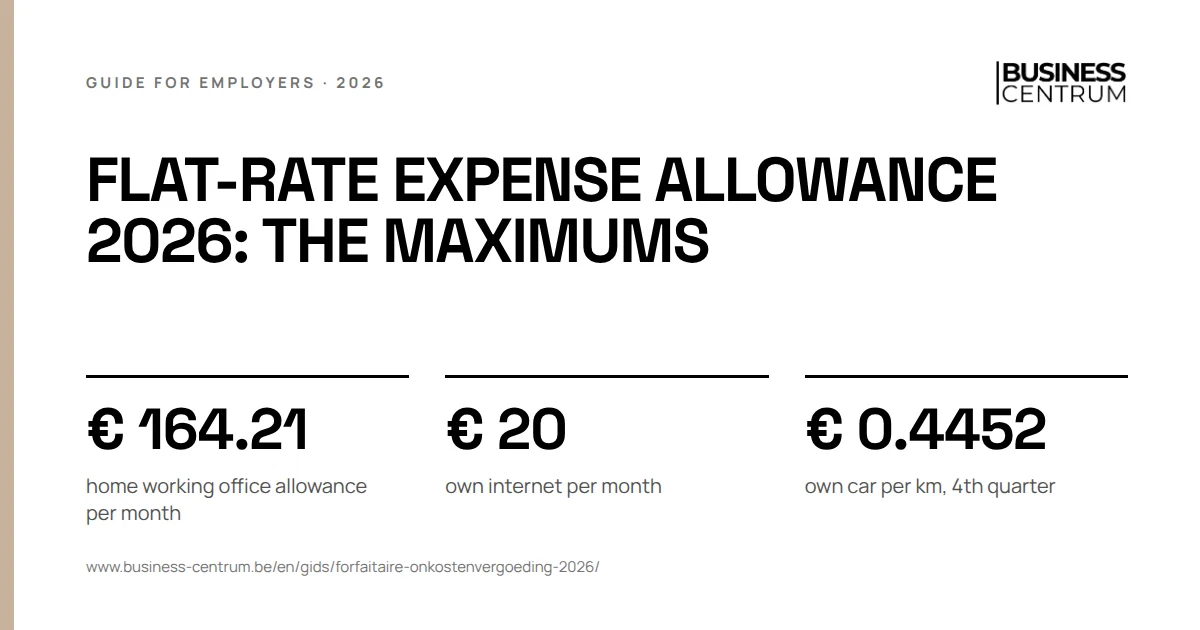
Flat-rate expense allowance 2026: all maximums in one table
The amounts come from the NSSO expense table and the circulars of the FPS Finance. They are maximums per employee. You may give less, never more without proof.
| Cost | NSSO maximum | Tax authorities | Main condition |
|---|---|---|---|
| Office allowance for home working | € 164.21 per month | Same amount | Structural home working: on average 1 working day a week |
| Internet at home, with subscription | € 20 per month | Same amount | Own connection, used for work |
| Own PC with peripherals | € 20 per month | Same amount | You do not provide a laptop or tablet yourself |
| Or: own screen, printer or scanner without own PC | € 5 per device, together € 10 per month | Same amount | For at most 3 years |
| Own mobile phone | No flat rate | No flat rate | Actual costs on the basis of receipts |
| Purchase of work clothing | € 2.20 per day | Serious standard needed | Overalls, safety shoes or a required uniform |
| Upkeep of work clothing | € 2.20 per day | Serious standard needed | Same type of clothing |
| Wear of own clothing | € 1.10 per day | Serious standard needed | Dirty working conditions |
| Own tools | € 1.25 per day | Serious standard needed | The employee uses his own tools |
| On the road, without sanitary facilities or canteen | € 10 per day | Serious standard needed | At least 4 hours on the road at a stretch |
| Meal on the road | € 9 per day | Serious standard needed | Has to eat away from home |
| Overnight stay in Belgium | € 35 per night | Federal civil servants' scheme | Workplace too far away to go home |
| Garage, parking, car wash | € 50, € 15, € 15 per month | Serious standard needed | The car is used mainly for work |
| Own car, business travel | € 0.45 per km in the 4th quarter of 2026, or € 0.48 on an annual basis | Same amount | The car is not yours and not financed by you |
| Own bicycle, business travel | € 0.37 per km | Bicycle allowance as a serious standard | The bicycle belongs to the employee |
| Business trip abroad | Daily allowance per country | Same amounts | A real business trip, now and then |
"Serious standard needed" means: the tax authorities only accept a flat rate if the amount is based on standards that result from repeated observations and sampling. We did not find a tax circular that adopts the amounts of the NSSO table for those items. If you want certainty for tax purposes, you can ask the Advance Decisions Service in tax matters (the ruling office) for an advance ruling.
Employer expense allowance: when is it free of NSSO contributions and tax?
An expense allowance is not pay if it reimburses a cost that your business should actually bear. The NSSO sets three conditions, which must all be met at the same time:
- the cost is part of the work;
- the cost was really incurred;
- you can justify the expense with supporting documents.
Small costs that are hard to prove may be estimated on a flat-rate basis. That is what the NSSO expense table is for. A flat rate from that table counts as proven, but not automatically for everyone: the cost must be plausible for the employee's job and working conditions. A clothing allowance for a white-collar employee who comes to the office in a suit will not hold up.
The tax authorities look at it in the same way. An allowance is only a non-taxable reimbursement of the employer's own costs if you prove that it is intended for costs of your business and is actually spent on them. A flat rate is allowed if it is based on serious standards. For home working, internet, a private PC, a private car and business trips abroad, the tax authorities set those standards themselves in circulars. There, the NSSO and the tax authorities follow the same amounts.
Home working, internet and PC: the flat-rate expense allowance for the employee
For home working, the NSSO fully follows tax circular 2021/C/20. The amounts are therefore the same for both. The office allowance of € 164.21 a month, the maximum since 1 September 2026, applies to employees who work from home on a structural basis, the equivalent of 1 working day a week, and also to a part-time employee who reaches that threshold. The tax authorities assess this per month. Anyone who does not reach the threshold receives no flat-rate office allowance, not even part of it.
Internet and PC are separate from that threshold. The tax authorities accept the € 20 for internet and the € 20 for an own PC also for an employee who only works from home now and then, for the months in which he uses his own connection or computer for work. If he works on a company laptop, the PC allowance falls away. If he only uses his own screen or printer, you pay € 5 per device and together at most € 10 a month.
Who receives which allowance, how you organise structural home working and what the home working agreement must contain is covered in our news item on the home working allowance 2026.
Worked example. A white-collar employee works from home two days a week, with his own laptop and his own internet. You pay him € 164.21 + € 20 + € 20 = € 204.21 a month, or € 2,450.52 a year, without NSSO contributions and without withholding tax. If you pay EUR 250 a month without proof of higher costs, € 45.79 is pay. On that, you pay NSSO contributions and deduct withholding tax.
Mobile phone allowance employer: no flat rate, but three routes
There is no flat rate for an employee's own mobile phone. The NSSO expense table and circular 2021/C/20 name internet and an own PC, not a mobile phone. A fixed amount per month for "use of the mobile phone" is therefore pay, unless you can show that it covers real professional costs. You have three routes:
- Actual costs. You reimburse the business calls and the business share of the subscription on the basis of the invoice. Keep the invoices and the calculation of the business share.
- A company phone. You provide a device with a subscription. If the employee may also use it privately, you declare a benefit in kind: € 36 a year for the device and € 48 a year for the subscription, together € 84. With mobile internet, € 60 a year is added.
- The subscription only. If the employee keeps his own device and you pay the subscription, the benefit is € 48 a year.
If the employee correctly pays back all of his private use, for example with two SIM cards or a split invoice, then according to the NSSO you declare no benefit for the device and the subscription. The tax authorities only accept this if the split covers both the phone subscription and the internet subscription.
Work clothing, tools and work on the road
For costs that a blue-collar worker or technician incurs on site or on the road, the NSSO expense table gives flat rates per day:
- Work clothing. € 2.20 per day for the purchase and € 2.20 per day for the upkeep. This only covers work clothing in the strict sense, such as overalls or safety shoes, or clothing that you require and that nobody wears as ordinary clothing, such as a uniform.
- Own clothing for dirty work. € 1.10 per day for jeans, T-shirts and underwear that need frequent washing because of the dirty work.
- Own tools. € 1.25 per day if the employee works with his own tools.
- Work on the road. A non-sedentary worker has to travel for at least 4 hours at a stretch during the working day. If he has no access to sanitary facilities, a canteen or a toilet during that time, you pay € 10 per day. If he has no option but to eat away from home, you pay € 9 per day for the meal.
If you provide the clothing yourself and have it washed, there is no cost for the employee and therefore no flat rate. A flat rate for clothing you already pay for is double reimbursement.
Business travel: kilometres, overnight stays and daily allowances
Own car. For business travel in their own car, the NSSO and the tax authorities accept the amount the federal government pays its civil servants: € 0.45 per km in the fourth quarter of 2026. You may also use the annual amount of € 0.48 per km, but then for the whole period until 30 June 2027. The car may not be yours and may not be financed by you. How that amount is calculated and what changes in 2027 is explained in our guide to the mileage allowance 2027.
Overnight stay in Belgium. If the employee cannot go home at night because the workplace is too far away, the NSSO accepts € 35 per night for dinner, accommodation and breakfast. For domestic business trips, the tax authorities use the federal civil servants' scheme as a serious standard, with its own conditions: among other things, a trip of at least 6 hours and further than 25 km from the fixed workplace. If you want to avoid both NSSO contributions and tax, check both sets of rules.
Abroad. For a business trip abroad, you may pay a flat-rate daily allowance per country. The NSSO and the tax authorities use the same amounts: those of the FPS Foreign Affairs, since 1 August 2025. Up to 30 days, category 1 applies, for a longer stay category 2. The daily allowance covers meals, drinks, local transport, telephone and small expenses. You reimburse the hotel and the journey separately on the basis of receipts. If you or a client pay for a meal, you reduce the daily allowance by 35% for lunch and 45% for dinner. Since 1 January 2025, you may also pay the full daily allowance on the day of departure and the day of return.
Worked example. A sales representative travels to France for three days. The category 1 daily allowance there is € 95 per day, so € 285 for three days. On day two, the client pays for lunch: you deduct € 33.25. You pay € 251.75 free of NSSO contributions and withholding tax, plus the hotel and the journey on invoice.
Flat-rate expense allowance maximum: what happens if you pay more
The amounts are maximums. If you pay more, the part above the maximum is pay. You pay NSSO contributions on it and deduct withholding tax, and on tax form 281.10 that part appears as taxable pay.
There is one way out: you prove the actual costs. If an employee's costs are really higher, you may reimburse them. But then you prove all the costs of that item, not just the part above the flat rate. Combining a flat rate and actual costs for the same cost is not allowed.
Never reimburse twice
The NSSO only accepts a flat rate if you do not also reimburse the same cost in another way. The tax authorities say the same. Some combinations that are not possible:
- paying the office allowance and also paying part of the employee's electricity bill;
- paying the internet allowance and also reimbursing part of the internet subscription;
- paying the PC allowance and letting the employee use a company laptop;
- paying a clothing allowance for clothing that you buy yourself and have washed.
What is possible: the office allowance as a flat rate and, in addition, reimbursing a standard office chair, desk or second screen on invoice, or providing one. The tax authorities accept this, as long as the reimbursement remains reasonable and you keep the invoices.
Flat-rate expense allowance for a company director
The tax scheme for home working in circular 2021/C/20 expressly does not apply to company directors. That does not rule out a reimbursement of costs. A company director can have costs of the company reimbursed on the basis of receipts, or as a flat rate if the amount is based on serious and consistent standards. The tax authorities assess this case by case, and you can request an advance ruling on it. The tax authorities do not publish amounts that are accepted as fixed for company directors in that circular. We therefore do not give any here.
Pitfalls
- A fixed amount in the policy. If your home working policy states an amount, the allowance does not rise by itself when the NSSO raises the maximum. Write "the maximum accepted by the NSSO" instead.
- A flat rate for everyone. A flat rate must match the job. A clothing allowance for all staff, including white-collar employees without work clothing, is pay.
- The structural home working threshold. If an employee does not reach 1 day a week in a given month, the office allowance lapses for that month.
- Forgetting the tax form. Exempt allowances also belong in the "miscellaneous information" box of tax form 281.10.
- The mobile phone. A monthly amount for the employee's own mobile phone that you cannot justify is pay.
What to check now
- Make a list of every allowance you pay monthly or per day, with the amount and the employees who receive it.
- Compare each amount with the table above and with the condition. If you are above it, lower the amount or collect proof of higher costs.
- For each home worker, check whether he reaches the equivalent of 1 working day a week every month.
- Look for double reimbursements: a flat rate next to a reimbursement of the same cost, or a PC allowance next to a company laptop.
- Record the allowances in the work rules, a service note or an annex to the employment contract.
- Check whether your payroll processing puts the exempt amounts on tax form 281.10.
What Business Centrum does for you
Business Centrum processes your payroll together with Acerta, with one fixed contact person in Ghent who knows your file. In your payroll we process the expense allowances you grant and put them on the payslip and tax form 281.10. Not sure whether an allowance stays below the maximum? Request a call back.