
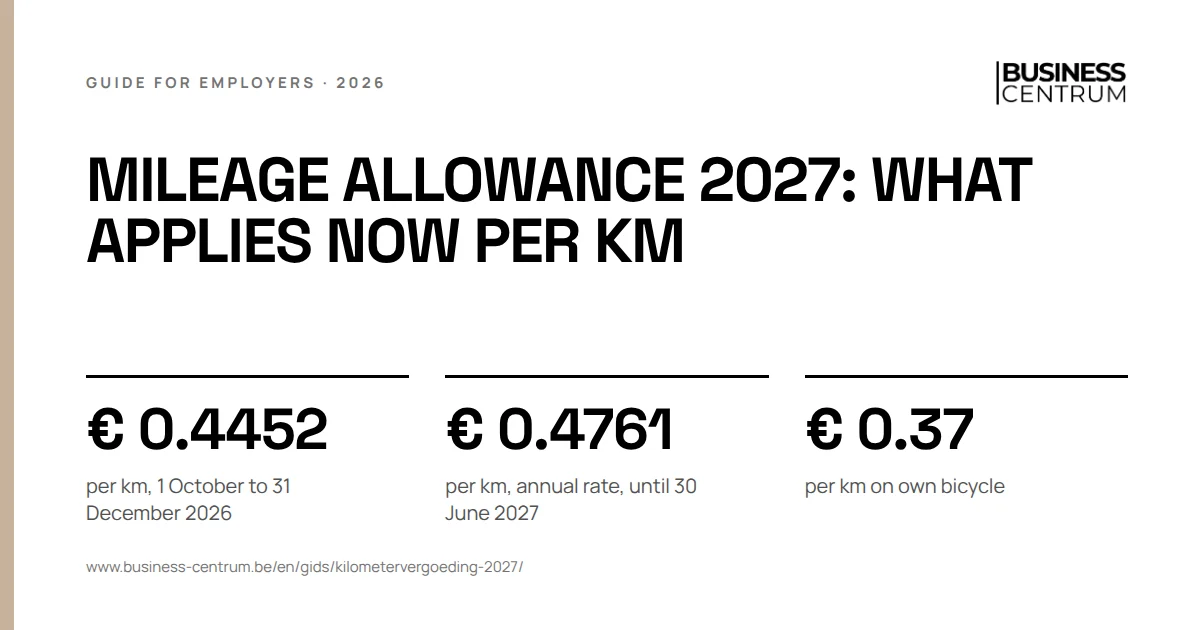
The mileage allowance 2027 has not been set yet: for business travel in their own car you pay until 31 December 2026 at most € 0.45 per km without NSSO contributions and without withholding tax, or € 0.48 per km if you choose the annual rate, which runs until 30 June 2027. Both amounts come from the federal government, which pays them to its own civil servants. The FPS Policy and Support (BOSA) publishes the quarterly rate for early 2027 in a circular in the Belgian Official Gazette. Until then, there is no official amount for 2027.
Mileage allowance 2027 and 2026: the rates per period
Since 1 October 2022, the federal government has adjusted its mileage allowance every quarter. In addition, there is an annual rate that always runs from 1 July to 30 June. The NSSO and the tax authorities accept both as the maximum for an allowance without contributions and without tax.
| Period | Rate per km |
|---|---|
| 1 January to 31 March 2026 | € 0.43 |
| April 2026 | € 0.46 |
| May 2026 | € 0.48 |
| June 2026 | € 0.51 |
| 1 July to 30 September 2026 | € 0.44 |
| 1 October 2026 to 31 December 2026 | € 0.45 |
| 1 January to 31 March 2027 | not yet set |
| Annual rate 1 July 2025 to 30 June 2026 | € 0.44 |
| Annual rate 1 July 2026 to 30 June 2027 | € 0.48 |
| Annual rate from 1 July 2027 | not yet set |
In the second quarter of 2026 a temporary measure applied because of the geopolitical situation in the Middle East: the rate was then revised every month, with retroactive effect. The tax authorities exceptionally allow employers who used the annual rate to switch to those monthly rates for April, May and June 2026. For the other months, the choice remains fixed.
How the mileage allowance is adjusted
The quarterly rate follows a fixed formula. The FPS BOSA starts from the rate of the previous quarter and splits it into two parts:
- 80% of the previous rate moves with the smoothed health index;
- 20% moves with the price of petrol and diesel.
For the fourth quarter of 2026, BOSA compared the average of July and August 2026 with that of the previous reference months. That is how € 0.44 per km became € 0.45. The rate is set out in circular no. 771 of 16 September 2026, published in the Belgian Official Gazette on 29 September 2026. The NSSO included it in its interim instructions, and the FPS Finance in circular 2026/C/92 of 15 October 2026.
The annual rate uses the same split, but always compares the month of May with May of the year before. That is how circular no. 767 of 8 June 2026 set it at € 0.48 per km. It appeared in the Gazette on 16 June 2026.
Quarterly rate or annual rate: which do you choose?
You choose one of the two systems. The quarterly rate follows fuel prices more quickly. The annual rate gives a fixed amount for twelve months and is simpler administratively. If you chose the annual rate in the third quarter of 2026, you have to stick with it until 30 June 2027. Switching to the quarterly rate is possible on 1 July 2027 at the earliest.
Worked example. In November 2026, a technician drives 1,200 km for client visits with his own car.
- At the quarterly rate: 1,200 x € 0.45 = € 534.24.
- At the annual rate: 1,200 x € 0.48 = € 571.32.
The annual rate gives him € 37.08 more that month. Both amounts are free of NSSO contributions and withholding tax. Which system works out more favourably over twelve months depends on the quarterly rates still to come.
Tax-free mileage allowance 2027: what the NSSO and the tax authorities accept
The rate per km is a maximum. You may pay less. To stay free of contributions and tax, these conditions apply:
- An own vehicle. The vehicle may not be yours and may not be financed by you. An employee with a company car does not receive a mileage allowance. What a company car costs and what the employee pays is explained in our guide to the benefit in kind of a company car.
- Real kilometres. The allowance follows the kilometres the employee actually drove for work. A fixed amount per month that has nothing to do with the distance is not a mileage allowance.
- All-in. The rate covers everything: fuel, maintenance, insurance. You do not reimburse those costs again separately.
- Business travel. This concerns trips for work: to a client, a site, a supplier or another branch.
For the tax authorities, the allowance is a non-taxable reimbursement of the employer's own costs if it is not higher than what the state pays its staff. That rule is set out in, among others, circular 2026/C/92. Other flat-rate allowances, such as for work clothing or meals on the road, are covered in our guide to the flat-rate expense allowance 2026.
Maximum mileage allowance 2027: what if you pay more per km?
If you pay more than the maximum, the part above it is pay for the NSSO. You pay contributions on it, unless you prove that the employee's actual costs are higher. The tax authorities only accept the allowance without proof up to the state's rate. Above that, you must be able to show the actual costs.
Take the same technician with 1,200 km in November 2026, but now at EUR 0.50 per km. He receives EUR 600. Of that, € 534.24 is a tax-free expense allowance. The difference of € 65.76 is pay for the NSSO, unless you show with invoices for fuel, maintenance and insurance that his costs per km are really higher.
Motorbike, moped and bicycle
The tax authorities accept the same rate per km for an own motorbike or moped. The NSSO speaks of travel with a private vehicle.
A different rate applies to the bicycle. For business travel on their own bicycle, including an electric bicycle or a speed pedelec, the NSSO accepts € 0.37 per km. The bicycle must belong to the employee. For commuting by bicycle, separate rules and an annual maximum apply, which you will find in our blog on the bicycle allowance.
The difference with commuting
Business travel is a trip for work. Commuting is the trip from home to the fixed workplace and back. The NSSO sets the same maximum per km for a private vehicle for both. The tax authorities do not: the circular on the mileage allowance covers business travel. An allowance for commuting in their own car falls under a separate, limited tax exemption. What you have to pay for commuting and what is exempt is explained in our blog on the commuting allowance.
If an employee works without a fixed workplace, as in construction, a sector collective bargaining agreement (CBA) may provide for a flat-rate mobility allowance. The NSSO accepts it if it is not higher than € 0.19 per km of distance between home and workplace, there and back. If it is higher, the entire allowance is pay.
What you need in writing
The NSSO may ask you how you calculate the allowance. Record the scheme in the work rules, a service note or an annex to the employment contract, and keep a trip log for each employee:
- the date of each trip;
- the starting point and the destination;
- the purpose of the trip, for example the client visit;
- the number of kilometres;
- the rate per km you applied and the system you chose, quarterly or annual.
On tax form 281.10, you report the exempt amount as a reimbursement of the employer's own costs.
Pitfalls
- Leaving the old rate in place. The quarterly rate changes on 1 January, 1 April, 1 July and 1 October. If you forget this when it falls, you pay too much and the difference becomes pay.
- Switching between systems. If you chose the annual rate, you may not switch when the quarterly rate turns out higher.
- Mixing up commuting and business trips. Different tax rules apply. Keep the two separate in the trip log.
- A flat rate without kilometres. A fixed monthly amount without a trip log will not hold up.
- The company car. A mileage allowance on top of a company car is pay.
What to check now
- Check which rate per km your payroll processing has applied since 1 October 2026: € 0.45 or the annual rate of € 0.48.
- Check whether you chose the annual rate in the third quarter of 2026. If so, that rate remains until 30 June 2027.
- Ask every employee who drives in their own car for a monthly trip log.
- Write "the maximum accepted by the NSSO" in your scheme instead of a fixed amount, if you always want to pay the maximum.
- Review the allowance again as soon as the quarterly rate for the first quarter of 2027 appears in the Gazette.
What Business Centrum does for you
Business Centrum processes your payroll together with Acerta, with one fixed contact person in Ghent who knows your file. In your payroll we process the mileage allowances you grant and adjust the rate per km as soon as the government changes it. Would you like to check whether your mileage allowance stays below the maximum? Request a call back.