
The JC 220 indexation in January 2027 falls on 1 January 2027: the wages of white-collar staff in the food industry rise in line with the four-month average of the health index of November 2026 against November 2025. So the percentage can already be calculated once Statbel publishes the November index on 27 November 2026. Below you read how the collective agreement calculates, which bonuses rise with it and how much wages have risen since 2021.
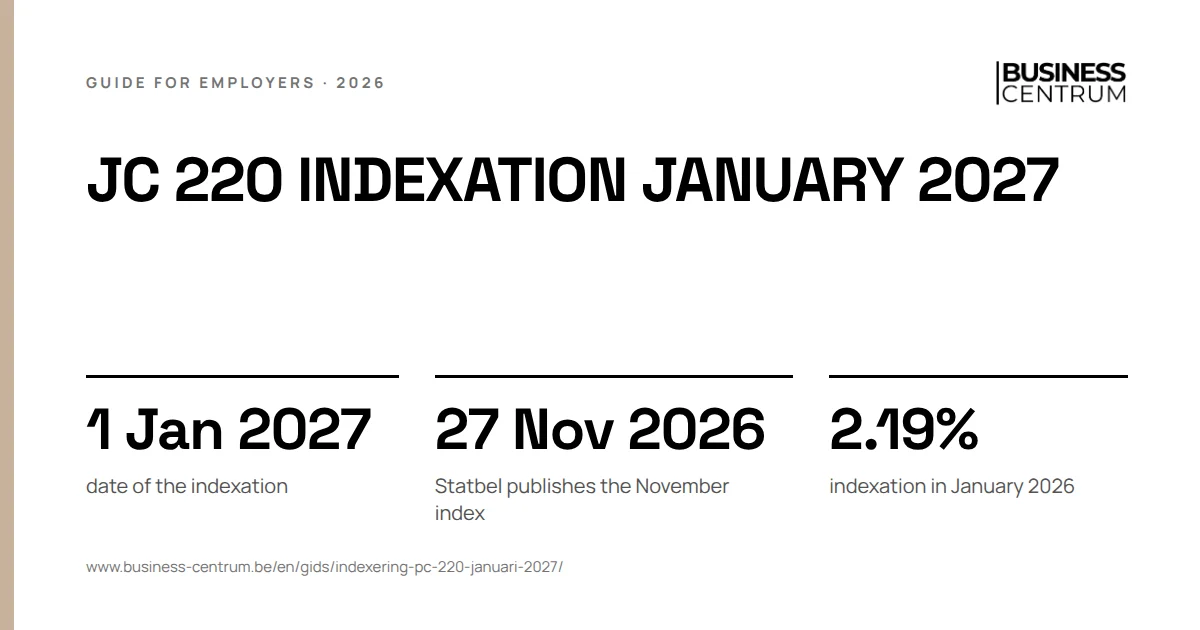
The percentage of the JC 220 indexation in January 2027
Until then there is no official percentage. The FPS database splits JC 220 into two subsectors, the vegetable canning industry and the other companies, each with its own pay scale but the same percentage. Their pages received their last edit after the January 2026 index on 20 January 2026.
Federal Planning Bureau forecast. In its inflation forecasts of 6 October 2026 the Planning Bureau estimates the smoothed health index at 102.35 points in November 2026. That is an estimate of the index, not a percentage for JC 220. The Planning Bureau does not calculate a sector percentage, and neither do we: the percentage only follows from Statbel's final figures. The next forecasts are published on 3 November 2026.
How does the indexation work in JC 220?
The rule is in the collective agreement of 5 December 2011 on linking pay to the index figure, which applies for an indefinite period. Every year on 1 January you adjust wages:
- Take the four-month average of the health index of November of the past year.
- Divide it by the same average of November a year earlier.
- The result minus 1, times 100, is the percentage. You round the indexed amounts to 2 decimals.
Statbel publishes that four-month average every month as the smoothed health index. According to the Federal Planning Bureau, that is the moving average of four months, times 0.98. For the change from November to November, that factor makes no difference.
What rises with it? The collective agreement speaks of the wages of white-collar staff, with no distinction between minimum and actual wage. The FPS database states that both the minimum wages and the actual wages are indexed. Since 1 January 2024 the sector bonuses and allowances of the 2023/2024 social programme also rise on 1 January, such as the supplementary allowance for long-term sickness and the clothing allowance.
Index first. If a negotiated pay rise coincides with the indexation, you calculate the indexation first and then the rise.
Blue-collar workers of the same company. Your blue-collar workers usually fall under JC 118, with the same formula. Their January index is on our page about the JC 118 indexation in January 2027.
JC 220 indexation history since 2021
This is how JC 220 wages rose on 1 January in recent years, according to the history in the FPS minimum wage database for subsector 220.00.02:
| Indexation on | Percentage |
|---|---|
| 1 January 2026 | 2.19% |
| 1 January 2025 | 3.57% |
| 1 January 2024 | 1.83% |
| 1 January 2023 | 10.96% |
| 1 January 2022 | 3.22% |
| 1 January 2021 | 1% |
In January 2023 wages rose by 10.96%: the index follows the prices of the past year, and those rose sharply in 2022. In January 2026 it was 2.19%. A past percentage predicts nothing: it only depends on prices up to and including November 2026.
What is already fixed for January 2027, and what is not?
What is already fixed:
- The date: 1 January 2027.
- The formula: the four-month average of the health index of November 2026 divided by that of November 2025.
- Who gets the rise: the minimum wages and the actual wages, plus the sector bonuses and allowances.
- The cents index: January 2027 is the first indexation in JC 220 since 1 June 2026.
What is not fixed yet:
- The percentage. It follows from the November 2026 index, published on 27 November 2026.
- The new pay scales of the two subsectors.
The cents index in the JC 220 indexation of January 2027
January 2027 is the first indexation in JC 220 since the cents index started on 1 June 2026. For a full-time reference wage above € 4,000 gross a month, the first 2% of indexation only counts on € 4,000. Anyone earning € 4,000 or less gets the full index.
- If the percentage is 2% or more, someone with a reference wage of € 4,500 gets € 80 (4,000 x 2%) on that first 2% instead of € 90. The part of the index above 2% applies to the full wage again.
- If the percentage is below 2%, the whole January index only applies to € 4,000, and the moderation continues until the indexations together reach 2%.
Meanwhile you pay a special wage moderation contribution to the NSSO. How to calculate it, with a full example, is in our piece on the cents index.
Worked example: how the January 2026 index worked
A white-collar employee earned € 3,200 gross a month at the end of 2025. On 1 January 2026 that rose by 2.19%: 3,200 x 1.0219 = € 3,270.08. In January 2027 you calculate the same way with the new percentage.
Where do you find the percentage for January 2027?
You find the percentage and the new amounts in these places:
- Statbel publishes the November 2026 index figure on 27 November 2026. With it, the formula of the collective agreement can be filled in completely.
- FPS Employment puts the percentage and the new amounts in the minimum wage database. The pages of the two subsectors were last edited after the 2026 index on 20 January 2026.
You then also see the new pay scales on our page with the JC 220 pay scale. The committee's standing rules, the pay scales and the bonuses are in our guide to joint committee 220. What a pay rise yields net for your employee is in our guide gross to net. How the 2026 index turned out per sector is in our news on wage indexation in 2026.
What Business Centrum does for you
Business Centrum applies the January 2027 indexation in JC 220 in your payroll administration, together with Acerta, with the percentage that follows from the collective agreement. We apply the percentage to the pay scale and the actual wage of each white-collar employee, index the sector bonuses and allowances with it and calculate the cents index per employee. All committees that index in January, with their formula, are in our overview of the January 2027 indexation.