
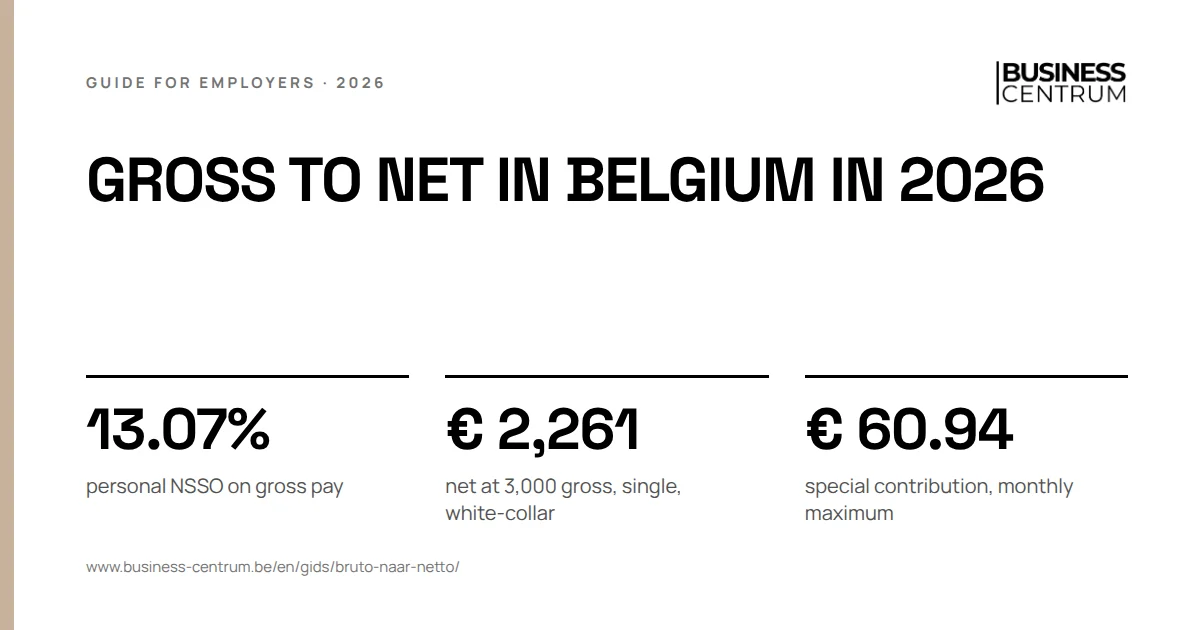
Gross to net in Belgium takes four steps: you deduct the personal NSSO contribution of 13.07%, reduced by the work bonus on low pay, then withholding tax and finally the special social security contribution. A full-time white-collar employee on € 3,000 gross, single and without children, takes home about € 2,261 net in 2026 this way.
Gross to net in four steps
| Step | What | On what |
|---|---|---|
| 1 | Personal NSSO contribution: 13.07% | gross pay, for a blue-collar worker on 108% |
| 2 | Work bonus: a reduction of that NSSO contribution | only for monthly pay up to € 3,403.62 |
| 3 | Withholding tax | taxable pay, after the NSSO contribution |
| 4 | Special social security contribution | quarterly pay, at most € 60.94 per month |
What remains is net pay. Meal vouchers, expense allowances and a benefit in kind appear separately on the payslip. How they affect net pay is explained further on.
Worked example: € 3,000 from gross to net salary
A full-time white-collar employee earns € 3,000 gross a month. He is single, has no dependent children, no company car and no meal vouchers.
| Amount per month | |
|---|---|
| Gross pay | € 3,000.00 |
| NSSO 13.07% | € 392.10 |
| Work bonus, part A | € 110.54 |
| Personal NSSO after the work bonus | € 281.56 |
| Taxable pay | € 2,718.44 |
| Withholding tax, after the tax work bonus of € 36.63 | € 438, rounded |
| Special social security contribution | € 19.24 |
| Net pay | € 2,261, rounded |
So of the € 3,000 gross, about three quarters remains net. On top of the gross pay, the employer also pays his own contributions: for this salary about € 3,585 a month in total. We work that out further on.
Gross to net at 2,500, 3,000, 3,500 and 4,000 euros
With the same method you can see how net pay grows with gross pay. Each time for a full-time white-collar employee, single, without dependent children, company car or meal vouchers, with the amounts that apply since September 2026:
| Gross pay per month | Net pay per month, rounded |
|---|---|
| € 2,500 | € 2,176 |
| € 3,000 | € 2,261 |
| € 3,500 | € 2,400 |
| € 4,000 | € 2,614 |
What stands out: from € 2,500 to € 3,000 gross, net pay rises by just under € 90. That is because the work bonus tapers off in that range. Every extra euro gross then also costs part of the work bonus, on top of the normal NSSO contribution and the higher withholding tax. Above € 3,403.62 the work bonus is gone completely and net pay grows more steadily again.
These amounts are worked examples. On a real payslip they can differ by a few euros through rounding, bonuses or a different working arrangement. With dependent children or a partner without income, net pay is higher.
Step 1: the personal NSSO contribution of 13.07%
Every employee pays a personal social security contribution of 13.07%. For a white-collar employee you calculate it on gross pay itself. For a blue-collar worker on 108% of gross pay.
The NSSO contribution is also deducted from most bonuses, such as an end-of-year bonus. On a white-collar employee's double holiday pay, a separate special contribution applies instead of the normal NSSO contribution. That is covered in our guide to holiday pay in 2026.
Step 2: the work bonus lowers the NSSO contribution on low pay
The work bonus is a discount on the personal NSSO contribution for low earners. It has two parts:
- Part B, very low pay: at most € 171.99 a month up to a reference monthly wage of € 2,300.62, then tapering to zero at € 2,937.93.
- Part A, low pay: at most € 127.54 a month up to € 2,937.93, then tapering by 0.27 per euro to zero at € 3,403.62.
At € 3,000 gross only part A still applies: € 127.54 minus 0.27 x (3,000 minus € 2,937.93) = € 110.54. On the minimum wage the work bonus even removes the personal NSSO contribution entirely, as our guide to the minimum wage in Belgium shows. How the amounts changed four times in 2026 is explained in our article on the work bonus 2026.
Part of the work bonus also comes back in withholding tax: 33.14% of part A and 63% of part B. This is called the tax work bonus.
Step 3: withholding tax under the key formula
Withholding tax is an advance on personal income tax. The employer deducts it every month and pays it over to the FPS Finance. The amount follows from a fixed calculation method, the key formula, which is adjusted every year:
- Taxable monthly pay is converted to an annual amount.
- The flat-rate professional expenses are deducted from it: 30% of gross annual income, up to a maximum of € 6,070.
- You apply the basic scale to the result, with rates from 26.75% to 53.50%, including the municipal tax of 7%. The brackets run up to € 16,710, € 29,500 and € 51,050.
- From that tax, € 2,987.98 is deducted, the tax on the tax-free allowance of € 11,170.
- Then come the reductions for the family situation, such as dependent children.
- The annual amount goes back to a monthly amount, minus the tax work bonus.
In the example of € 3,000 gross, this comes to about € 438 a month. What withholding tax is exactly, and when you declare and pay it, is explained in our article what is withholding tax.
Step 4: the special social security contribution
The last deduction is the special social security contribution. It depends on quarterly pay and on the household. A single person pays nothing below quarterly pay of € 5,836.14. Above that it rises on an NSSO scale. Per month the deduction is at most € 60.94.
In the example, quarterly pay is € 9,000, which gives € 19.24 a month. The deduction from pay is an advance: the final contribution follows in personal income tax. More on this in our article on the special social security contribution.
Gross vs net salary: what makes the difference bigger or smaller
Two employees with the same gross pay do not always have the same net pay. These are the biggest differences:
- Dependent children. They reduce withholding tax by a fixed amount per year, which rises with each child. A single parent gets an additional reduction.
- A partner without income. Then the marital quotient applies: part of the income, up to a maximum per year, is allocated to the partner. That lowers withholding tax.
- A company car. The benefit in kind counts towards taxable pay. Net pay falls, even though the employee receives no extra money.
- Meal vouchers. They sit outside net pay. The employer pays at most € 8.91 per voucher, the employee at least € 1.09, and that personal share is deducted from net pay.
- Bonuses. An end-of-year bonus or double holiday pay gets its own withholding tax scale, separate from monthly pay.
Net to gross: calculating backwards
Want to know which gross salary is needed for a given net amount? Then you calculate backwards. There is no simple reverse formula: the work bonus and the withholding tax brackets change with the pay. Anyone who wants to give € 100 more net therefore has to budget more than € 100 extra gross, and how much more depends on the pay level.
The quickest way is trial and error. Enter a gross salary in the gross-to-net calculator, look at the net amount and adjust the gross until you see the amount you want. For an offer to a candidate, we recommend having the final amount recalculated with the real family situation.
Gross to net salary for blue-collar workers, part-timers and company directors
Blue-collar workers. The steps are the same, but the NSSO contribution applies to 108% of gross pay and the work bonus has its own, higher amounts. The reference monthly wage for that work bonus is the pay at 100%, though. A blue-collar worker and a white-collar employee with the same gross pay therefore do not have exactly the same net pay. Our calculator works for a white-collar employee; for a blue-collar worker we are happy to calculate the net pay for you.
Part-time employees. The deductions apply to the part-time pay. For the work bonus, the NSSO first converts the part-time pay to a full-time reference monthly wage: the pay per declared hour multiplied by the hours of a full-time month. The discount is then adjusted to the hours worked.
Company directors and the self-employed. This guide is about employees with an employment contract. For a company director with a mandate, other rules apply. They are on our page about the status of the company director.
From gross to employer cost
Gross pay is not what an employee costs the employer. On top of gross pay you pay employer contributions: a basic contribution of 25%, reduced by the structural reduction for lower pay. For the white-collar employee on € 3,000 gross, the cost for the employer thus comes to about € 3,585 a month, without meal vouchers, holiday pay and end-of-year bonus.
The structural reduction is largest on low pay and disappears as pay rises. The NSSO calculates it per quarter, on the reference quarterly wage. On higher pay you therefore pay almost the full basic contribution.
As a result, the difference between what you pay and what the employee receives net is bigger than the difference between gross and net. The white-collar employee on € 3,000 gross costs you about € 3,585 and receives about € 2,261. If you are considering a pay rise, it is best to work out both sides: what it costs you extra, and what the employee keeps of it net.
What Business Centrum does for you
Business Centrum calculates your employees' pay every month together with Acerta, with the right NSSO contribution, work bonus, withholding tax and special contribution for their family situation. If you are considering a new hire or a pay rise, we work out the gross pay, the net pay and your cost for you. Request a call back.