
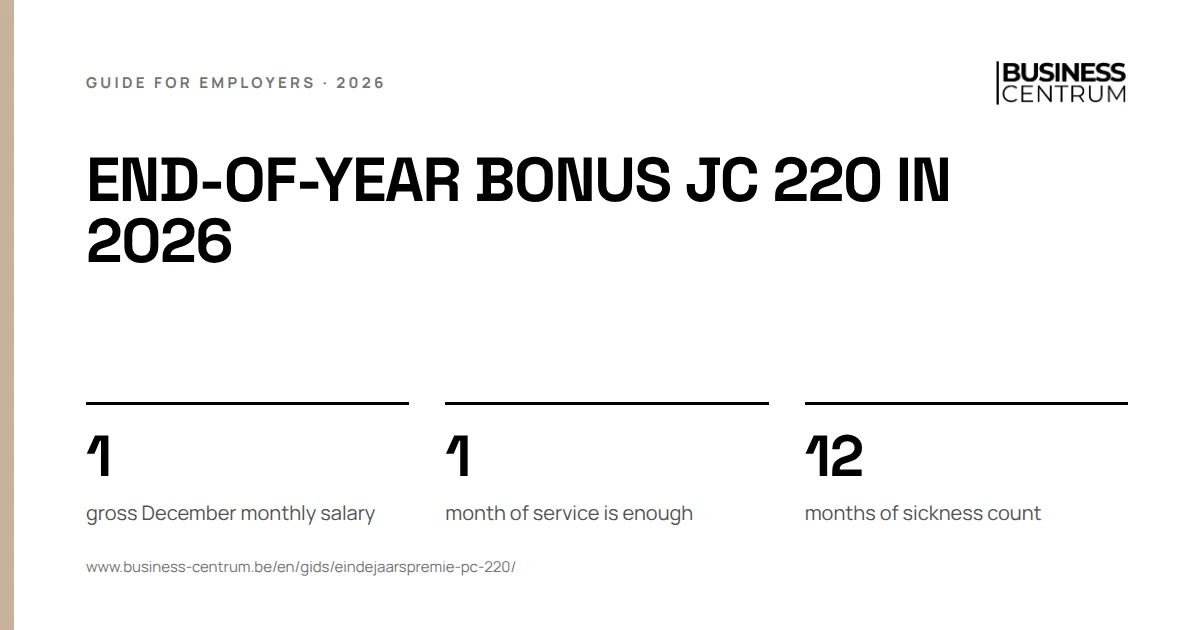
The end-of-year bonus in JC 220 is the gross December salary plus average variable pay, and you as the employer pay it yourself, before 25 December 2026, to those in service on 1 December 2026. The employee is entitled from 1 month of service in your company. Someone who did not work the whole year gets one twelfth per month of service.
Who gets the end-of-year bonus in JC 220?
The agreement has applied since 1 January 2025, for an indefinite period, to the employers and white-collar employees of the food industry: from breweries and dairies to biscuit factories, meat processors and chocolate makers. The blue-collar workers of the same companies fall under JC 118 and have their own rules. Whether your employees belong to this committee, you can read in our guide to joint committee 220.
Two kinds of companies fall outside this agreement:
- companies that grant an equivalent benefit, whatever it is called, as a contractual bonus or as a gift;
- companies that set the pay and working conditions of their employees themselves by agreement, if the benefits of that agreement together are at least equal to those of the sector agreement.
Do you already pay a thirteenth month or another annual bonus? Compare it with this agreement on amount, conditions and leaving. If it is at least equivalent, the sector agreement does not apply in your company.
The conditions for the employee are short. He has at least 1 month of service in the company. He is entitled to one twelfth of the bonus per month of service actually worked in the calendar year the bonus relates to. A full year therefore gives the full bonus.
How much is the end-of-year bonus in JC 220?
The bonus has three parts. Only pay subject to social security deductions counts:
- The fixed part: the gross monthly salary of December of the year in which you pay the bonus. That is 1 monthly salary: the December salary, not an average over the year. The minimum monthly salary per category is in the JC 220 pay scale for vegetable canning and for the rest of the food industry.
- The variable part: the monthly average of the variable pay the employee received from January to December. The agreement means pay directly linked to his work and subject to social security deductions.
- Benefits in kind subject to social security.
Bonuses or allowances granted in return for actual costs do not count.
The agreement says nothing separate about part-time employees. It only speaks of the gross December salary and one twelfth per month of service.
Worked example: an employee who started in June
This is an example, not a calculation for your situation. An employee earns € 3,000 gross a month and has no variable pay. He started on 10 June 2026. Because he started between the 1st and the 15th of the month, June counts in full. He therefore has seven twelfths: June to December. His end-of-year bonus is 3,000 x 7/12 = € 1,750 gross. Had he started on 20 June, June would not count and he would get 3,000 x 6/12 = € 1,500 gross.
When do you pay the end-of-year bonus in JC 220?
The agreement sets two moments, unless your company agrees otherwise:
- before 25 December 2026 to the employees in service on 1 December 2026;
- at the moment of leaving for the other employees.
The bonus goes through the normal payroll, with 13.07% personal social security and withholding tax under the scale for exceptional payments. What your employee keeps net and what the bonus costs you on top of the basic contribution of 25%, you can check with our explanation of calculating the end-of-year bonus.
Which absences count for the end-of-year bonus in JC 220?
The bonus follows the months of service actually worked. A long list of absences counts as worked:
| Absence | Counts for the bonus |
|---|---|
| Sickness or non-work accident | up to 12 months |
| Workplace accident or occupational disease with compensation | yes; for partial incapacity after full incapacity: 12 months |
| Maternity leave, maternity protection and breastfeeding breaks | yes |
| Paternity leave, birth leave, adoption leave and foster care leave | yes |
| Statutory and contractual holidays, public holidays and replacement days | yes |
| Temporary unemployment | yes |
| Short leave, prophylactic leave, civic duties, public office | yes |
| Trade union duties and training, judge or counsellor in labour courts | yes |
| Social advancement courses, paid educational leave and Flemish training leave | yes |
| Strike or lock-out, military obligations of EU citizens | yes |
For sickness, a joint comment applies. If the employee returns part-time under a gradual return to work, with the approval of the medical adviser, the assimilation continues as long as the full incapacity and the part-time return together last no longer than 12 months. Those months count in full, not half: six months of half-time return are six assimilated months.
Months of unemployment with company top-up are an exception. They give a right to 20% of the remaining bonus, until 31 December of the current year.
For each day of unjustified absence you may deduct a percentage of the bonus, if the works council, the trade union delegation or the work rules set that percentage.
End-of-year bonus JC 220 on dismissal or leaving
If an employee leaves during the year, you pay the bonus at the moment of leaving. The month of leaving counts if he leaves after the 15th of the month. The agreement names two cases in which the employee loses his right:
| Situation | What the agreement says |
|---|---|
| Dismissal for serious misconduct | loss of the right |
| Resignation during the first year of service | loss of the right |
| Resignation after 1 year of service | not a ground for loss: pro rata bonus |
| Dismissal by the employer for another reason | not a ground for loss: pro rata bonus |
| Leaving after an act of the employer equal to breach of contract | does not count as voluntary leaving |
| End due to force majeure from an occupational disease or workplace accident | does not count as voluntary leaving |
| Unemployment with company top-up | 20% of the remaining bonus until 31 December |
| End of a fixed-term contract, retirement, mutual agreement | the agreement does not expressly cover these cases |
For the last row the agreement gives no answer. It does not list these cases among the grounds for loss, nor separately. If in doubt, ask for advice before you prepare the final settlement.
Example. An employee with a € 3,000 monthly salary and three years of service resigns and leaves on 20 September. He is past his first year of service, so he keeps his right. September counts because he leaves after the 15th: 3,000 x 9/12 = € 2,250 gross, payable when he leaves. This is an example, not a calculation for your situation.
What can your company arrange itself?
The agreement leaves room on four points:
- An equivalent benefit or its own agreement. The sector agreement then does not apply, as described above.
- A more favourable or equivalent calculation. Special agreements in your company that calculate this way remain in force.
- A deduction per unjustified absence. Only through the works council, the trade union delegation or the work rules.
- A different payment moment. The two payment moments apply unless other arrangements are agreed at company level.
Mistakes we see with the end-of-year bonus in JC 220
- Taking only the fixed salary. The monthly average of the variable pay over the whole year belongs in it.
- Including cost allowances. Allowances for actual costs stay outside the bonus.
- Deducting temporary unemployment. Those days count as service worked.
- Forgetting the month of joining. Someone who starts between the 1st and the 15th gets that month in full.
- Refusing the bonus to someone who resigns. After the first year of service, resignation is not a ground for loss.
What Business Centrum does for you
Business Centrum calculates the end-of-year bonus of your employees under this agreement, together with Acerta, as part of your payroll administration. We track the assimilated months, include the variable pay and put the bonus in the final settlement when someone leaves. The rules of the other committees are in our overview of the end-of-year bonus in 2026 per joint committee.