
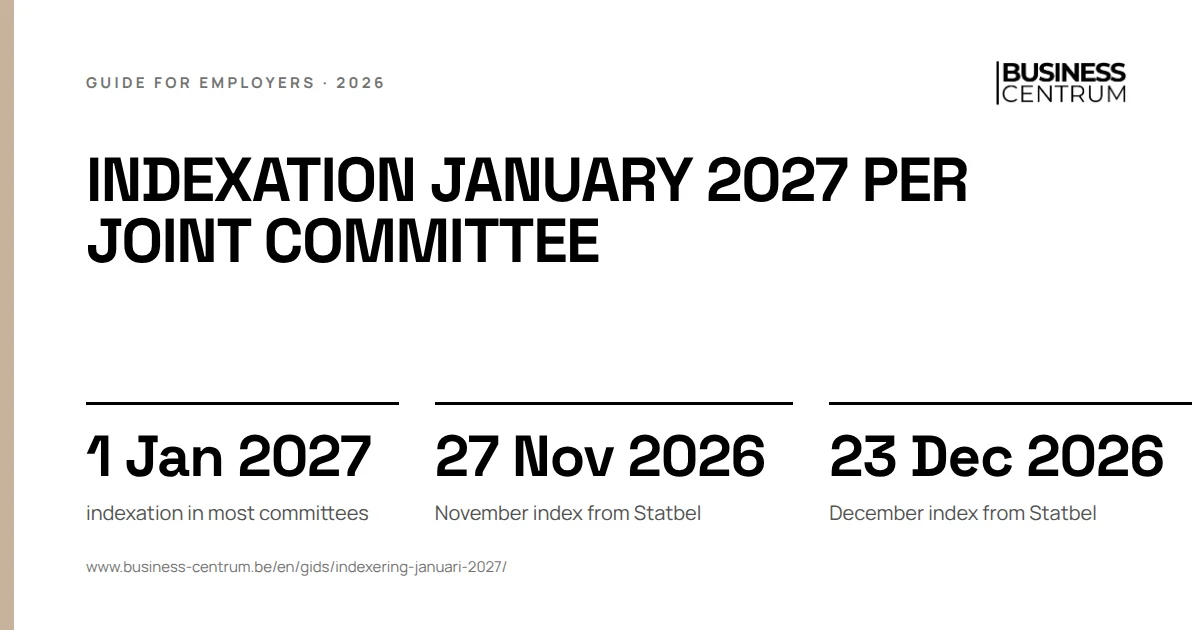
The indexation of January 2027 falls on 1 January 2027 for most joint committees with a January index, but the percentage differs per committee and is not known yet. Each committee follows its own collective agreement: one compares the November index with that of a year earlier, another uses December, yet another the average of two months. Below you see per committee when wages rise, under which formula, when the percentage can be calculated and how much it was last year. Each committee has its own page with the collective agreement as the source.
Indexation January 2027: the overview per joint committee
| Committee | Sector | Indexation | Formula in the collective agreement | Can be calculated from | January 2026 |
|---|---|---|---|---|---|
| JC 200 | White-collar staff (auxiliary committee) | 1 January | average Nov + Dec 2026 against Nov + Dec 2025 | 23 December 2026 | 2.21% |
| JC 226 | White-collar staff in international trade, transport and logistics | 1 January | December 2026 against December 2025 | 23 December 2026 | 2.23% |
| JC 341 | Intermediation in banking and investment services | 1 January | average Nov + Dec 2026 against Nov + Dec 2025 | 23 December 2026 | 2.21% |
| JC 335 | Services to and support of businesses | 1 January | average Nov + Dec, fixed pay up to a ceiling | 23 December 2026 | 2.21% |
| JC 306 | Insurance | 1 January | index December 2026 against December 2025 | 23 December 2026 | 2.23% |
| JC 119 | Food trade (blue-collar) | 1 January | reference index December 2026 against December 2025 | 23 December 2026 | 2.21% |
| JC 149.01 | Electricians (blue-collar) | 1 January | social index December 2026 against December 2025 | 23 December 2026 | 2.23% |
| JC 302 | Hospitality | 1 January | November 2026 against November 2025 | 27 November 2026 | 2.19% |
| JC 118 | Food industry (blue-collar) | 1 January | November 2026 against November 2025 | 27 November 2026 | 2.19% |
| JC 220 | Food industry (white-collar) | 1 January | November 2026 against November 2025 | 27 November 2026 | 2.19% |
| JC 140.03 | Road haulage and logistics (blue-collar) | 1 January | November 2026 against November 2025 | 27 November 2026 | 2.18% |
| JC 145 | Horticulture | 1 January, sometimes also 1 July | November 2026 against November 2025 | 27 November 2026 | 2.19% |
| JC 121 | Cleaning | 1 January and 1 July | average Nov + Dec against May + Jun 2026 | 23 December 2026 | 0.56% |
| JC 124 | Construction (blue-collar) | every quarter | average Oct + Nov against Jul + Aug 2026 | 27 November 2026 | 0.22% |
"Can be calculated from" is the day on which Statbel publishes the last index figure the collective agreement needs. That is not a publication of the percentage itself. The official percentage then appears in the minimum wage database of FPS Employment, sometimes also with the joint committee or the social fund. Each committee page says where.
The table summarises and does not replace the collective agreement. The text of the collective agreement and what the sector itself announces take precedence. A company agreement or an arrangement within your company can deviate, for example with its own indexation system that the sector agreement allows. Read also how we show official data.
Four kinds of formula for the January 2027 indexation
According to their collective agreement, almost all committees in the overview follow the health index, usually in its smoothed form: the average of four months, which Statbel publishes every month. The collective agreement of JC 306 only speaks of the December index, that of JC 341 of the smoothed index figure. And the committees look at different months.
- November against November. Hospitality (JC 302), the food industry (JC 118 and 220), road haulage (JC 140.03) and horticulture (JC 145) compare the index of November 2026 with that of November 2025. Their percentage is known first.
- December against December. JC 226, insurance (JC 306) and the electricians (JC 149.01) compare December 2026 with December 2025.
- The average of November and December. JC 200, JC 341 and JC 335 take the average of two months. JC 119 works with a reference index figure based on the same two months.
- More than one step a year. Cleaning (JC 121) indexes in January and in July, each time over half a year. Construction (JC 124) indexes every quarter. Their January step is therefore smaller than that of committees that index only once a year.
That is why the percentages are close together but rarely equal. In January 2026 JC 200 received 2.21%, JC 226 2.23% and hospitality 2.19%.
When is the January 2027 indexation percentage known?
| Date | What is published | For whom |
|---|---|---|
| 29 October 2026 | Statbel: index of October 2026 | construction (JC 124), first month of the numerator |
| 3 November 2026 | Federal Planning Bureau: new inflation forecasts | forecast, no percentage |
| 27 November 2026 | Statbel: index of November 2026 | JC 302, 118, 220, 140.03, 145 and 124 |
| 23 December 2026 | Statbel: index of December 2026 | JC 200, 226, 341, 335, 306, 119, 149.01 and 121 |
| December and January | FPS Employment: percentage and pay scales in the minimum wage database | all committees, on different days |
The minimum wage database does not keep up equally fast for every committee. The pages with the January 2026 index received their last edit on very different days: JC 140.03 as early as 9 December 2025 and JC 145 on 9 December 2025, JC 200 on 19 January 2026, JC 118 on 3 February 2026 and JC 335 only on 30 April 2026. If you calculate yourself, use the same index series and the same rounding as the sector. When in doubt, the percentage that the sector or FPS Employment publishes takes precedence.
Federal Planning Bureau forecast for January 2027
The Federal Planning Bureau publishes inflation forecasts every month, with an estimate per month. In its forecasts of 6 October 2026 it estimates the smoothed health index at 101.78 points in October, 102.35 points in November and 102.92 points in December 2026.
Those are estimates of the index, not percentages per committee. The Planning Bureau does not calculate a sector percentage, and neither do we: your committee's percentage only follows from Statbel's final figures and the formula of your collective agreement. The next forecasts are published on 3 November 2026.
The cents index in the January 2027 indexation
The cents index has applied since 1 June 2026. For a full-time reference wage above € 4,000 gross a month, the first 2% of indexation only counts on € 4,000. After that, the index applies to the full wage again. Anyone earning € 4,000 or less gets the full index. The moderation starts at the committee's first indexation after 1 June 2026.
- For most January committees 1 January 2027 is that first indexation. That applies to JC 200, 226, 302, 118, 119, 220, 140.03, 145, 149.01, 306, 335 and 341.
- In cleaning (JC 121) the first indexation was that of 1 July 2026, with 2.07%. The moderation was then already complete, so in January 2027 the index applies to the whole wage again.
- In construction (JC 124) the moderation ran from 1 July 2026. The July and October steps, 1.10% and 0.83%, together did not reach 2%. So in January 2027 part of the index still only counts on € 4,000.
Meanwhile you pay a special wage moderation contribution to the NSSO. How it works, with a worked example, is in our piece on the cents index.
Who gets the rise: the percentage or an amount?
In most committees the minimum wages and the wages you actually pay rise by the same percentage. If you pay above the pay scale, you also index that higher wage. A few committees deviate:
- The same amount instead of the percentage. In road haulage (JC 140.03), insurance (JC 306) and construction (JC 124), a wage above the minimum receives the rise in euros of the minimum, not the percentage on its own wage.
- A limit. In JC 226 actual salaries only rise up to the final salary of class 8. In JC 335 the supplementary sector rule only indexes the fixed monthly wage up to € 3,750 full-time, and only in companies without their own indexation system.
- Only the fixed part. In JC 200, with partly variable pay you only index the fixed part.
- Bonuses and allowances too. In JC 140.03 the subsistence allowances and other allowances rise as well, in JC 220 the sector bonuses and allowances, in cleaning the bonuses.
Rounding differs too: to four decimals for an hourly wage in hospitality, to three in construction, to the euro cent in most other committees. The rule per committee is on the committee page.
What the January 2027 indexation costs you
Each indexation raises your payroll cost for the whole year, and through the end-of-year bonus and holiday pay also those extra months. How to calculate the cost of one percent of indexation for a white-collar employee is in our news on wage indexation in 2026. What a pay rise yields net for your employee is in our guide gross to net. The pay scales per committee, as FPS Employment publishes them, are in our overview of the pay scales.
Your committee is not on the list?
Then your committee probably indexes at another moment or with another system. Metalworking, for example, indexes in July, independent retail each time its own pivot index is reached. An overview of that calendar per sector is in our piece on wage indexation in 2026. Which committee applies to your employees is explained in our piece on the right joint committee.
We only include committees whose rule we could take from the collective agreement and for which employers look up the January percentage. If a committee is not included, that does not mean it has no January index.
What Business Centrum does for you
Business Centrum applies the January 2027 indexation in your payroll administration, together with Acerta, according to the collective agreement of each employee's committee. We apply the percentage or the amount as the sector requires, calculate the cents index per employee and give you an estimate of your 2027 payroll cost in December.