
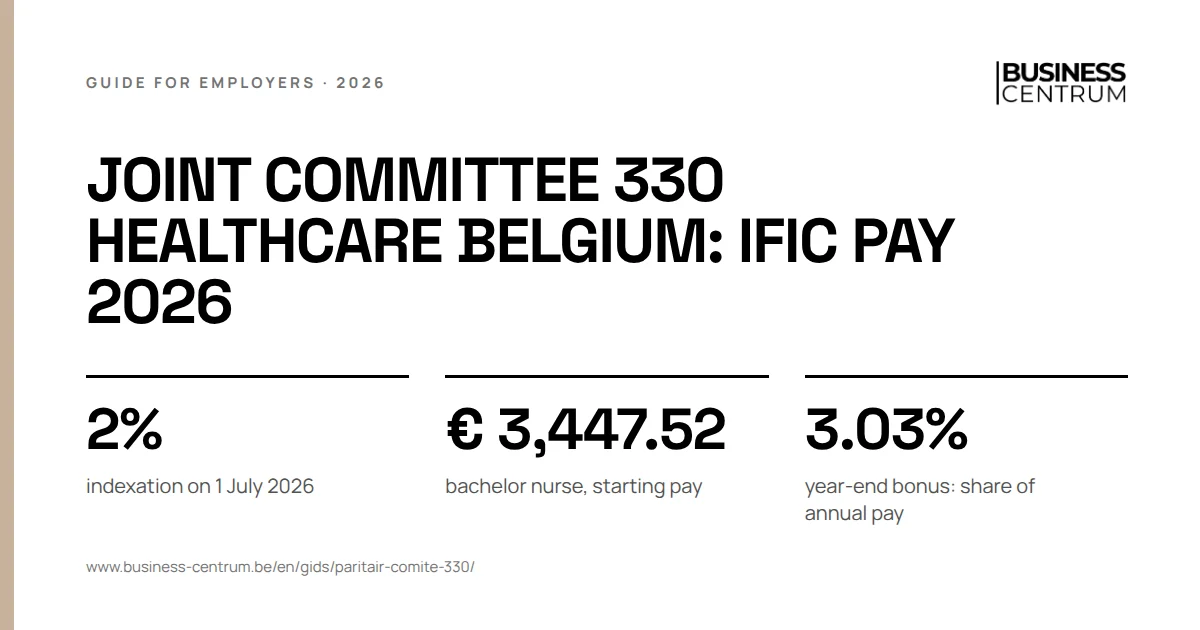
Joint committee (JC) 330 covers private healthcare in Belgium: hospitals, care homes, home nursing and the practices of doctors, dentists and physiotherapists. On 1 July 2026 salaries rose by 2%. A nurse with a bachelor's degree starts on the IFIC scale at € 3,447.52 gross per month. Practices without their own collective agreement follow the 330.99 scale.
Who falls under joint committee 330?
JC 330 covers all employees, blue-collar and white-collar, of institutions and services that provide medical, preventive or hygiene care, of medical and sanitary services, of institutions for social, mental or physical healthcare and of dental prosthetics firms. The scope lists, among others:
- hospitals, psychiatric care homes and rehabilitation centres;
- old people's homes, nursing homes, service flats and day care centres for the elderly;
- home nursing services and palliative home care teams;
- community health centres and polyclinics;
- the practices of GPs, specialists, dentists, physiotherapists and other paramedical professionals;
- clinical biology labs, non-emergency patient transport and the external services for prevention and protection at work.
Since 1 January 2008 the former JC 305 no longer exists in NSSO declarations either. Three committees replaced it. Working in care does not automatically mean JC 330:
| Situation | Committee |
|---|---|
| Hospital, care home, home nursing, rehabilitation centre | JC 330 |
| GP, dentist or physiotherapy practice | JC 330 |
| Childcare, mental health centre or primary care zone recognised by Flanders | JC 331 |
| The same welfare services recognised by the French or German-speaking Community | JC 332 |
| Family care or additional home care service | JC 318 |
| Non-profit organisation for which no other committee is competent | JC 337 |
Profit motive plays no role in JC 330: a private clinic with shareholders and a non-profit hospital fall under the same committee. The auxiliary committee JC 337 only applies to a non-profit organisation that no other committee covers. How a committee is determined is explained in what a joint committee is.
330.01, 330.04 or 330.99: which code applies in joint committee 330?
JC 330 has no joint subcommittees. The numbers with a dot are subdivisions, and two authorities each use their own series. The minimum wage database of the FPS Employment splits the committee into subsectors by type of institution. The NSSO asks for a different code in the DmfA, because declaring JC 330 without a subdivision is not possible.
| Activity | Minimum wage database | DmfA code |
|---|---|---|
| Private hospital, psychiatric care home | 330.01 | 330.01.10 |
| Old people's home, nursing home, service flat, day care | 330.02 | 330.01.20 |
| Home nursing | 330.04 | 330.01.30 |
| Community health centre | 330.06 | 330.01.53 or 330.01.54 |
| Dental prosthetics | 330.07 | 330.03 |
| Doctor's, dentist's or physio practice, lab, patient transport | 330.99 | 330.04 |
How does the IFIC pay scale work in joint committee 330?
IFIC is the job classification of the care sector. Each job is matched to a sector reference role, and each reference role sits in a category with its own scale. The job decides the category, not the diploma. There is one exception: in category 14, nurses with a bachelor's degree get scale 14 and nurses with a lower level of training get scale 14B. A care assistant (zorgkundige) is in category 11.
The IFIC scale applies to anyone who joined or changed job from:
- 1 May 2018 in the federal sectors: hospitals, home nursing, community health centres and the Red Cross blood services;
- 1 November 2019 in the Flemish sectors, such as care homes and psychiatric care homes;
- between 17 October 2022 and 16 January 2023 in the Brussels sectors;
- 9 January 2023 in the Walloon private sectors.
Since 1 July 2021 the IFIC scale has applied in full in the federal and Flemish sectors. A new hire has no choice and starts on the IFIC scale straight away. Only a nurse who received a premium for a special professional title or qualification (BBT-BBK) from a previous employer is an exception. Staff already employed could choose once, in writing and within 1 month of receiving the employer's information. That choice cannot be undone.
The IFIC target scales since the July 2026 index, gross per month for a full-time job of 38 hours a week:
| IFIC category | Start | After 10 years | After 20 years |
|---|---|---|---|
| 4 | € 2,512.05 | € 2,865.16 | € 3,022.50 |
| 6 | € 2,563.35 | € 2,962.84 | € 3,153.59 |
| 8 | € 2,674.81 | € 3,128.18 | € 3,370.41 |
| 11 (care assistant) | € 2,949.72 | € 3,428.47 | € 3,654.87 |
| 12 | € 3,083.46 | € 3,687.09 | € 4,062.60 |
| 13 | € 3,187.48 | € 3,948.64 | € 4,398.66 |
| 14B (nurse, below bachelor) | € 3,187.48 | € 4,061.55 | € 4,533.27 |
| 14 (nurse, bachelor) | € 3,447.52 | € 4,447.70 | € 5,022.97 |
| 15 | € 3,692.71 | € 4,758.33 | € 5,374.51 |
The full table runs from category 4 to 20 and up to 35 years' seniority. IFIC, the non-profit body set up by the social partners, publishes it at every index, with a calculator that sets the IFIC scale next to the old pay scale. The IFIC scale already includes the household or residence allowance, the function supplement and the function allowance. Staff who stayed on the old scale still receive those items separately.
Pay scale in JC 330.99: practices and labs
Institutions without their own collective agreement, including the practices of doctors, dentists and physiotherapists, apply the collective agreement of 22 January 2024 on pay and working conditions. The IFIC scale does not apply there. The minimum wage database shows these scales as 330.99. They are built per staff group and category, with a step for each year of seniority. Gross per month, full time:
| Group and category | Start | After 10 years | After 20 years |
|---|---|---|---|
| Administrative staff, category 1 | € 2,433.92 | € 2,506.47 | € 2,618.10 |
| Administrative staff, category 3 | € 2,494.13 | € 2,812.31 | € 3,315.55 |
| Administrative staff, category 5 | € 2,872.01 | € 3,664.52 | € 4,529.98 |
| Technical and paramedical staff, category 3 | € 2,602.96 | € 2,876.02 | € 3,183.12 |
| Technical and paramedical staff, category 5 (higher technical education) | € 2,879 | € 3,755.75 | € 4,626.42 |
| Nursing staff, category 3 (including hospital assistants) | € 2,602.96 | € 2,876.02 | € 3,183.12 |
| Nursing staff, category 5 (graduate nurse, midwife) | € 2,687.38 | € 3,152.66 | € 3,717.86 |
Blue-collar workers have hourly wages, from € 14.78 for category 1 at entry to € 17.71 for category 5 after twenty years. A white-collar employee's hourly wage is the annual salary divided by 1,976 hours. Nobody may earn less than the guaranteed minimum monthly wage of € 2,366.98, household and residence allowance included.
If your staff work on a Saturday, Sunday or public holiday, at night or on a split shift, you pay a 20% supplement on the actual wage for those hours. A split shift is a day shift with a break of at least 4 consecutive hours; the supplement then applies to the hours before and after the break.
So a nurse with a bachelor's degree starts at € 2,687.38 in a practice, and at € 3,447.52 in a hospital or home nursing. The scale is a minimum: you can always pay more.
Joint committee 330 indexation in 2026
Salaries in JC 330 follow the pivot index. Each time the smoothed health index reaches the next pivot index, they rise by 2% in the following month. Both minimum wages and the wages you actually pay go up.
| Indexation | Percentage |
|---|---|
| 1 July 2026 | 2% |
| 1 January 2026 | 2% |
| 1 February 2025 | 2% |
| 1 May 2024 | 2% |
The July 2026 index was the first under the cents index, which has applied since 1 June 2026. The 2% now only applies to the slice up to € 4,000 gross per month, full time. Above that, the rise is at most € 80. In care, a nurse reaches that threshold quickly: in category 14 the IFIC scale is already € 4,015.77 after five years. For a part-timer, you use the full-time salary to see whether the threshold is reached. The rule and its exceptions are explained in our article on the cents index.
Joint committee 330 year-end bonus
In JC 330 the year-end bonus depends on the sector and on the community that recognises your institution. In the federal and Flemish sectors it follows the same pattern: an indexed flat-rate part plus 3.03% of gross annual pay. That annual pay is twelve times the scale salary for October, including any household or residence allowance.
| Sector | Flat-rate part | Percentage part |
|---|---|---|
| Federal sectors: hospitals, home nursing, community health centres | € 1,057.56 plus € 400 (2022 amounts, indexed every year since) | 3.03% |
| Flemish sectors: care homes, psychiatric care homes, sheltered housing, rehabilitation | € 1,271.26 plus an additional flat rate of € 480.83 (2025 amounts) | 3.03% |
The flat rate rises every year by the ratio between the October index and that of October the year before. The rules:
- Reference period: January to September inclusive of the year of payment.
- Pro rata: anyone who did not work the whole reference period, or works part time, gets a share in proportion to the work performed and periods treated as work.
- Payment: in one go, by December at the latest, or in the month the employee leaves.
- No entitlement: on dismissal for serious misconduct and for work under a student contract.
And the attractiveness bonus? In the federal and Flemish sectors it no longer exists as a separate bonus. The Flemish sectors folded it into the year-end bonus from 2,018, the federal sectors from 1 January 2022. Some Walloon and Brussels sectors still have their own collective agreements, sometimes with a separate attractiveness bonus. There, check the agreement for your own sector.
For practices under 330.99 we found no sector-wide year-end bonus in the collective agreement database. Whatever you promise in the employment contract or the work rules, you must pay. The calculation per sector, with NSSO contributions and payroll tax on the bonus, is in calculating the year-end bonus.
Example: year-end bonus for a care assistant in a care home
A care assistant works full time in a Flemish care home, has five years' seniority and is paid on the IFIC scale in category 11. Her October salary is € 3,226.11 gross. She worked the whole reference period.
- Gross annual pay: 12 x 3,226.11 = € 38,713.32.
- Percentage part: 3.03% of € 38,713.32 = € 1,173.01.
- Flat-rate parts at 2025 amounts: € 1,271.26 + € 480.83 = € 1,752.09.
- Year-end bonus: € 1,173.01 + € 1,752.09 = € 2,925.10 gross.
In 2026 the flat-rate part will come out slightly higher, because it is adjusted to the October 2026 index. If the same care assistant works half time, she gets half: € 1,462.55. A home nurse with the same seniority, in category 14 at € 4,015.77, receives as the percentage part 3.03% of 12 x 4,015.77 = € 1,460.13, plus the federal flat rate.
Flexi-jobs and students in joint committee 330
Since 1 July 2026 flexi-jobs have in principle been open in almost every sector. Tasks covered by the law on healthcare professions remain excluded. A flexi-job worker can therefore do reception, kitchen, cleaning or admin work in a care home or practice, but no care. You pay a special contribution of 28% on the flexi wage plus 7.67% flexi holiday pay. More in our article on flexi-jobs in all sectors.
In the federal and Flemish sectors, a working student has no right to the year-end bonus for hours worked under a student contract. If the student later joins on an ordinary employment contract, they count from then on.
Pitfalls in joint committee 330
- The wrong code. The DmfA code and the number in the minimum wage database differ. A practice that applies the home nursing scale, or the other way round, pays too much or too little.
- Household allowance on top of IFIC. The household or residence allowance is already included in the IFIC scale. Adding it again means paying it twice.
- A new hire on the old scale. In the federal and Flemish sectors, everyone hired since 1 July 2021 starts on the IFIC scale. The old scale only remains for staff already employed who did not choose.
- Not keeping the IFIC choice on file. The choice of an employee already in service is irreversible. Keep the written answer and the information you gave in the personnel file.
- Not checking seniority. An employee who changes job within your business keeps their scale seniority. For experience with previous employers, a sector agreement from 1975 applies. Check which service counts before you set the starting salary.
- Applying the cents index to the whole salary. Above € 4,000, the index only applies to the slice up to that threshold. Payroll software that still indexes the whole salary pays too much.
- Forgetting the supplement in a practice. Under 330.99 the 20% supplement also applies to a practice that opens on Saturday morning.
Checklist: a new employee in joint committee 330
- Determine your institution's activity and the community that recognises it: federal, Flemish, Brussels or Walloon.
- Choose the right DmfA code and look up the scale under the right number in the minimum wage database.
- In an IFIC institution, assign the sector reference role and record the category in the employment contract.
- Calculate scale seniority according to the sector rules, including experience with previous employers.
- For a nurse, ask whether there was a BBT-BBK premium.
- Record the hours that carry a supplement: Saturday, Sunday, public holiday, night and split shift.
- Plan the year-end bonus for December, based on the October salary.
What Business Centrum does for you
Business Centrum handles the payroll of JC 330 employers, together with Acerta. We check which DmfA code and which scale fit your institution or practice, record each employee's category and seniority, apply every index with the cents index threshold and calculate the year-end bonus under your sector's collective agreement.