
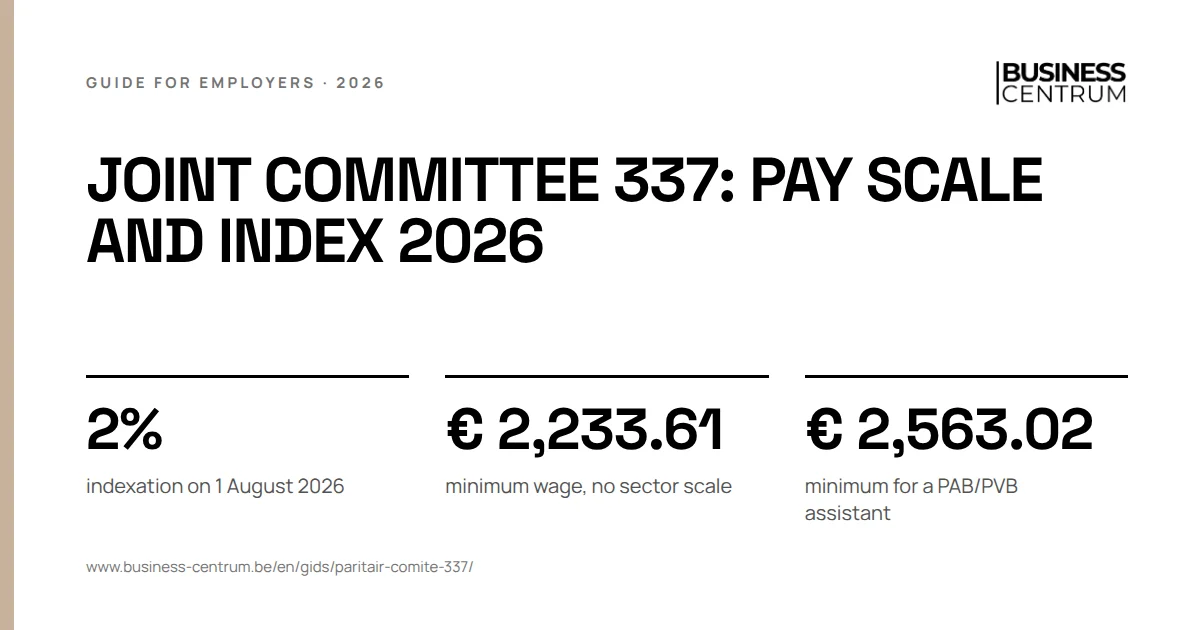
Joint committee 337 is the supplementary committee for non-profit associations (vzw/ASBL) and other non-profit organisations that no other committee covers. There is no general sector pay scale: you pay at least the GGMMI of € 2,233.61 gross a month. On 1 August 2026, all wages rose by 2%. The year-end bonus is a fixed amount plus 2.50% of twelve times the October wage.
Who falls under joint committee 337?
JC 337 has existed since the royal decree of 14 February 2008. Its scope has three parts.
- Non-profit organisations whose activity does not fall under another committee that is specifically competent for it. "Non-profit" here means: without the aim of making a profit.
- Private individuals who employ staff on their own account for their personal service or that of their household. Think of someone with a Flemish personal assistance budget (PAB) or person-linked budget (PVB) who hires an assistant directly. Agricultural, horticultural and forestry work is excluded, as is domestic staff under a domestic worker contract.
- JC 337 is not competent for the representative trade unions and employers' organisations, or for non-profit organisations that fall under another committee as their main or secondary activity.
JC 337 is therefore a safety net. In its interpretation notes, FPS Employment has settled a few borderline cases. A health insurance fund (mutualiteit) falls under JC 337, not JC 330. A PAB budget holder falls under JC 337, not JC 319.01, even though the assistant works in disability care. An association that organises reflection groups falls under JC 337; if it also offers meals or accommodation, those staff move to JC 302, the hotel and catering industry.
| Activity of the organisation | Committee |
|---|---|
| Hospital, care home, home nursing, rehabilitation centre | JC 330 |
| Educational and residential institutions: youth care, services for people with disabilities | JC 319 (319.01 in Flanders) |
| Socio-cultural sector: youth work, socio-cultural adult education | JC 329 |
| Flemish welfare and healthcare sector, childcare included | JC 331 |
| French- and German-speaking welfare and healthcare sector | JC 332 |
| Domestic staff under a domestic worker contract | JC 323 |
| Health insurance fund, PAB or PVB budget holder, non-profit without another committee's activity | JC 337 |
Does your association work in care? Read the guide to joint committee 330 first: the IFIC pay scales apply there. A general explanation of how a committee is determined is in our article on joint committees.
Which pay scale applies in joint committee 337?
For ordinary employees, JC 337 has no pay scale. The minimum wage database of FPS Employment shows no amounts for this committee and refers to the sector page of SOM, the Flemish employers' federation of social enterprises. That page only has a scale for personal assistants.
Ordinary employees. The statutory minimum is the guaranteed average minimum monthly income (GGMMI). Since 1 July 2026 it has been € 2,233.61 gross a month, full-time and from age 18. That amount is a floor, not a pay scale: seniority, qualifications or job title give no right to a higher minimum in JC 337. If your organisation follows its own pay scale or that of a funding body, it is set out in the employment contract or the work rules and is binding for those employees. The minimum and its indexation are explained in the GGMMI in 2026.
PAB and PVB assistants. A budget holder who hires a personal assistant follows the agreement of 6 July 2021. The minimum wage is adjusted at each pivot index:
| Valid from | Gross per month | Gross per hour |
|---|---|---|
| 1 August 2026 | € 2,563.02 | € 15.56 |
| 1 February 2026 | € 2,512.90 | € 15.26 |
| 1 March 2025 | € 2,463.58 |
The minimum annual wage has been € 30,756.21 since August. A part-time assistant receives the minimum in proportion to their hours. A half-time assistant therefore earns at least € 1,281.51 gross a month.
Indexation in joint committee 337 in 2026
Wages in JC 337 follow the smoothed health index, as in the public sector. Each time that index reaches a pivot index, wages rise by 2%, from the first day of the second month that follows. This is laid down in the agreement of 6 December 2016, and it applies both to minimum wages and to the wages you actually pay. If you pay more than the GGMMI, that higher wage rises too.
| Indexation | Percentage |
|---|---|
| 1 August 2026 | 2% |
| 1 February 2026 | 2% |
| 1 March 2025 | 2% |
The latest step came because the smoothed index reached 100.37 points in June 2026, above the pivot index of 100.28. The second month after June is August. Note the difference with public sector salaries: they only rose on 1 September 2026, because the law for the public sector has waited one month longer since 2025. The JC 337 agreement does not follow that law and stayed with the second month.
The next indexation. The next pivot index is set at 102.29 points. In September 2026 the smoothed index stood at 101.20. Once the pivot is reached, wages in JC 337 rise again two months later.
Cent index. The cent index has applied since 1 June 2026. For a full-time reference wage above € 4,000 a month, indexation is temporarily limited: only the part up to that ceiling rises, until the wage has undergone a moderation of 2%. In JC 337, the indexation of 1 August 2026 was the first under that rule. A coordinator on € 4,500 gross therefore received 2% on € 4,000, or € 80, and now earns € 4,580 instead of € 4,590. Wages up to € 4,000 received the full 2%. After that, the full wage is indexed again; a second moderation period starts on 1 January 2028. On that saving, however, you pay a special wage moderation contribution to the NSSO. Everything about this rule is in our article on the cent index.
Exceptions. The indexation agreement does not apply to health insurance funds, the free universities or PAB assistants; the latter have the same mechanism in their own agreement. An organisation that already had an indexation system at least as favourable before the 2016 agreement may keep it.
Year-end bonus in joint committee 337
Since 1 January 2024, an agreement builds the year-end bonus from two parts: a fixed amount and a variable part.
- Fixed amount. A set sum, separate for blue-collar and white-collar staff. It is adjusted every year by the ratio between the consumer price index for October of that year and October of the previous year.
- Variable part. 2.50% of the gross annual wage, which is twelve times the gross monthly wage for October, excluding other bonuses, supplements or allowances.
- Reference period. From 1 January to 30 September, 9 months in total. Each month worked or treated as worked gives a right to one ninth. A month counts if the contract starts before day 16 of that month.
- Part-time. The same rights, in proportion to working hours.
- No bonus on dismissal for serious misconduct, and none for work under a student contract.
- Payment. In one go in December, or at the latest in the month after the employee leaves.
| Fixed amount | Blue-collar | White-collar |
|---|---|---|
| 2023 agreement (base) | € 435.12 | € 575.91 |
| 2024 | € 448.17 | € 593.19 |
| 2025 | € 457.13 | € 605.05 |
Worked example 2025. A white-collar employee earned € 2,800 gross a month in October 2025 and worked full-time all year. The variable part is 2.5% x 12 x 2,800 = € 840.00. With the fixed amount of € 605.05, the bonus comes to € 1,445.05 gross. Had she started on 10 March, the reference period would have counted seven months: 7/9 of € 1,445.05 is € 1,123.93.
What this becomes in 2026. After the August indexation, the same employee earns € 2,856. The variable part becomes € 856.80. You will only know the 2026 fixed amount once the October index is published. As an indication: the September 2026 index stood at 104.42 points, against 100.10 in October 2025. If October stays close to that, the coefficient will be 1.04 and the fixed amount for white-collar staff will become € 629.25.
If your organisation already pays a year-end bonus at least equal to both parts combined, you add nothing. If it is lower, you top it up to the amount in the agreement. An overview by sector is in calculating the year-end bonus.
PAB and PVB assistants have their own scheme: 54.54% of the sector minimum monthly wage for October, with a reference period from 1 October to 30 September and one twelfth per month. For a full-time assistant on the minimum, that is 54.54% x 2,563.02 = € 1,397.87 in 2026.
Flexi-jobs in joint committee 337
Since 1 July 2026, an employer in JC 337 can use flexi-job workers. The committee is not on the NSSO list of excluded sectors. Certain functions do remain excluded in every sector: tasks that fall under the healthcare professions, such as nursing care, and artistic functions.
- The flexi-job worker works at least 4/5 for another employer in the reference quarter, or is retired.
- You pay 7.67% flexi holiday pay on top of the flexi wage.
- On both together you pay a special contribution of 28%.
- Outside the hospitality sector, the flexi wage may be at most 150% of the minimum basic wage.
For an association that organises events or an annual campaign, this is an alternative to student workers. The cost is set out in the extension of flexi-jobs.
Which other rules apply in JC 337?
Commuting. For public transport you follow the national agreement of the National Labour Council. The sector agreement requires the employer to join the third-party payer scheme with the national railway (NMBS/SNCB), so the train is free for the employee. The cycling allowance follows the tax-exempt maximum: € 0.37 per kilometre in 2026. Since 1 September 2026, there is no longer an allowance for e-scooters, hoverboards and other motorised personal transport devices, except an electric wheelchair. E-bikes and speed pedelecs are not covered by that exclusion. More in the cycling allowance for employers.
Business travel. With a private car you pay the amount from the federal travel expenses scheme, adjusted every quarter: € 0.45 per kilometre in the fourth quarter of 2026.
Seniority leave. One day after 3 years of service, two days after 7 years. From 1 January 2027, a third day is added after 10 years and a fourth after 13 years. If you already give at least as many extra-statutory days off, you do not have to add the third and fourth day.
Consecutive holiday. Since 1 September 2026, every employee may request 3 consecutive weeks of holiday, including three weekends. You may refuse for organisational reasons, but only in writing and with reasons. If the request comes less than 2 weeks in advance, the refusal need not be reasoned.
Training. With fewer than 10 employees, each employee has a right to 1 day of training a year. From 10 up to fewer than 20 employees, there is a collective right to an average of 2 days a year.
Working time. Overtime is recovered within at most 6 months. For training and team meetings, a work period may be shorter than the statutory 3 hours, which helps for an evening meeting with a part-time colleague.
Telework. For structural telework, the employer provides the equipment and pays the internet and communication costs.
Risk groups contribution. In 2025 and 2026 you pay 0.10% of wages via the NSSO to the sector's social fund, for the training and employment of risk groups.
Five pitfalls for a small non-profit in joint committee 337
- Deriving the committee from the non-profit form. The activity decides. With every new activity, such as a cafeteria or childcare, check that it does not fall under another committee.
- Indexing only the minimum. In JC 337, wages above the GGMMI rise too. Anyone who only adjusted the lowest wages on 1 August 2026 has arrears.
- Forgetting the cent index or applying it wrongly. Above € 4,000 gross full-time, the wage rose by € 80 in August. For a part-time employee, the ceiling applies to the full-time equivalent of their wage.
- Paying last year's fixed amount. The fixed part of the year-end bonus changes every year with the October index, and the variable part depends on the October wage, so after the August indexation.
- Treating a PAB assistant as an ordinary employee. They have their own minimum wage and their own year-end bonus, and are not covered by the general indexation and bonus agreements.
What Business Centrum does for you
Business Centrum checks which committee is competent for your association, tests wages against the GGMMI and the August indexation, and calculates the year-end bonus with this year's fixed amount. Payroll is processed through Acerta, and you keep one fixed contact person in Ghent who knows the JC 337 rules. See how we handle your payroll administration.