
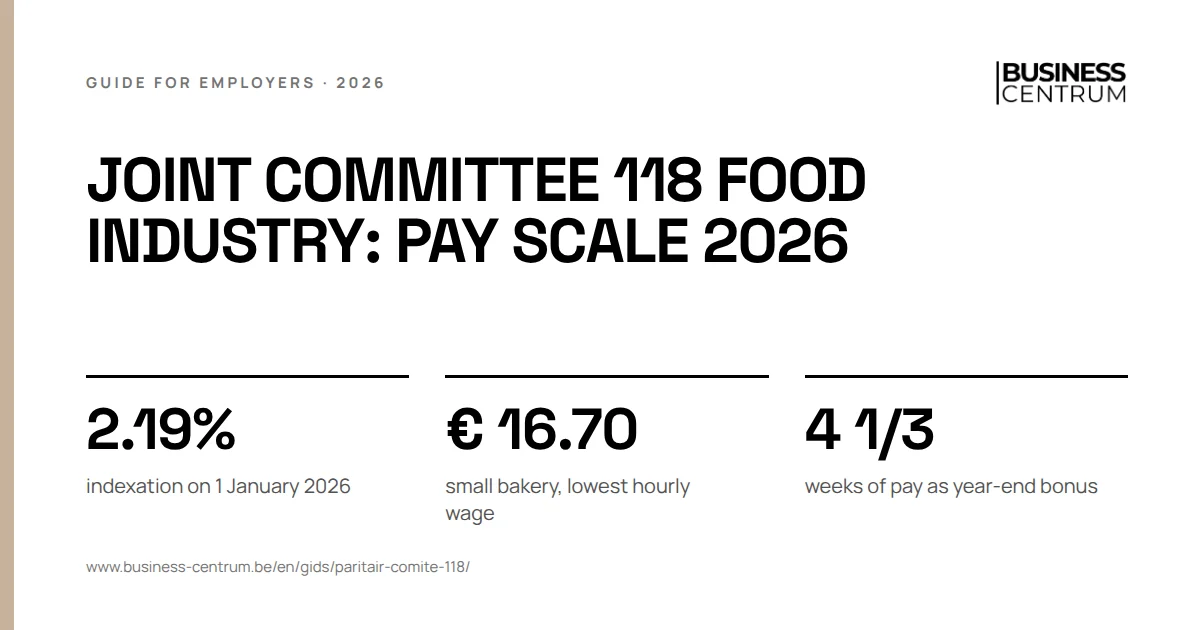
Joint committee 118 covers blue-collar workers in the Belgian food industry: bakeries, breweries, slaughterhouses, dairies, chocolate makers and some thirty other sectors. On 1 January 2026, all wages rose by 2.19%. Each sector has its own pay scale: in a small bakery, the lowest scale is € 16.70 an hour. You pay the year-end bonus yourself.
Who falls under joint committee 118 for the food industry?
JC 118 covers workers who mainly do manual work in companies that make, process or store food or drink. The minimum wage database of FPS Employment splits the committee into 37 activity areas, from flour mills to potato peeling plants, grouped into 22 sub-sectors numbered 118.01 to 118.22. You will see those numbers on payslips and in searches: 118.03 for bakeries, 118.07 for breweries, 118.11 for meat, 118.12 for dairy, 118.14 for chocolate, 118.19 for food specialities.
The boundaries with other committees:
| Situation | Committee |
|---|---|
| Workers who make or process food or drink | JC 118 |
| Workers of a baker or pastry maker who bakes fresh products on site | JC 118, sub-sector 118.03 |
| Workers of an industrial pastry or biscuit factory | JC 118, separate sector outside 118.03 |
| White-collar staff of the same food companies | JC 220 |
| Sales assistants in a baker's shop | JC 201 (independent retail) |
| Workers of a food wholesaler or shop without its own production | JC 119 |
Craft bakeries are therefore split across two committees. The bakehouse falls under JC 118, the shop under JC 201. The bakery agreement says so explicitly: category 9, the mixed job for a worker who does less than half sales tasks and more than half bakehouse tasks, does not affect the sales staff of independent retail. Someone who mostly works behind the counter usually falls under JC 201 as a white-collar employee.
A food company almost always has two committees: JC 118 for production and JC 220 for white-collar staff. If you only trade in food without producing it, your warehouse belongs to JC 119. If you do both, the company's main activity decides, not what your articles of association say.
JC 118 pay scale: one scale per sector
JC 118 has no general pay scale. Each activity area has its own job classification and its own minimum hourly wages. In food specialities the scale runs from category I to XII, in chocolate from I to IV, in breweries and dairies from unskilled or labourer through semi-skilled to skilled, and in bakeries from category 1 to 16. Most sectors have a second, higher scale after six months' seniority. Meat, vegetables and potato processing raise pay in more steps with the years spent in the wage class.
All amounts apply from 1 January 2026. They follow from the wage agreements each sector signed on 22 January 2026, after the January indexation. Most sectors use a 38-hour week, some also have a column for 37 hours.
A table for every sector would make this guide unreadable. We therefore show bakeries in full, because they have their own system, and for the largest other sectors the lowest and highest minimum wage. Every full scale is in the FPS Employment minimum wage database.
JC 118.03 bakeries: pay scale in 2026
Bakeries, pastry shops that make fresh products with a very short shelf life and tea rooms attached to a pastry shop follow their own agreement. It sets four scales, depending on the size of the bakery and the worker's seniority. Hourly wages at 38 hours a week:
| Category | Fewer than 10 workers | Small bakery | Large bakery, first 6 months | Large bakery, after that |
|---|---|---|---|---|
| 1. Beginner, labourer, bread slicer | € 16.49 | € 16.70 | € 16.26 | € 16.71 |
| 2. Third baker | € 17 | € 17.24 | € 16.73 | € 17.25 |
| 3. Second baker | € 18.12 | € 18.34 | € 17.87 | € 18.35 |
| 4. Skilled worker | € 18.72 | € 18.91 | € 18.45 | € 18.92 |
| 5. Team leader | € 19.79 | € 20.04 | € 19.50 | € 20.05 |
| 6. Head baker or head pastry chef | € 21.40 | € 21.65 | € 21.08 | € 21.67 |
| 9. Mixed job, shop and bakehouse | € 17.67 | € 17.88 | € 17.39 | € 17.89 |
| 12. Delivery driver, B licence | € 18.12 | € 18.34 | € 17.87 | € 18.35 |
The other categories cover cleaning, forklift and warehouse work, drivers with a C licence and technicians. For large bakeries we take the amounts from the agreement itself. The minimum wage database shows one to two cents less and, for workers with six months' seniority, the small bakery amounts. The registered agreement prevails.
Entry wage in a small bakery. A small bakery may pay a new worker 90% of the actual wage for the job during the first 6 months. After that, the worker is entitled to a bonus of 10% of 26 times their hourly wage multiplied by their weekly hours. That is exactly what they missed during those six months: the entry wage is a deferral, not a discount. A large bakery uses the lower scale for the first 6 months instead. You cannot combine the two.
Students. A student worker aged 18 or over gets 90% of the scale, at 17 80%, at 16 70% and at 15 60%. That scale applies in almost all JC 118 sectors. The rules and the hours quota are on our page about hiring students.
Large or small bakery in JC 118.03 bakeries: what counts?
The difference between a large and a small bakery does not depend on your turnover or number of shops, but on a headcount.
- Who counts. A bakery is large from an average of 20 blue-collar workers in full-time equivalents, per technical business unit. Agency workers count, white-collar staff do not. A worker on less than 75% of a full-time schedule counts as half. Long-term sick workers and those on full-time career break or thematic leave do not count.
- When you count. Every year on 30 September, day X. For 2026 that is 30 September 2026, over the reference period from 1 September 2025 to 31 August 2026.
- What happens. If your bakery changes size, you tell your workers in writing before 31 October 2026. The new scale applies from 1 January 2027.
Worked example. A large bakery hires a bread slicer in category 1. For the first six months it pays € 16.26 an hour, then € 16.71. The difference is €0.45 an hour or €74.10 gross a month at 38 hours (0.45 x 38 x 13 / 3). In a small bakery the same worker on the entry wage gets €15.03 an hour (90% of €16.70). After six months they receive a bonus of €1,649.96 (10% of 26 x 16.70 x 38).
JC 118 pay scale by sector
For the other sectors with the most searches, we show the range of the scale at 38 hours a week: the lowest minimum hourly wage is the lowest category at the start, the highest is the top category with maximum seniority.
| Sector (sub-sector) | Lowest minimum hourly wage | Highest minimum hourly wage |
|---|---|---|
| Breweries (118.07) | € 17.99 | € 19.76 |
| Water and soft drinks (118.08) | € 17.91 | € 20.61 |
| Vegetables (118.09) | € 15.53 | € 20.35 |
| Meat products and sausages (118.11) | € 17.59 | € 21.06 |
| Slaughterhouses and cutting plants (118.11) | € 16.99 | € 19.74 |
| Dairies, butter and cheese (118.12) | € 18.21 | € 19.89 |
| Chocolate and spreads (118.14) | € 16.99 | € 19.15 |
| Food specialities and dietary food (118.19) | € 17.17 | € 22.58 |
| Animal feed (118.20) | € 18.04 | € 19.53 |
The slaughterhouse figures are for a Monday to Friday week. Workers who also work on Saturday have a higher scale there. If your sector is not listed, such as biscuits, potato processing, coffee or cold storage, the full scale is in the FPS database. Your social secretariat has to record the right sector, category and seniority step for every worker. A wrong sector affects every payslip.
JC 118 indexation: index 2026 and 2027
JC 118 indexes once a year, on 1 January. Both minimum and actual wages go up: if you pay above the scale, you also index that higher wage. The percentage follows the change in the smoothed health index from November to November of the previous year.
| Indexation on 1 January | Percentage |
|---|---|
| 2026 | 2.19% |
| 2025 | 3.57% |
| 2024 | 1.83% |
| 2023 | 10.96% |
| 2022 | 3.22% |
The bakery weekend bonus and the shift and night bonuses in euros in breweries, chocolate and dairy, among others, also follow the index. The next indexation falls on 1 January 2027. You will only know the percentage after the November 2026 index figures. It will also be the first January indexation under the cent index, which has applied since 1 June 2026. For a reference wage above € 4,000 a month, indexation is capped at 2% on that threshold. At 38 hours, that only matters above an hourly wage of about € 24.29, so for few JC 118 workers. More in our article on the cent index and the overview of wage indexation in 2026.
Joint committee 118 year-end bonus
The JC 118 year-end bonus is set in an agreement of 16 September 2025 and applies in all sectors, bakeries included. You pay it yourself, not a fund.
- Amount: 4 1/3 weeks of December gross hourly pay, plus the monthly average of contractual bonuses from January to November linked to the worker's performance. At 38 hours a week, the fixed part is 164.67 times the hourly wage.
- Condition: at least 1 month of service. The worker receives one twelfth per month of service worked or treated as worked.
- Loss: workers who leave voluntarily before 1 year of service, or who are dismissed for serious misconduct.
- Absence: for each day of unjustified absence, you may deduct a percentage if the works council, the union delegation or the work rules set one.
- Payment: before 25 December 2026 for workers employed on 1 December, on departure for the others.
Sugar factories use a mixed hourly wage because of the campaign: three quarters of the hourly wage of 1 September and one quarter of the average hourly wage of November. More favourable company arrangements still apply.
Worked example. A second baker in a small bakery earns € 18.34 an hour and works every weekend, which gives four weekend bonuses of € 5.28 a month on average. The year-end bonus for a full year is 4 1/3 x 38 x 18.34 = €3,019.99 for the fixed part, plus €21.12 for the weekend bonuses: €3,041.11 gross. A full explanation by sector is in calculating the year-end bonus.
Bonuses and supplements by sector
Bakeries. Workers who work at least 4 hours at the weekend, between 6 pm on Saturday and 6 pm on Sunday, get a weekend bonus of € 5.28 in a small bakery and € 3.92 in a large one. Night work between 10 pm and 6 am earns a 20% supplement. Work in cold rooms or refrigerated lorries earns 5% below 8 degrees and 10% for frozen products.
Shifts and nights in industry. Each sector agreement sets its own supplements. Some examples:
| Sector | Shift bonus (morning / afternoon) | Night bonus |
|---|---|---|
| Large bakeries | € 0.33 an hour | 20% |
| Meat products | 10% | 20% |
| Breweries | € 0.64 / € 0.73 an hour | 15%, at least € 2.54 an hour |
| Chocolate | € 0.64 / € 0.73 an hour | 10%, at least € 2.54 an hour |
| Dairy | € 0.64 / € 0.73 an hour | 10%, at least € 2.54 an hour |
Eco-vouchers. JC 118 is not on the FPS list of committees with sector eco-vouchers (as updated on 28 September 2026). Your blue-collar workers therefore have no sector entitlement to them. White-collar staff in JC 220 are a different story.
Meal vouchers, commuting and leave in JC 118
Meal vouchers. If your company already gave meal vouchers on 1 October 2025, the employer share rose by € 1 on 1 January 2026, up to a maximum of € 8.91. The worker pays at least € 1.09, and the voucher is worth at most € 10. If you gave no meal vouchers, you had to introduce an equivalent benefit: with a union delegation by agreement before 15 February 2026, without one before 1 July 2026. If you did not, you have owed € 240 net a year since then, in proportion to the working days per week. See also the employer share in meal vouchers.
Commuting. For the train, you pay on average 80% of the rail pass. Workers who cycle get € 0.31 per kilometre, there and back, since 1 February 2026. For cars and other private transport, the agreement sets a flat-rate table.
Leave. Workers with 5 years' seniority with you get end-of-career days: 3 a year from age 55, 6 from 57, 9 from 59 and 12 from 62. In bakeries it is 1 from age 57, 3 from 59 and 4 from 62. The bakery fund refunds you € 200 per day given to a worker aged 57 or 58. In every sector, 20 years' seniority in the company gives one extra day off a year, and workers who take at least 3 months of parental leave get an extra day the following year.
Temporary unemployment. If you put workers on temporary unemployment, you pay a daily top-up yourself on top of the NEO benefit, for the first 60 working days a year. The amount follows the index.
Flexi-jobs in joint committee 118 food industry
Bakeries have been able to use flexi-job workers since 1 January 2018. For the rest of the food industry it has been possible since 1 July 2026: JC 118 is not on the list of sectors that opted out. The rules:
- Pay: at least the scale for the job in your sector, at most 150% of it.
- On top of pay: 7.67% flexi holiday pay, paid with the wage.
- Contribution: you pay a 28% special employer contribution on the total. The flexi worker pays no personal NSSO contribution.
- Who qualifies: an employee who works at least 4/5 for another employer in the reference quarter, or a pensioner. For non-pensioners, flexi income is tax-free up to € 18,440 a year.
A flexi-job costs less than a regular worker, but the weekend peak in a bakery or a slaughterhouse at Christmas takes planning: you sign a framework agreement first and file a Dimona for each assignment. More in flexi-jobs in all sectors.
Worked example: what does a baker cost per month?
A second baker (category 3) in a small bakery, full time at 38 hours, who works every weekend:
| Item | Calculation | Amount |
|---|---|---|
| Gross wage | 18.34 x 38 x 13 / 3 | €3,019.99 |
| Weekend bonuses | 4 x 5.28 | €21.12 |
| Employer NSSO | 25% on 108% of 3,041.11 (3,284.40) | €821.10 |
| Holiday contribution | 15.84% on 3,284.40 | €520.25 |
| Year-end bonus per month | 3,041.11 / 12 | €253.43 |
| Total per month | €4,635.89 |
This is an estimate without sector fund contributions, NSSO on the year-end bonus, meal vouchers and reductions such as the structural reduction. The real cost depends on your company.
Mistakes we often see in JC 118
- The wrong sector. A pastry maker who mainly makes long-life cakes for supermarkets may not fall under 118.03 but under industrial pastry. The scale depends on the activity area, which follows your products.
- No count on 30 September. A bakery that grows to 20 workers without counting applies the wrong scale from January and fails to inform its workers.
- Entry wage without the bonus. A small bakery that pays six months of entry wage and then forgets the bonus owes back pay for every new worker.
- Bonuses left out of the year-end bonus. Weekend, night and shift bonuses count in the variable part. Taking only the hourly wage means paying too little.
- Actual wages not indexed. Even if you pay above the scale, you index in January.
- The sales assistant in JC 118. Someone who mainly sells belongs in JC 201. The wrong committee means the wrong bonuses and the wrong fund contributions.
What Business Centrum does for you
Business Centrum works out which JC 118 sector your workers belong to, keeps track of the large or small bakery count every year and applies scales, indexation, bonuses and flexi-jobs correctly in your payroll. We work with Acerta and you have one fixed contact person in Ghent.