
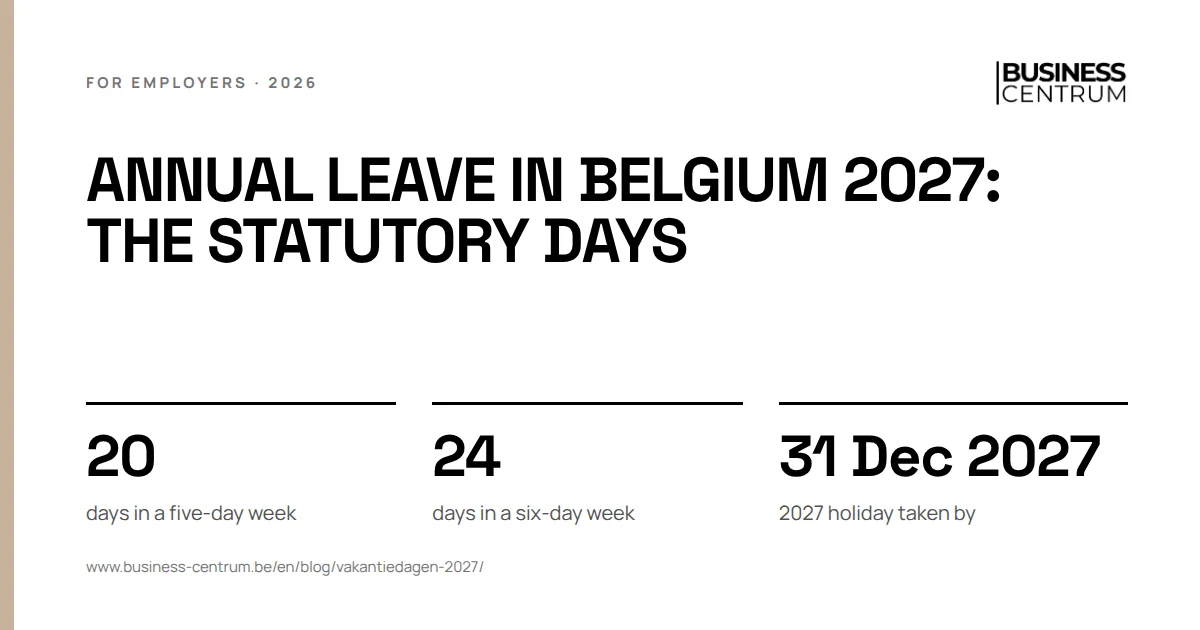
A full-time employee in a five-day week gets 20 days of statutory annual leave in Belgium in 2027 if they worked all of 2026, and 24 in a six-day week. The number depends on what they worked in 2026, the reference year for holiday. Anyone who started later or was absent for a long time gets fewer days, and can sometimes top up with youth holiday, senior holiday or supplementary holiday. The money that goes with those days is covered in our guide to holiday pay 2026: what white-collar and blue-collar staff get, who pays and when.
How much annual leave in Belgium in 2027?
The law counts per reference year. For the 2027 holiday, everything the employee did in 2026 counts: the days they worked and the days treated as worked, such as paid public holidays, statutory holiday itself, and sickness or an accident up to 12 months. Statutory holiday never exceeds 4 weeks a year.
| Work pattern in 2027 | Maximum holiday days after a full year 2026 |
|---|---|
| Six-day week | 24 |
| Five-day week | 20 |
| Four-day week | 16 |
| Three-day week | 12 |
Parental leave and time credit are not on the list of days treated as worked. A white-collar employee who took three months of full-time parental leave in 2026 therefore has fewer days in 2027. The other forms of leave, from short leave for family events to care leave, are in our overview of the types of leave.
Annual leave days in Belgium for a blue-collar worker
For a blue-collar worker, the law uses a fixed table. It counts the working days and equivalent days of 2026, converted to a full-time five-day week. With 231 days or more, the worker is entitled to 20 holiday days. Below that, the entitlement drops by band: 144 to 153 days give, for example, 12 holiday days.
You do not pay a blue-collar worker's holiday pay yourself. The National Annual Holiday Office (RJV) or your sector's holiday fund does. The worker sees their holiday entitlement in the RJV online service Mijn vakantierekening. Since holiday year 2020, the RJV calculates that entitlement for all holiday funds together, even if the worker is affiliated with more than one fund.
Worked example. Samir started on Monday 15 June 2026 as a warehouse worker, full-time from Monday to Friday. From 15 June to 31 December 2026, that is 144 weekdays. The paid public holidays and his week of sickness count, because they are treated as worked. That falls in the band of 144 to 153 days: he gets 12 days of statutory leave in 2027. For the rest of the summer shutdown, he can ask for supplementary holiday, see below.
Annual leave entitlement in Belgium for a white-collar employee
A white-collar employee builds up 2 holiday days per month of work or equivalent absence in 2026, counted in a six-day week. After twelve months, that gives 24 days, or 20 in a five-day week. Months with a previous employer count. On leaving, that employer hands over a holiday certificate, which the employee passes on to you when they take their days.
You calculate and pay a white-collar employee's holiday pay yourself: normal pay during the holiday and the double holiday pay. To work out the amount, use our holiday pay calculator.
Worked example
Lotte graduated in June 2026 and started with you on 1 July 2026 as a full-time white-collar employee in a five-day week. She worked six full months in 2026: 6 x 2 = 12 days in a six-day week, or 10 days in her five-day week. To reach four weeks, she can take another 10 days of youth holiday in 2027, because she is under 25 and worked more than a month after her studies.
Part-time: converting holiday days to the 2027 work pattern
The entitlement is expressed in weeks. How many days that is depends on the work pattern in which the employee takes the holiday. If they work four days a week in 2027, the maximum is 16 days, in a three-day week 12. If the work pattern changes between 2026 and 2027, you convert the entitlement to the new pattern. The RJV offers a holiday day converter for part-time workers. If someone works more hours than last year, check whether they are entitled to supplementary holiday.
Youth holiday and senior holiday in 2027
Youth and senior holiday top up an incomplete entitlement to 4 weeks. The employee first uses up their ordinary holiday days. They are not obliged to take the extra days, and you do not pay for them: the RVA pays a benefit of 65% of the capped gross pay, with a maximum of € 76.80 gross per day in a six-day week.
Youth holiday. On 31 December 2026, the young worker is not yet 25, finished their studies or training in 2026, and then worked as an employee for at least 1 month, with at least 13 working days. Youth holiday can only be taken while in employment.
Senior holiday. On 31 December 2026, the employee is at least 50 and does not have four weeks of paid holiday in 2027 because they were fully unemployed or on invalidity in 2026. If the shortfall comes from temporary unemployment, unpaid leave or a career break, there is no senior holiday.
The employee applies for the benefit with form C103 at their payment body, after the first month in which they take youth or senior holiday. For that first month you file an electronic declaration scenario 9 with the RVA, and for every month with youth or senior holiday a declaration scenario 10.
Supplementary holiday for starters and returners
Supplementary holiday, also called European holiday, is for anyone who starts work for the first time or returns to work after unemployment or long sickness. After a qualifying period of 3 months of work in the same calendar year, the employee is entitled to one week of supplementary holiday per three months, until they reach four weeks together with their ordinary days. A part-time worker who moves to full-time can also qualify.
- White-collar employee: you pay their normal pay for those days on the usual pay date. That amount is later deducted from their holiday pay the following year.
- Blue-collar worker: they apply for supplementary holiday pay with a form at the RJV or their holiday fund. It amounts to 7.69% of the pay of the qualifying period and is deducted from their holiday pay the following year.
Samir from the example started in June 2026. A start runs until the end of the following year, so he can take supplementary holiday in 2027 after three months of work.
When must annual leave for 2027 be taken?
The 2027 holiday must be granted within 12 months after the end of the reference year, so by 31 December 2027 at the latest. Planning follows fixed rules:
- Every employee gets at least 1 week of holiday in one block.
- Between 1 May and 31 October, you guarantee 2 weeks of uninterrupted holiday, 3 weeks for those under 18, unless the employee asks otherwise.
- The employee may ask to take 3 days of the fourth week as half days. You can refuse if that disrupts the work.
- A public holiday during the holiday is not a holiday day. How public holidays are replaced is in public holidays 2027.
If an employee falls sick during their holiday, they keep those days since 1 January 2024. What they must do and what you pay is in sick during holiday. Days they could not take because of sickness, an accident or maternity leave can still be taken up to 24 months after the end of the holiday year, for 2027 until 31 December 2029. When you may refuse or postpone a request is in can an employer refuse leave.
Collective holiday in 2027: who sets the period?
If your business closes in summer or between Christmas and New Year, that is collective holiday. The law sets an order:
- The joint committee can set the holiday dates for the sector. That decision must reach the minister by 31 December 2026.
- The works council, if the committee decided nothing.
- The employer with the union delegation, or without a delegation with the employees.
- An individual agreement between you and each employee, if nothing is set at any level.
The dates of the collective holiday belong in your work rules. If an employee has too few days to cover the whole shutdown, first check whether they can take supplementary holiday or youth holiday. To plan bridge days around the public holidays, see our overview of bridge days 2027.
Employer's corner: what you check in January 2027
- The entitlement per employee. Recalculate the months of 2026 for each white-collar employee, including equivalent absences. For blue-collar workers, compare your planning with the holiday entitlement the RJV or the holiday fund communicates.
- New staff. Ask for the holiday certificate from the previous employer and note who started in 2026: they may ask for supplementary holiday or youth holiday.
- Carried-over days. Days from 2026 not taken because of sickness can still be used until 31 December 2028. Track them separately.
- The collective shutdown. Set the dates, put them in the work rules and announce them before summer planning starts.
- Part-time staff. Convert the entitlement to the 2027 work pattern, especially for anyone who changed pattern in 2026.
What Business Centrum does for you
We calculate the 2027 holiday days of each white-collar employee from their 2026 work, track balances and carried-over days, and file the youth and senior holiday declarations with the RVA. In payroll, we book holiday pay, supplementary holiday and leaving holiday pay, together with Acerta. Want to go through the 2027 holiday and the collective shutdown in advance? Ask us to call you back.