
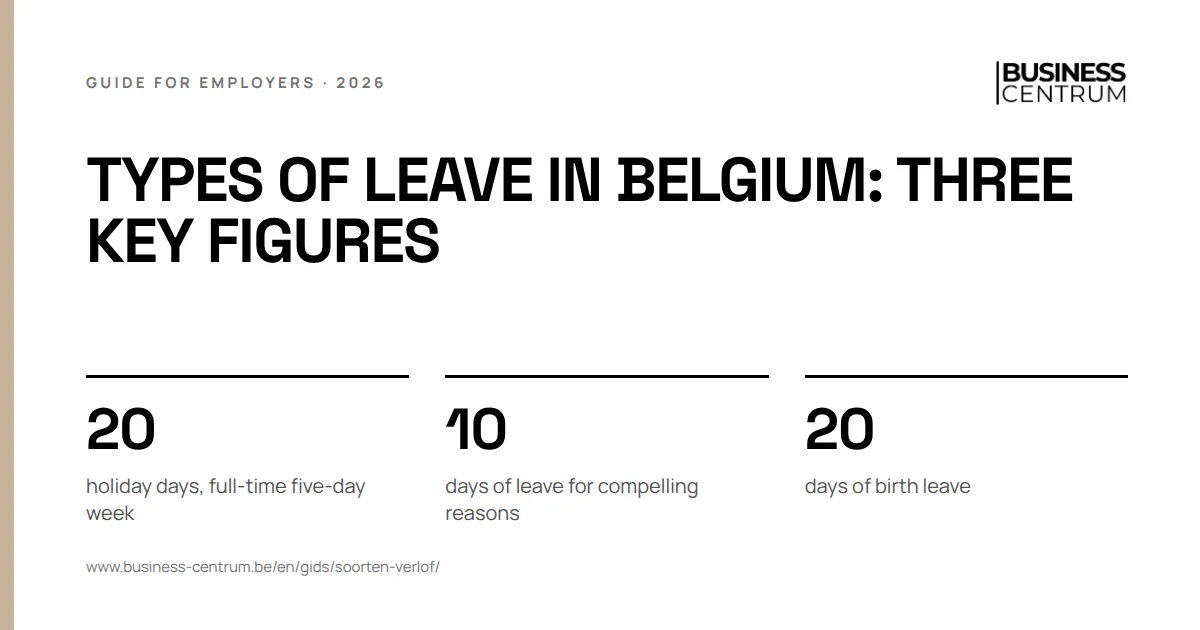
There are around ten types of leave in Belgium for employees, and for each type it differs who pays and what you as an employer may refuse. The main ones: the annual holiday of 20 days for a full-time employee, public holidays, short leave for family events, leave for compelling reasons, birth and maternity leave, parental leave and time credit. You pay some types of leave yourself, others are paid by the health insurance fund or the National Employment Office (RVA/ONEM), and a few are unpaid.
Types of leave in Belgium: the overview in one table
| Leave | Duration | Who pays | May you refuse? |
|---|---|---|---|
| Annual holiday | 20 days for a full-time five-day week | White-collar: you. Blue-collar: the holiday fund | A requested period yes, the holiday itself no |
| Public holidays | 10 per year | You | No, and if one falls on a Sunday you grant a replacement day |
| Short leave | From 1 to 10 days per event | You | No |
| Leave for compelling reasons | 10 days per year | Unpaid in principle | No, if the reason exists |
| Care leave | 5 days per year, within those 10 | Unpaid in principle | No, with a certificate |
| Birth leave | 20 days | You for the first 3 days, then the health insurance fund | No |
| Maternity leave | 15 weeks | The health insurance fund | No |
| Parental leave | 4 months full-time per child | Benefit from the RVA/ONEM | Postponement is possible, up to 6 months |
| Time credit | Depends on the reason | Benefit from the RVA/ONEM, if the employee is entitled to it | Postpone or limit through the threshold |
| Informal carer leave | 3 months full-time per person cared for | Benefit from the RVA/ONEM | No |
| Flemish training leave | Up to 125 hours per school year | You, with a refund from Flanders | In a few cases |
| Job-search leave | During the notice period | You | No |
Sickness is not in the table. A sick employee does not take leave: their contract is suspended and you pay guaranteed salary. That is worked out separately in sick leave in Belgium.
Statutory leave in Belgium: holidays and public holidays
Annual holiday. A full-time employee in a five-day week who worked the whole of the previous year is entitled to 20 holiday days. Holidays therefore follow from what they worked the year before: anyone who started later or worked part-time builds up fewer. The dates are set collectively through the joint committee or the works council, or you agree them with the employee. You may refuse a requested period, as long as the employee can take 2 consecutive weeks between 1 May and 31 October. A white-collar employee receives their holiday pay from you, a blue-collar worker from the holiday fund. How that pay is calculated is in double holiday pay.
Public holidays. There are 10 statutory public holidays: 1 January, Easter Monday, 1 May, Ascension Day, Whit Monday, 21 July, 15 August, 1 November, 11 November and 25 December. On those days the employee does not work and you pay their wages. If a public holiday falls on a Sunday or on a normal non-working day, you grant a replacement day. How to choose and announce it is in replacement public holiday.
In construction, holidays are largely set collectively. The dates for next year are in construction holiday dates 2027.
Circumstantial leave: short leave for family events
Short leave (klein verlet) is paid absence for a family event or a civic duty. In the public sector and in education it is called circumstantial leave (omstandigheidsverlof). The statutory table, with some examples:
- Employee's own wedding: 2 days.
- Death of a partner or child: 10 days, of which 3 around the funeral and 7 within the year.
- Death of a parent or parent-in-law: 3 days.
- Death of a brother, sister or grandparent who lived with the employee: 2 days, otherwise 1 day.
Your joint committee can grant more. In JC 200, for example, it has been 12 days on the death of a partner or child since 2026. The full table, the rules per committee and how to book short leave are in short leave.
Leave for compelling reasons and care leave
An employee may stay away for up to 10 days per year for compelling reasons: an unforeseen event that requires their urgent intervention, such as the sickness or hospitalisation of a member of their household, or damage to their home from fire or flooding. This leave is unpaid in principle, unless your collective agreement or work rules say otherwise.
Within those 10 days, the employee is entitled to 5 days of care leave per year, to care for a household or family member with a serious medical reason. They inform you in advance and provide a certificate from the treating doctor. Care leave is also unpaid in principle.
Birth leave and maternity leave
Maternity leave. An employee who gives birth is entitled to 15 weeks of maternity leave. Part of it falls compulsorily around the birth, the rest she takes before or after. You pay no wages: the health insurance fund pays a maternity benefit. From the moment you know of the pregnancy, she is protected against dismissal.
Birth leave. The other parent is entitled to 20 days of birth leave, to be taken within 4 months of the birth. You pay the wages for the first 3 days, the health insurance fund pays the rest. More in is birth leave paid.
Parental leave, time credit and informal carer leave
These types of leave suspend the contract or reduce working time for a longer period. You pay no wages for the hours the employee does not work. They can receive a benefit from the RVA/ONEM.
Parental leave. Per child, 4 months full-time or 8 months half-time, as long as the child is younger than 12. You can postpone it for serious reasons, but the leave then starts no later than 6 months later. What you may and may not do, with two template letters, is in refusing parental leave as an employer.
Time credit. An employee with at least 24 months' seniority can take time credit with a reason, such as caring for a child or training. In a business with no more than 10 employees it is not a right. If more than 5% of the staff want time credit at the same time, a priority scheme applies. The employee notifies you 6 months in advance if you have no more than 20 employees, and 3 months in advance above that. More in time credit for employers.
Informal carer leave. A recognised informal carer can fully suspend their contract for 3 months per person cared for, or reduce their working time by a fifth or a half. They inform you in writing at least 7 days in advance.
Anyone who applies for or takes such leave is protected against dismissal. A dismissal in breach of that protection costs a fixed compensation of 6 months' pay on top of the normal payment. See also dismissal in Belgium.
Training leave and job-search leave
Flemish training leave. An employee in the Flemish private sector who follows an approved course may be absent for up to 125 hours per school year on full pay. You pay the wages and apply for a refund: for the 2026-2027 school year that is € 24.50 per hour. You may only refuse or postpone the leave in a few cases. Everything is in Flemish training leave for employers.
Job-search leave. During the notice period, the employee may be absent on full pay to look for work, and with long notice from the employer 1 day a week in the last 26 weeks. See job-search leave.
Unpaid leave in Belgium and other absences
Unpaid leave. There is no general right to unpaid leave. If an employee asks for a few weeks off without pay, you decide, and it is best to put the arrangement in writing: the period, the return and the consequences for their holidays and social security.
Compensatory rest and ADV. Anyone working more hours than the average working time receives working time reduction days (ADV) or compensatory rest in many sectors. How that works is in ADV days.
Temporary unemployment. This is not leave taken by the employee but a suspension you apply for because of a lack of work or force majeure. The employee then receives a benefit from the RVA/ONEM.
Employee leave: what you as an employer may refuse
The rule of thumb: leave the law grants as a right for an event, such as short leave, birth leave and maternity leave, you cannot refuse. Leave the employee schedules, such as holidays, parental leave and time credit, you can refuse or postpone in some cases, within precise deadlines. By type of leave, with a template letter for refusing holidays, it is set out in can an employer refuse leave.
Answering a leave request in four questions
- Which leave is it exactly? An employee asking for time off for a funeral is asking for short leave. Someone asking for time off for a sick child is asking for leave for compelling reasons or care leave. The type determines the rest.
- Is it a right or a favour? They are entitled to short leave, birth leave and maternity leave. Unpaid leave is a favour.
- Which deadline applies? For parental leave, time credit and informal carer leave, the employee must notify you in writing in advance, and you have a deadline of your own to postpone.
- Who pays? Record the leave correctly in the payroll, so that the pay, the benefit and the declaration are right.
All guides on leave
- Can an employer refuse leave: by type of leave.
- Short leave: the days for a wedding, a death and a house move.
- Refusing parental leave as an employer: postponement and protection.
- Time credit for employers: refusing, postponing and the threshold.
- Flemish training leave for employers: hours and refund.
- Sickness during holidays: which days you grant again.
- Replacement public holiday: what if a public holiday falls on a Sunday.
- Sick leave in Belgium: who pays what during sickness.
Business Centrum records every absence in the payroll: which days you pay, which the holiday fund, the health insurance fund or the RVA/ONEM takes over, and which code they get in the declaration. Together with Acerta we make sure it is right. Unsure about a request from an employee? Ask us before you reply.