
The labour deal in Belgium is the law of 3 October 2022 containing various labour provisions, and as an employer it mainly asks four things of you: an answer to a request for a four-day week or an alternating weekly schedule, longer notice for the rosters of part-time staff, training days for your employees and, from 20 employees, an annual training plan and rules on disconnection. The law appeared in the Belgian Official Gazette on 10 November 2022 and mostly entered into force on 20 November 2022. Later laws changed part of it. Below is what still applies on 20 October 2026, part by part, with what you need to do.
What is the labour deal?
The labour deal (Arbeidsdeal in Dutch, deal pour l'emploi in French) is the political name for a package of measures from the 2022 federal government. The FPS Employment uses the same name. Legally, it is one law with a series of chapters. For an SME, these parts matter:
| Part | For whom | Since |
|---|---|---|
| Four-day week on request | full-time employees | 20 November 2022 |
| Alternating weekly schedule | full-time employees | 20 November 2022 |
| Rosters for part-timers on a variable schedule | part-time employees | 20 November 2022 |
| Training plan | employers with 20 or more employees | 1 September 2022 |
| Individual training right | employers with 10 or more employees | 10 November 2022 |
| Right to disconnect | employers with 20 or more employees | 20 November 2022 |
| Transition track on dismissal | employers who dismiss with notice | 20 November 2022 |
The rest of the law deals with platform work, sector consultation on shortage occupations and diversity, and the subsistence security funds. None of that requires action from an ordinary employer.
Labour deal: the four day work week on the employee's request
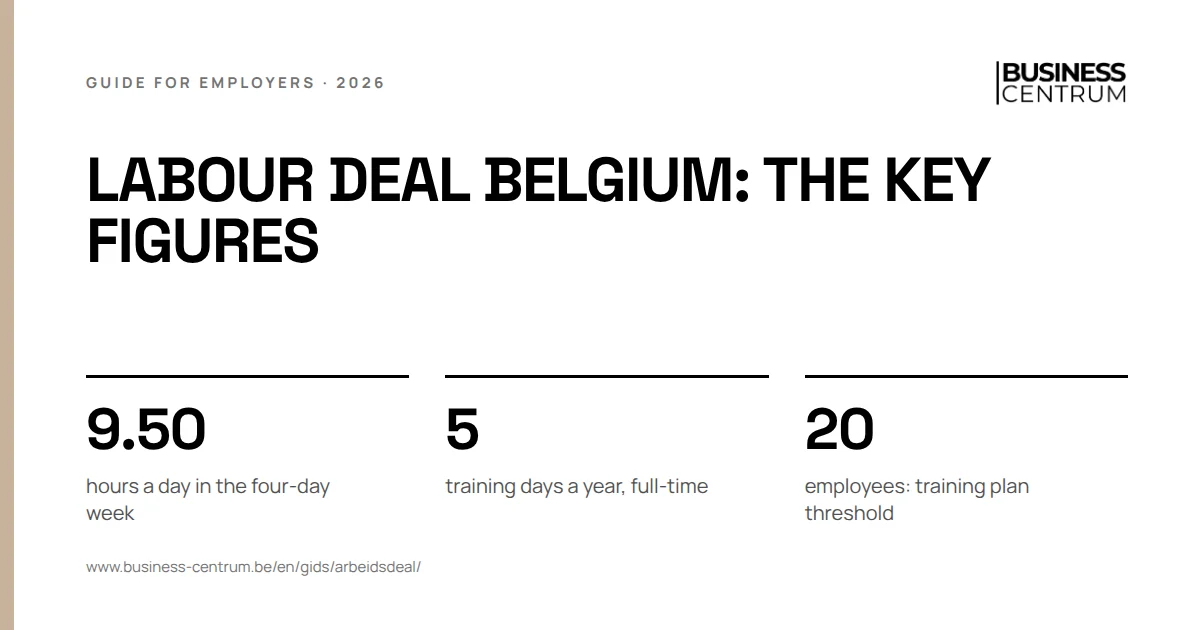
A full-time employee may ask to work his normal full-time hours in four days instead of five. He then works longer days, not fewer hours. The daily limit rises to 9.50 hours.
How the arrangement enters your company. If the actual working time in your company is at most 38 hours a week, you introduce the four-day week through the work rules, including the schedule. If working time is higher, up to 40 hours, only a collective agreement can do it. The daily limit is then the weekly hours divided by four. An employee may also request the four-day week if your work rules do not yet provide for it.
The request. The employee makes it in advance and in writing, on paper or by e-mail. A request covers at most 6 months and can then be renewed.
Your answer. You are not obliged to say yes. If you refuse, you give your reasons in writing and hand them to the employee within 1 month. An employee who asks for a four-day week may not be treated unfavourably or dismissed for that reason.
The agreement. If you say yes, you sign a written agreement no later than the day the employee starts on the new schedule. It states:
- the start and end of the working day;
- the time and length of breaks;
- the days off in the week;
- the start and end date of the period, at most 6 months.
The employee gets a copy. The committee for prevention and protection at work, or failing that the union delegation, may also ask for a copy. During the period, the request and the agreement are kept where the work rules can be consulted. After that, you keep them for another 5 years.
An employee on a four-day week may not work voluntary overtime on his other days. Do not confuse this arrangement with the collective four-day week, a separate measure that reduces working time itself.
The alternating weekly schedule
With an alternating weekly schedule, a full-time employee works more one week and less the next, so that on average he works his normal weekly hours. It is meant to combine work and family, for example in co-parenting.
- A cycle runs over 2 consecutive weeks. In the third quarter it may be 4 weeks, and also after an unforeseen event in the employee's life, if he asks for it in writing with reasons.
- At most 9 hours a day and 45 hours a week.
- The work rules set the framework: the average weekly hours, the days and the daily time window in which work can be scheduled, and the minimum and maximum daily and weekly hours.
- Request, refusal, agreement and retention follow the same rules as the four-day week: at most 6 months per request, a reasoned refusal within 1 month, documents kept for 5 years.
- The employee may stop early and return to his usual schedule if he tells you 2 weeks before the start of a new cycle.
Worked example. In your company, full-time working time is 38 hours a week. Sarah works on an alternating weekly schedule: 45 hours in the week her children stay with their other parent and 31 hours in the week they stay with her. Over the two-week cycle that is 76 hours, 38 hours a week on average. The 45 hours stay within the limit of 45 hours. Her longest day may not exceed 9 hours, so she spreads 45 hours over at least five days.
Rosters for part-timers on a variable schedule
If a part-time employee works a variable schedule, you give him his roster in a written and dated notice. The labour deal raised the notice from 5 to 7 working days in advance. A sector agreement declared generally binding can shorten that period, but never below 3 working days. Your work rules state how and within what period you give the notice.
Since the law of 18 May 2026, a part-time employment contract may in principle not fall below 1/10 of full-time weekly hours, instead of one third. That is a later change, not the labour deal itself. What goes into the contract and the work rules is set out in our guide on the part-time employment contract. To adjust a roster that is already running, first read changing a work schedule as an employer.
Labour deal training right: how many days a year?
Every employee has an individual right to training. The number of days depends on the size of your company, measured in full-time equivalents over a reference period:
| Employees | Training right of a full-time employee |
|---|---|
| fewer than 10 | no statutory duty |
| 10 to 19 | at least 1 day a year; you set the number before 30 September of the year, for 2027 before 30 September 2027 |
| 20 or more | 5 days a year since 2024 (4 in 2023), unless a sector agreement provides otherwise |
Your sector may deviate. A generally binding agreement of your joint committee can set the number of days and a growth path, but never fewer than 2 days. In the auxiliary joint committee for white-collar workers (JC 200), for example, companies with 20 or more employees grant 4 days a year from 2026 and 5 from 2028. So check the agreement of your own committee first.
Part-timers and employees who are not employed for the whole year get a share: the number of days of a full-timer, times their work regime, times the number of months employed divided by twelve. A month that has started counts as a full month.
Worked example. Your company has 25 employees and is not covered by a sector agreement on training. Tom works 4/5 and starts on 10 July. July counts as a full month, so he is employed for six months. His right for that year: 5 x 0.8 x 6/12 = 2 training days.
Days not taken carry over to the next year, on top of the new credit. Over a period of 5 years, a full-time employee must on average have followed his statutory number of days a year. The counter then goes back to zero.
What counts as training. Formal training (courses and work placements, in a place separate from the workplace) and informal training directly related to the job, including training on wellbeing at work. If the employee follows the training outside his hours, you pay the normal wage for those hours, without overtime pay.
On dismissal. If you dismiss the employee for a reason other than serious misconduct, he may still take his accumulated training credit before the contract ends. You agree together on how. If you pay compensation in lieu of notice, the outstanding credit counts as a contractual benefit. If the employee resigns or you dismiss him for serious misconduct, he does not have that right.
Flemish training leave is a separate scheme next to this federal right. How to respond to it: Flemish training leave for employers.
Labour deal training plan: who, by when and what goes in it
If you employ 20 or more people, you draw up a training plan every year. For 2027, the calendar looks like this:
- Submit the draft. You give the draft to the works council, or failing that the union delegation, at least 15 days before the meeting where it will be discussed. If there is neither, you submit it directly to the employees, no later than 15 March 2027.
- Opinion. The works council or union delegation gives its opinion no later than 15 March 2027.
- Adopt. The plan is adopted before 31 March 2027 and runs for at least 1 year.
- Send a copy. Within 1 month of the start of the plan, you send a copy to the FPS Employment electronically via transfer.werk.belgie.be. You anonymise personal data first. This filing has been mandatory since 2 September 2024.
- Keep it. The plan stays in the company. Employees and their representatives can see it on simple request.
What goes in it. You choose the training and the format yourself; there is no mandatory template. The plan contains at least formal and informal training and explains how it contributes to the training effort. It pays particular attention to risk groups, to employees aged 50 and over, to shortage occupations in your sector, to employees with a disability and to the gender dimension. If your joint committee has set minimum conditions for the plan in a generally binding agreement, you follow them.
According to the FPS Employment, there is currently no sanction for a missing training plan. The FPS adds that a penalty provision may follow, and the plan is the document that shows what training you offer.
The right to disconnect in the labour deal
With 20 or more employees, you set out in a company agreement or, without one, in the work rules how employees can be unreachable outside their hours and how you regulate the use of digital tools. In practice this had to be in place by 1 April 2023. A generally binding sector agreement that covers every point makes your own rules unnecessary. The mandatory content, the procedure and a sample text are in our article on the right to disconnect. Changing the work rules follows the steps in our guide to drawing up work rules.
Transition track on dismissal
If you dismiss an employee with a notice period, you can offer him a transition track, or he can ask for one. During his notice he then works for another employer, the user, through a temporary work agency or the regional employment service (VDAB in Flanders).
- You, the employee, the user and the agency or employment service sign a document with the conditions and duration beforehand.
- The track lasts at most the rest of the notice period. The King sets the minimum duration.
- You pay the wage that applies at the user for that job, or your own wage if that is higher. The user reimburses part of it to you.
- If the track runs its full course, the user must hire the employee on an open-ended contract. If he does not, he pays the employee compensation equal to the wage for 50% of the length of the track.
The transition track is separate from outplacement. The employability part of the labour deal has since been replaced: since 1 April 2025, an employee with at least 30 weeks' notice is entitled to a budget of € 1,840 for training and guidance, to be requested from the National Employment Office. During a transition track he may not be absent with pay for those measures. When outplacement is mandatory: see mandatory outplacement.
E-commerce, evening work and platforms
The labour deal made evening work in e-commerce logistics easier: it could be introduced by a collective agreement with a single union, and an employer could set up a pilot project with voluntary evening work. That chapter has been repealed since 1 June 2026. The same law of 18 May 2026 abolished the general ban on night work on 1 June 2026. For new employees in distribution and e-commerce, night premiums now only apply from 23:00.
Since 1 January 2023, a presumption of employment applies to people who receive assignments through a digital platform. That only affects you if your company runs such a platform itself.
What changed in the labour deal since 2022?
| Part | What changed | Status on 20 October 2026 |
|---|---|---|
| E-commerce, chapter 7 | repealed by the law of 18 May 2026 | no longer in force since 1 June 2026 |
| Recording of training | Federal Learning Account abolished | no statutory registration duty since 1 January 2026 |
| Training plan | electronic filing introduced by royal decree | mandatory since 2 September 2024 |
| Employability after dismissal | two-part package replaced by a budget | in force since 1 April 2025 |
| Four-day week and alternating schedule | no change | at most 6 months per request |
| Training right | no change in the number of days | 5 days in the law |
The legal text on Justel is updated to 1 June 2026. The theme pages of the FPS Employment confirm on 20 October 2026 the six months for the four-day week and the five training days.
Employer checklist
What you need to have
- Work rules with the four-day week schedule, if you allow it (or a collective agreement above 38 hours).
- A framework for the alternating weekly schedule in the work rules, if you allow it.
- The 7 working days' notice, or that of your sector agreement, for variable part-time rosters.
- With 20 or more employees: disconnection rules, in an agreement or the work rules, unless a sector agreement covers everything.
- With 20 or more employees: a 2027 training plan before 31 March 2027, with the copy within 1 month.
- With 10 to 19 employees: the number of training days for 2027 set before 30 September 2027.
- An overview per employee of training days and the balance.
When a request comes in
- Note the date of receipt.
- Yes: sign the agreement before the first day of the new schedule, with a start and end date.
- No: a written, reasoned refusal within 1 month.
- File the request and agreement with the work rules and keep them for 5 years.
What Business Centrum does for you
We keep requests and agreements for a four-day week or an alternating weekly schedule in your personnel file, with the end date and the retention period. In payroll we set up the new schedule correctly, including for part-timers on a variable schedule, and we track training days per employee, together with Acerta. Your fixed contact person compares the agreement of your joint committee with the law. To check what the labour deal means for your company, ask for a call back.