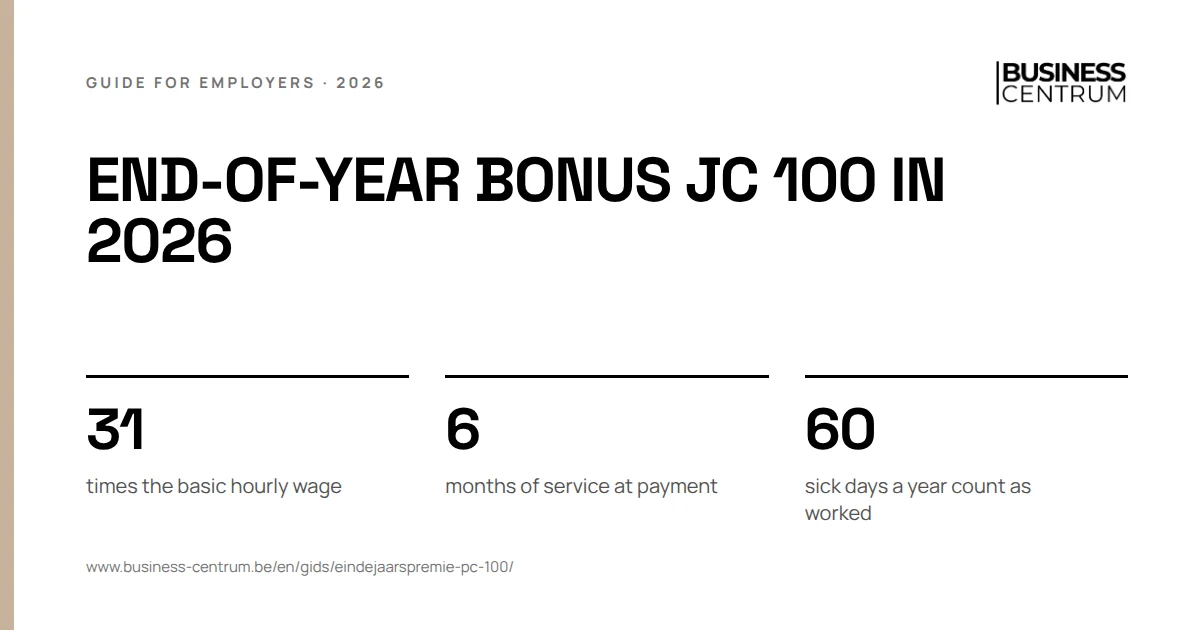
The end-of-year bonus in JC 100 is called the annual bonus in the collective agreement: 31 times the basic hourly wage in force on 1 December 2026, paid by you as the employer in December. At the time of payment the worker has at least 6 months of service. Someone who started or left during the year receives a share per calendar month worked.
An end-of-year bonus in JC 100: since when?
The Auxiliary Joint Committee for blue-collar workers introduced the annual bonus with the 2015-2016 sector agreement. It was first paid in December 2016 and was then 11 times the basic hourly wage. Since 1 December 2017 it has been 31 times the basic hourly wage. The 2017 collective agreement is open-ended and has been amended three times since, most recently in 2026, each time on the conditions and the days treated as worked. The amount itself has not changed since.
In the collective agreements database the bonus is listed under the theme end-of-year bonus, and the 2016 agreement also calls it that in one place. For your payroll, it is a compulsory sector bonus, subject to the article 9 reservation below.
Who gets the end-of-year bonus in JC 100?
The collective agreement applies to the employers and the male and female blue-collar workers of companies under the Auxiliary Joint Committee for blue-collar workers. White-collar staff are not covered.
A worker is entitled to the bonus if he meets two conditions:
- Employed at the time of payment. He is still bound by a blue-collar employment contract. For someone who leaves earlier, a separate list of cases applies, further down this page.
- At least 6 months of service at the time of payment. A break of 7 calendar days or less does not count as a break in service. A preceding period as an agency worker counts if the hiring follows the agency period and the job is similar. A period of inactivity of 7 days or less between two agency assignments counts as employment.
The article 9 reservation
The bonus does not apply to the extent that your company granted equivalent effective pay rises or other benefits in 2016 and/or in 2017-2018, at the same cost as the bonus, gross plus employer contribution. Bonuses under collective agreement no. 90 and automatic increases under a company pay scale do not count for this. The amount of those other benefits must be verifiable. If you rely on this reservation, make sure you can prove it with documents.
How much is the end-of-year bonus in JC 100?
The bonus is 31 times the basic hourly wage in force on 1 December of the year concerned, so for this year's bonus on 1 December 2026. The collective agreement does not define exactly what the "basic hourly wage" covers. The amount is granted in proportion to actual and assimilated work in the calendar year, per calendar month worked:
- someone who joins before the 16th of the month has that month counted as worked;
- someone who leaves after the 15th of the month has that month counted as worked.
For part-time workers, you adjust the amount in proportion to their work, as article 9 of national collective agreement no. 35 requires.
Worked example: a full year, a start in March and a part-timer
This is an example, not a calculation for your situation. We take a notional basic hourly wage of € 15.00 on 1 December 2026. The minimum hourly wage per category is in the JC 100 pay scale.
- Full year, full-time: 15.00 x 31 = € 465 gross.
- Joined on 10 March 2026: March counts, because he started before the 16th. That makes ten months: 465 x 10/12 = € 387.50 gross. In December he has more than 6 months of service.
- Full year, four fifths: 465 x 4/5 = € 372 gross.
If the worker only started on 1 August with no preceding agency period, he does not have 6 months of service in December and the sector agreement gives him no bonus.
Which days count for the end-of-year bonus in JC 100?
Since 1 January 2026 these days count as assimilated work:
| Absence | Counts for the bonus |
|---|---|
| Annual holidays and public holidays | in full |
| Short leave | in full |
| Maternity leave, paternity leave | in full |
| Prophylactic leave, breastfeeding leave | in full, since 2026 |
| Occupational disease, workplace accident | in full |
| Working time reduction days | in full |
| Sickness or accident | 60 days |
| Temporary unemployment, whatever the scheme | 20 days per calendar year, counted in a five-day week, since 1 January 2024 |
A worker who was temporarily unemployed for thirty days in 2026 therefore has 20 assimilated days; the rest does not count. The collective agreement does not say how to convert those days into calendar months. Choose a method, apply it equally to everyone and record it. The scheme itself is explained in our guide to temporary unemployment.
End-of-year bonus JC 100 on dismissal or leaving
If a worker leaves before the December payment, he receives the bonus pro rata to his actual work in the current calendar year, but only in these cases:
| Situation | Entitled to a pro rata bonus |
|---|---|
| Dismissal by the employer, except for serious cause | yes, with 6 months of service on leaving |
| Retirement | yes, with 6 months of service on leaving |
| Unemployment with company top-up under collective agreement no. 17 | yes, with 6 months of service on leaving |
| Permanent medical force majeure | yes, with 6 months of service on leaving |
| Death | yes, with 6 months of service on leaving |
| End of a fixed-term or specific-work contract of at least 6 months | yes, with 6 months of service on leaving |
| Resignation | yes, with at least 5 years of service with the company |
| Dismissal for serious cause | no |
An end by mutual agreement is not on the list. For someone who leaves before December, you pay the pro rata amount when he leaves. It therefore belongs in the final settlement and on the social documents on dismissal.
Note the word "actual": article 7 refers to actual work when someone leaves, while article 6 also counts assimilated work for the ordinary calculation. The collective agreement does not say expressly whether assimilated days count when someone leaves.
Example. A worker with three years of service resigns and leaves on 30 June. He does not have 5 years of service, so the sector agreement gives him no bonus. If you dismiss him on the same date, and not for serious cause, he receives six twelfths.
When do you pay the end-of-year bonus in JC 100?
Every year in December. The collective agreement sets no fixed day. The bonus goes through the ordinary payroll calculation: you withhold 13.07% personal social security and pay the employer contribution, with a basic rate of 25%. Withholding tax follows the scale for exceptional payments, for example 40.38% for a normal annual salary between € 26,340 and € 31,830. What that leaves net, you can check with our page about calculating the end-of-year bonus.
Mistakes we see with the end-of-year bonus in JC 100
- Thinking JC 100 has no end-of-year bonus. The annual bonus is compulsory, even though it has a different name.
- Applying the old amount. Since 1 December 2017 it has been 31 times the basic hourly wage, no longer 11.
- Deducting all temporary unemployment. Since 1 January 2024, 20 days a year count.
- Forgetting the agency period. A worker hired after an agency assignment in a similar job often reaches the 6 months sooner than his contract date suggests.
- Waiting until December when someone leaves. The pro rata amount is paid when the worker leaves.
What Business Centrum does for you
Business Centrum calculates your workers' annual bonus under this collective agreement, together with Acerta, as part of your payroll. We track service, assimilated days and the limit for temporary unemployment, and include the pro rata amount in the final settlement when someone leaves. The rules of the other committees are in our overview of the end-of-year bonus in 2026 by joint committee.