
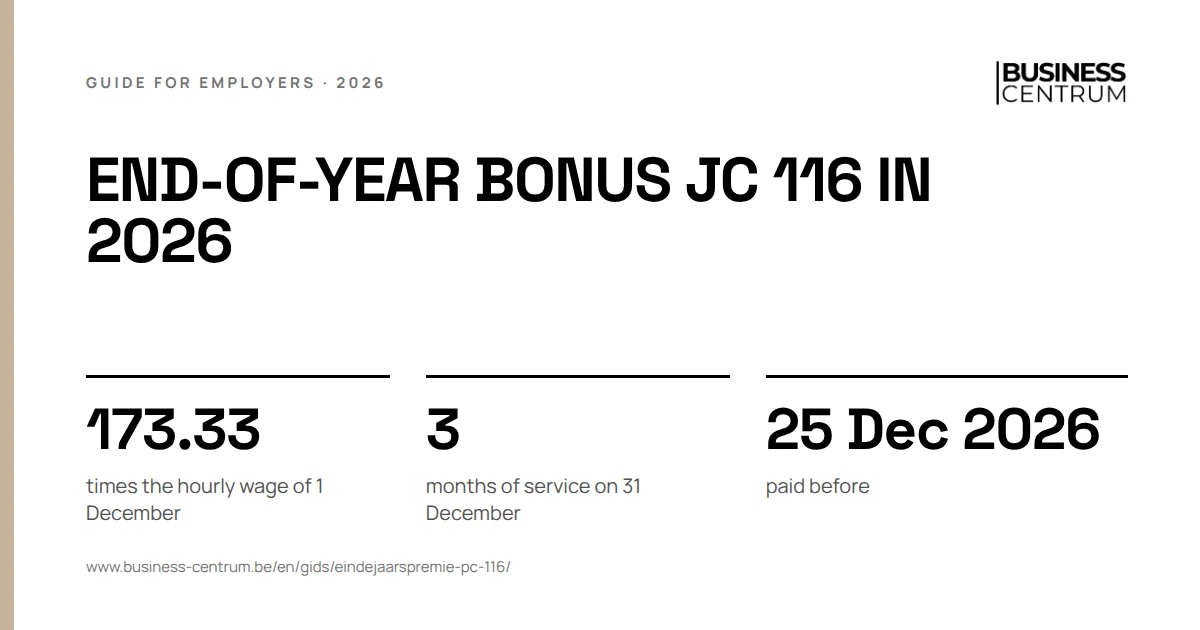
The end-of-year bonus in JC 116 is at least 173.33 times the base hourly wage in force on 1 December, in a regime of 40 hours a week. You pay it yourself as the employer, before 25 December 2026. On 31 December 2026 the worker has at least 3 months of service in the company.
Who gets the end-of-year bonus in JC 116?
The agreement applies to the employers and blue-collar workers of all companies under the Joint Committee for the chemical industry. White-collar staff in the same sector fall under JC 207 and have their own scheme. For plastics processing in West Flanders and Limburg, provincial agreements apply on top of the sector agreement, further down this page.
A worker is entitled to the bonus if two conditions are met:
- At least 3 months of service in the company on 31 December 2026.
- Employed at the time of payment. The worker is then still bound to the company by an employment contract. A separate rule applies to anyone who leaves earlier, further down this page.
If the worker first worked for you as a temp, that period does not count for the bonus. The sector counts service as a temp for other benefits in the company, but the agreement on temporary agency work expressly says this does not apply to the end-of-year bonus.
Calculating the end-of-year bonus in JC 116
The minimum base amount has been set since 1990 at 173.33 times the base hourly wage in force on 1 December of the year. That multiplier belongs to a working week of 40 hours. If wages were converted to a shorter working week, the multiplier falls proportionally. The minimum hourly wage per category is in the national JC 116 pay scale.
The agreement itself gives the multipliers for companies that reduce working hours per day or per week and calculate wages on the hours actually worked:
| Hour regime | Reduced working hours in the agreement | Bonus |
|---|---|---|
| 40 hours a week | none | 173.33 x base hourly wage |
| 39.5 hours a week | 30 minutes a week and 9 paid compensatory rest days | 171.16 x base hourly wage |
| 39 hours a week | 60 minutes a week and 6 paid compensatory rest days | 169.00 x base hourly wage |
| 38.5 hours a week | 90 minutes a week and 3 paid compensatory rest days | 166.83 x base hourly wage |
| 38 hours a week | 120 minutes a week, no paid compensatory rest days | 164.66 x base hourly wage |
If your company grants reduced working hours as paid compensatory rest days, the bonus stays at 173.33 times the base hourly wage. The agreement says nothing specific about part-time workers.
A worker who did not work the whole year receives the bonus pro rata: 1/12 of the base amount per month actually worked in the service year from 1 January 2026 to 31 December 2026. If the worker had several fixed-term contracts in the same year, they count together for the pro rata. Two rules apply to an incomplete month:
- starting before the 16th of the month counts as a month of service and a month of actual work;
- the month in which the contract ends counts in full if the contract ends after the 15th of the month.
Worked example: a worker on a 38-hour week
This is an example, not a calculation for your situation. A worker works 38 hours a week in a company that reduces working hours per week, without paid compensatory rest days. His base hourly wage on 1 December 2026 is € 18.50. He worked the whole year. His bonus is 164.66 x 18.50 = € 3,046.28 gross.
Had he started on 1 May 2026, he would have more than 3 months of service on 31 December 2026 and would have worked eight months: 3,046.28 x 8/12 = € 2,030.86 gross.
When do you pay the end-of-year bonus in JC 116?
You pay the bonus before 25 December 2026, in the year it relates to. A more favourable scheme in your company still applies. In plastics processing in Limburg the date is earlier, see below.
The bonus goes through the normal payroll calculation, with 13.07% personal social security and withholding tax under the scale for exceptional payments. What your worker keeps net and what the bonus costs you above the basic contribution of 25%, you can check with our explanation on calculating the end-of-year bonus.
Which absences count for the end-of-year bonus in JC 116?
The bonus is calculated per month actually worked. These absences are treated as actual work:
| Absence | Counts for the bonus |
|---|---|
| Occupational disease, work accident or commuting accident, recognised by the insurer | up to 12 months |
| Illness with a medical certificate, recognised by the insurer | up to 6 months in total |
| Maternity leave with a medical certificate, recognised by the insurer | in full |
| Statutory holidays, public holidays, short leave, leave for compelling reasons, educational leave, social promotion, union leave | in full |
| Partial unemployment | up to 65 days |
| Seniority and age leave under the sector agreement | in full |
| Birth leave and adoption leave | in full |
| Period covered by the sector income guarantee for compulsory removal from work during pregnancy and for breastfeeding leave | in full |
For seniority and age leave the agreement refers to two texts: until 30 June 2026 to the agreement of 29 June 2023, from 1 July 2026 to the new agreement of 13 February 2026 on that leave. In both cases the leave counts.
Anything not on the list does not count as actual work. The agreement does not say how to count a month in which the worker was partly absent for a non-assimilated reason. Choose a method, apply it equally to everyone and record it. For temporary unemployment itself, see our guide on temporary unemployment.
End-of-year bonus JC 116 on dismissal
If the contract ends during the year, the worker receives a bonus in proportion to the months actually worked, if they have 3 months of service at the end of the period covered by the statutory notice. Suspensions during the notice period are not taken into account. If you pay compensation in lieu of notice, the period it covers counts for that service.
| Situation | Right to a pro rata bonus |
|---|---|
| Dismissal by the employer | yes, with 3 months of service at the end of the covered notice period |
| Dismissal for serious cause | no |
| Resignation | yes, with at least 1 year of service at the end of the contract |
| End due to force majeure | yes, with 3 months of service at the end |
| Retirement during the year | yes, under the same conditions |
| Death during the year | yes, for the beneficiaries, under the same conditions |
| Termination by mutual agreement, unemployment with company top-up | not covered separately |
The beneficiaries are the surviving spouse, failing that the children and failing those the parents of the deceased. The agreement does not list the end of a fixed-term contract as a separate departure case; it does say that several fixed-term contracts in the same year count together for the pro rata. The amount belongs in the final settlement and on the social documents on dismissal.
Plastics processing in West Flanders: 174 times the hourly wage
For workers in plastics processing in West Flanders, provincial agreement 197638/CO/116 of 20 January 2026 applies until 31 March 2027. It differs on three points:
- Amount. The bonus stays at 174 times the base hourly wage of December, in a regime of 40 hours a week. You grant it pro rata temporis before the end of the calendar year.
- Assimilations. All seniority days and age leave count, and all days of partial unemployment are treated as actual work, not just the first 65.
- Temps. Service as a temp is not carried over on hiring for the end-of-year bonus.
For the rest you follow the rules of the sector agreement.
Plastics processing in Limburg: 174 times the hourly wage and payment before 15 December
For workers in plastics processing in Limburg, agreement 199110/CO/116 of 17 March 2026 applies. The article on the end-of-year bonus runs until 31 December 2026.
- Amount. 174 times the base hourly wage in force on 1 December, in a regime of 40 hours a week.
- Shift workers. You add the worker's average shift premium to the base hourly wage: the total of his shift premiums from 15 December 2025 to 14 December 2026, divided by his hours worked in that period.
- Payment. Pro rata temporis, before 15 December 2026.
- Assimilations. Days of partial temporary unemployment count up to 85 days. The 5 extra days of leave for compelling reasons that the agreement grants also count.
For the rest, the rules of the sector agreement of 13 February 2026 apply.
Can your company keep its own scheme?
Yes, if it is more favourable. The provisions of the agreement do not affect more favourable working conditions that exist in companies. A less favourable scheme does not replace the sector agreement: the agreement sets a minimum.
Mistakes we see with the end-of-year bonus in JC 116
- Always calculating with 173.33. With reduced working hours per day or per week and wages on the hours actually worked, a lower multiplier applies, down to 164.66 for 38 hours.
- Using the reduced multiplier with compensatory rest days. If you grant reduced working hours as paid rest days, it stays 173.33.
- Taking the hourly wage at the wrong moment. The sector agreement looks at the base hourly wage in force on 1 December.
- Treating resignation like dismissal by the employer. A worker who leaves of their own accord needs at least 1 year of service.
- Forgetting the plastics rules. In West Flanders and Limburg it is 174 times the hourly wage, and in Limburg you pay before 15 December 2026.
What Business Centrum does for you
Business Centrum calculates the end-of-year bonus of your blue-collar workers under this agreement, together with Acerta, as part of your payroll administration. We track the assimilated absences and include the bonus in the final settlement when someone leaves. The rules of the other committees are in our overview of the end-of-year bonus in 2026 per joint committee.