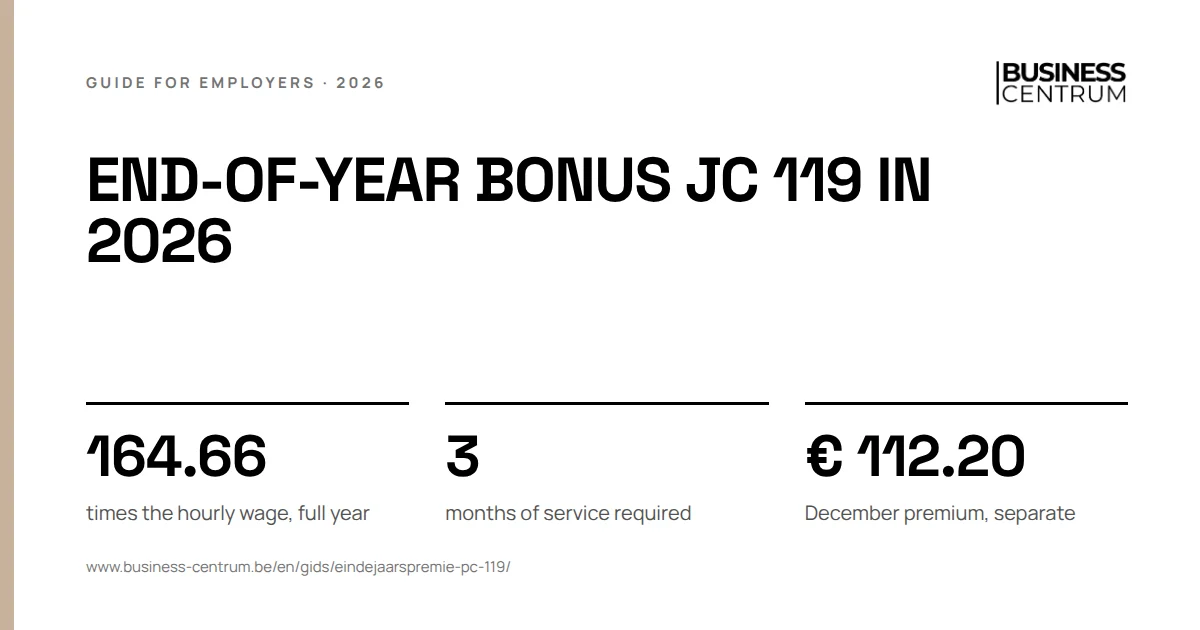
The end-of-year bonus in JC 119 is the worker's normal monthly wage, 164.66 times the hourly wage, and you as the employer pay it yourself, in the second half of December. The worker is entitled from 3 months of service, if he is in service on 31 December 2026 or falls under one of the leaving cases in the agreement. Someone who did not work the whole year gets one twelfth per full month of service.
An old agreement that still applies
The end-of-year bonus in JC 119 is set in the agreement of 23 November 2005. That agreement had a fixed term, but it is tacitly renewed every year for a period of 1 year, unless one of the parties terminates it. According to the collective agreement database of the FPS Employment, it is in force, without an end date. That database contains no later agreement that replaces or amends it.
Who gets the end-of-year bonus in JC 119?
The agreement applies to the employers and blue-collar workers of the food trade: wholesale, semi-wholesale and retail. It applies to blue-collar workers only. Whether your company falls under this committee, you can read in our guide to joint committee 119.
A worker is entitled if he has at least 3 months of service in the company, continuous or not, and if one of these three situations applies:
- He is in service on 31 December 2026. Career break, palliative leave, leave to care for a seriously ill person and parental leave also count as being in service.
- You dismissed him during the year, except for serious misconduct.
- He left the company for one of these reasons: early retirement, retirement, invalidity, end of a first-job agreement, end of a fixed-term contract, serious fault of the employer or force majeure.
Three groups also get a bonus if they do not meet those conditions:
- workers with at least 1 year of seniority who leave of their own accord during the year;
- workers with at least 3 months of seniority, not necessarily continuous, in a company that usually employs seasonal workers, in the year concerned;
- workers who joined during the year within 4 months after the end of their studies.
Calculation of the end-of-year bonus in JC 119
For a worker employed the whole year, the bonus is his normal monthly wage. The agreement writes that as 164.66 times the hourly wage, based on 38 hours a week. You calculate with the normal wage at the time of payment.
For the other workers, the bonus is one twelfth per full month of service. A month is an uninterrupted period of 30 calendar days, in February the number of days of that month.
The amount corresponds to full-time work. For a part-time worker, you set the amount pro rata to the number of hours worked. If your company uses a full-time working week other than 38 hours, the agreement does not say how to calculate.
Worked example: a full year and a partial year
This is an example, not a calculation for your situation. A full-time worker earns € 16.00 gross an hour in December and was in service the whole year. His end-of-year bonus is 164.66 x 16.00 = € 2,634.56 gross. The minimum hourly wage per category is in the JC 119 pay scale.
A colleague with the same hourly wage has seven full months of service this year and is in service on 31 December. He gets 2,634.56 x 7/12 = € 1,536.83 gross. If he works half-time, that amount is calculated pro rata to his hours worked.
When do you pay the end-of-year bonus in JC 119?
The agreement has two moments:
- to workers in service on 31 December 2026: in the second half of December, unless a deviation is jointly approved at company level;
- to the other workers: at the moment they leave the company.
The bonus goes through the normal payroll, with 13.07% personal social security and withholding tax under the scale for exceptional payments. What the bonus costs you on top of the basic contribution of 25%, you can check with our explanation of calculating the end-of-year bonus.
Which absences reduce the end-of-year bonus in JC 119?
The agreement refers to the annual holiday legislation. You reduce the bonus for absences during the year that are not assimilated under that legislation. Absences that the holiday legislation assimilates therefore do not reduce the bonus. The agreement gives no list of its own.
How exactly you calculate the reduction, in days or in months, the agreement does not set. Choose a method, apply it equally to everyone and record it.
End-of-year bonus JC 119 on dismissal or leaving
If a worker leaves during the year, you pay the bonus when he leaves, one twelfth per full month of service. The agreement settles the cases as follows:
| Situation | Right to a bonus |
|---|---|
| Dismissal by the employer, except for serious misconduct | yes, with 3 months of service |
| Dismissal for serious misconduct | no |
| Early retirement or retirement | yes, with 3 months of service |
| Invalidity or force majeure | yes, with 3 months of service |
| End of a fixed-term contract or a first-job agreement | yes, with 3 months of service |
| Leaving because of a serious fault of the employer | yes, with 3 months of service |
| Resignation | only with at least 1 year of seniority |
| End by mutual agreement | the agreement does not expressly cover this case |
On an end by mutual agreement, the agreement says nothing. If in doubt, ask for advice before you prepare the final settlement.
Example. A worker who joined on 1 February resigns and leaves on 30 September. He has eight months of seniority and not a year, so the agreement gives him no bonus. If you dismiss him on the same date, he is entitled: eight twelfths of his bonus, for eight full months of service.
What can your company arrange itself?
- Similar benefits. The bonus is not automatically due if similar benefits actually paid during the year already reach or exceed the amount.
- Conversion into other benefits. After an agreement in the company with the delegates of the most representative workers' organisations, you may convert the bonus into other benefits that give equivalent compensation.
- A different payment moment. Only if the deviation is jointly approved at company level.
The December premium: a separate premium
Besides the end-of-year bonus, JC 119 has an annual premium payable in December, in its own agreement (196822/CO/119 of 10 December 2025). It amounts to € 112.20 for a worker employed the whole year, and one twelfth per full month of work for the others. A worker is entitled with at least 1 month of work in the year. You pay it in the second half of December. It applies in companies that did not convert the sector's original December premium into an equivalent benefit, and it is not automatically due if similar benefits already reach the amount. The agreement runs until 30 June 2027. The January premiums and the sector's other premiums are in our guide to the committee.
Mistakes we see with the end-of-year bonus in JC 119
- Counting the December premium as the end-of-year bonus. They are two premiums, each with its own agreement.
- Deducting assimilated absences. What the holiday legislation assimilates does not reduce the bonus.
- Forgetting a seasonal worker or school leaver. They are entitled under conditions, even without meeting the ordinary conditions.
- Refusing the bonus on resignation after a year. With at least 1 year of seniority, the worker is entitled.
- Calculating with an average hourly wage for the year. The agreement uses the normal wage at the time of payment.
What Business Centrum does for you
Business Centrum calculates the end-of-year bonus and the December premium of your workers under the JC 119 agreements, together with Acerta, as part of your payroll administration. We track seniority and absences and put the bonus in the final settlement when someone leaves. The rules of the other committees are in our overview of the end-of-year bonus in 2026 per joint committee.