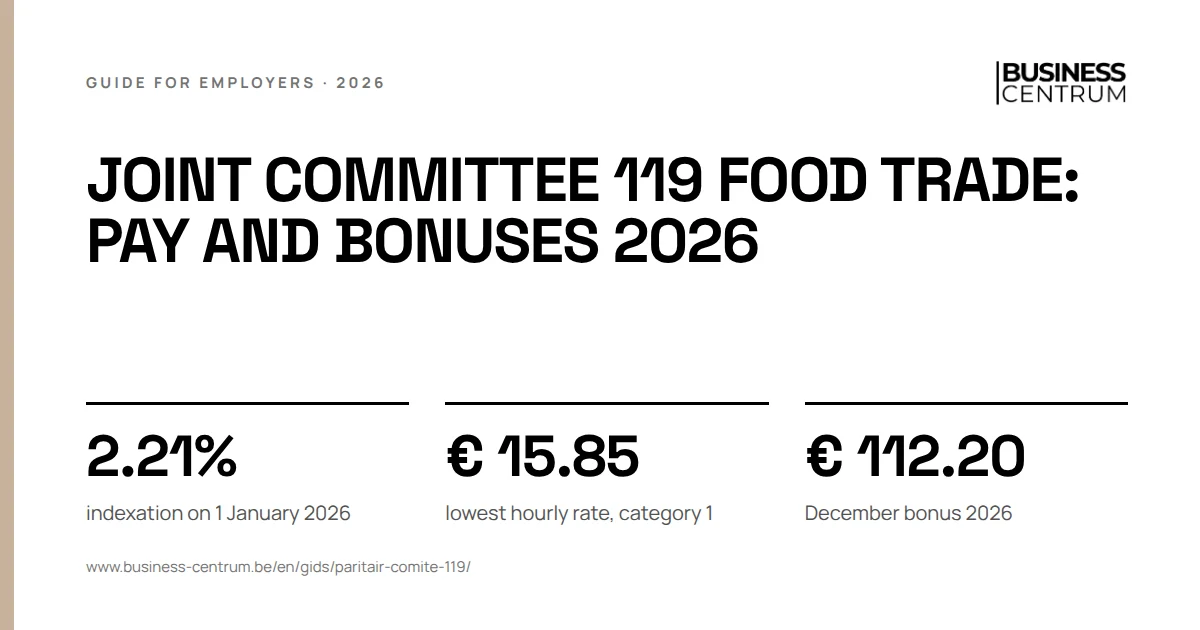
Joint committee 119 covers blue-collar workers in food wholesale, semi-wholesale and retail in Belgium. On 1 January 2026 wages rose by 2.21%: the lowest hourly rate is now € 15.85 gross, on a 38-hour week. You pay the year-end bonus, a December bonus and two January bonuses yourself. JC 119 has no notice periods of its own.
Who falls under joint committee 119?
JC 119 covers workers who mainly do manual work in companies that trade in food, wholesale, semi-wholesale or retail, without processing it beyond what is needed to pack it. Think of order pickers, warehouse staff, delivery drivers, shelf fillers and butchers at a food wholesaler, a cash-and-carry or an independent food shop.
The boundaries with other committees:
| Situation | Committee |
|---|---|
| Blue-collar staff of a food wholesaler | JC 119 |
| White-collar staff of a food wholesaler | JC 200 |
| White-collar staff of a small food shop (fewer than 20 employees) | JC 201 |
| White-collar staff of a medium food retailer (20 employees or more, at most 2 outlets) | JC 202.01 |
| Workers who produce or process food | JC 118 (food industry) |
| Purely logistics services for third parties | not JC 119 |
A food wholesaler therefore nearly always has two committees: JC 119 for the warehouse and JC 200 for the office. The scales for those white-collar staff are on our JC 200 page. If you also make products yourself, such as cooked meats, the company's main activity decides. If trade remains the core, you stay in JC 119. If production becomes the main activity, JC 118 may apply, with JC 220 for the white-collar staff. Your articles of association do not settle it.
Which pay scale applies in JC 119 in 2026?
JC 119 scales are hourly rates for a working week of 38 hours. They depend on four things: the job category, the number of employees in your company, seniority, and the choice your company made in 2012 about eco vouchers. The table shows the starting rate on scale I since 1 January 2026.
| Category | Fewer than 10 employees | 10 to 49 employees | 50 employees or more |
|---|---|---|---|
| 1 | € 15.85 | € 15.87 | € 16.35 |
| 2 | € 15.97 | € 16.03 | € 16.51 |
| 3 | € 16.45 | € 16.57 | € 17 |
| 4 | € 16.99 | € 17.13 | € 17.56 |
| 5 | € 17.65 | € 17.69 | € 18.21 |
Seniority. After four years' service the scale rises to 101% of the starting rate, after eight years to 102% and after twelve years to 103%. The highest minimum hourly rate in the sector is € 18.85, for category 5 after twelve years in a company with 50 or more employees, on scale II.
Scale I or II. In 2012 the sector converted the eco vouchers. Companies that converted them into another benefit, usually a higher meal voucher, follow scale I. Companies that did not follow scale II, where the hourly rate is € 0.09 higher. Scale II also applies to every company founded since 1 January 2016 or that has only hired blue-collar workers since then. If your company existed before and you do not know which scale you apply, look at your 2012 meal vouchers.
Young workers. A regular worker aged 15 or 16 receives 70% of the scale, at 17 77.50% and from 18 100%. For students, apprentices and trainees the scale rises more slowly up to age 21.
Indexation in joint committee 119 in 2026
JC 119 indexes once a year, on 1 January. Both minimum and actual wages go up. If you pay above the scale, you index that higher wage too.
| Indexation on 1 January | Percentage |
|---|---|
| 2026 | 2.21% |
| 2025 | 3.58% |
| 2024 | 1.48% |
| 2023 | 11.08% |
The next indexation falls on 1 January 2027. It will also be the first JC 119 indexation under the cent index, which has applied since 1 June 2026. For a reference wage above € 4,000 per month, indexation is temporarily limited to 2% on the threshold. For a blue-collar worker the NSSO converts the hourly wage with the formula hourly wage x 38 x 13 / 3. The rule only applies above an hourly wage of about € 24.29, so in practice only for your best-paid workers. More in our piece on wage indexation in 2026.
Year-end bonus in joint committee 119
In JC 119 the employer pays the year-end bonus directly, not the social fund. The rules:
- Amount: 164.66 times the December hourly wage. On 38 hours a week that is exactly one month's pay.
- Condition: at least 3 months' service in the company, continuous or not.
- Pro rata: the bonus follows the days worked and treated as worked in the calendar year and the employment fraction. A half-time worker gets half.
- Leaving during the year: the worker keeps the right on dismissal by you (not for serious cause), retirement, the end of a fixed-term contract or force majeure. A worker who resigns is only entitled after at least 1 year's seniority.
- Payment: in the second half of December, or on leaving for a worker who leaves the company.
Worked example. An order picker you placed in category 2, in a company with 10 to 49 employees and with five years' service, earns € 16.19 an hour. His year-end bonus for a full year is 164.66 x 16.19 = € 2,665.85 gross.
A full guide by sector, with the days treated as worked and the NSSO on the bonus, is in calculating the year-end bonus.
December and January bonuses: what else do you pay?
On top of the year-end bonus, JC 119 has three bonuses that are often forgotten. They are due unless your company converted them earlier into an equivalent benefit, such as a higher meal voucher:
| Bonus | Amount 2026 (full year) | When |
|---|---|---|
| December bonus | € 112.20 | in December |
| January bonus, first part | € 66.17 | with January's wages |
| January bonus, second part | € 185.26 | with January's wages |
Anyone who did not work the full year receives one twelfth of the December bonus per full month. Companies with 50 employees or more also pay two January bonuses under a 2014 agreement: € 165.42 and € 78.54 gross per full-time worker for a full year, holiday pay included, unless these were converted too. There are also supplements that depend on the work:
- Shift and afternoon premium: € 0.34 an hour.
- Cold premium: 2% on wages for work in cold stores or refrigerated vehicles below 8 degrees, 5% below 5 degrees and 10% for frozen goods.
- Seniority leave: since 2026, one extra day off after 20 years' unbroken service. If you already grant seniority leave, this day counts towards it.
Meal vouchers and travel in JC 119
Meal vouchers. Since 1 April 2026 you raise the employer share of your meal vouchers by € 1.50. If you did not give meal vouchers yet, you introduce them with that amount as the employer share. Companies with fewer than 20 blue-collar workers on 31 March 2026 are exempt. You count per head, not in full-time equivalents, and per legal entity. There is one voucher per day actually worked, regardless of the hours. By law the employer share may not exceed € 8.91. What the new maximum voucher means is covered in the new maximum meal voucher.
Commuting. For own transport over more than 2 km you pay 100% of the price of a second-class rail pass for the same distance. The cycling allowance is € 0.29 per kilometre single distance, per day worked, from the first kilometre.
The JC 119 Guarantee and Social Fund
Through the NSSO you pay a contribution to the Guarantee and Social Fund for the food trade: a basic contribution of 0.35% of the wages of all blue-collar workers, calculated on wages at 108%. On top of that you pay an employment contribution for risk groups: 0.32% until 1 July 2026 and 0.27% since then.
What the fund pays:
- To your workers: a supplement of € 5.40 per day for temporary unemployment (at most 60 days a year), long-term sickness (60 days after guaranteed pay), dismissal for force majeure and collective dismissal (120 days). For temporary unemployment the fund calculates this itself from the Crossroads Bank data. For long-term sickness you file a request as the employer.
- To you: an employment bonus of € 1,569.46 if you hire someone from an at-risk group full-time on a permanent contract, such as a long-term jobseeker or a low-skilled jobseeker. For a worker under 26 it is € 2,354.19. You apply after 6 months' service, via eFunds.
Flexi-jobs in joint committee 119
The food trade has been allowed to use flexi-jobs since 1 January 2018, long before the general extension of 1 July 2026. Outside hospitality, flexi pay is at least the scale wage for the job and at most 150% of it. On top you pay 7.67% flexi holiday pay and a special contribution of 28%.
Worked example. A flexi-jobber in category 1, in a shop with fewer than 10 employees:
- Flexi pay of at least € 15.85 an hour.
- With flexi holiday pay: 15.85 x 1.0767 = € 17.07 an hour, net for the flexi-jobber.
- Special contribution: 28% of 17.07 = € 4.78.
- Cost per hour to you: € 21.85.
The flexi-jobber may not work for you under another contract at the same time and must have worked enough elsewhere in quarter T-3. All conditions are in the cost of a flexi-job.
JC 119 or JC 201: what is the difference?
| JC 119 | JC 201 | |
|---|---|---|
| For whom | blue-collar, food wholesale and retail | white-collar, independent retail |
| Pay | hourly rate by category and size | monthly salary by group and size |
| Indexation | every year on 1 January, 2.21% in 2026 | when the pivot index is exceeded, 2% on 1 May 2026 |
| Year-end bonus | paid by the employer | own sector scheme |
A food shop with a butcher and two cashiers therefore applies JC 119 to the butcher and JC 201 to the cashiers. The scales for those white-collar staff are on our JC 201 page.
Notice in JC 119
JC 119 no longer has notice periods of its own. Since the single status, blue-collar workers follow the same statutory periods as white-collar staff. Only seniority from before 2014 may still count under an old sector rule. For contracts starting from 1 August 2026, notice in the first six months is 1 week, after one year 8 weeks. For contracts from 1 June 2026 a cap of 52 weeks applies.
Worked example: what does an order picker cost per month?
The same order picker, category 2, 10 to 49 employees, five years' service, full-time at € 16.19 an hour, in a company with at least 20 blue-collar workers that introduces meal vouchers. Average monthly cost in 2026:
| Item | Calculation | Amount |
|---|---|---|
| Gross wage | 16.19 x 38 x 13 / 3 | € 2,665.95 |
| Employer NSSO | 25% on 108% (2,879.23) | € 719.81 |
| Holiday contribution | 15.84% on 2,879.23 | € 456.07 |
| Fund contribution | 0.35% on 2,879.23 | € 10.08 |
| Year-end bonus | 2,665.85 / 12 | € 222.15 |
| December and January bonuses | 363.63 / 12 | € 30.30 |
| Meal vouchers | 21 days x 1.50 | € 31.50 |
| Total per month | € 4,135.86 |
For blue-collar workers the holiday contribution replaces the holiday pay you pay a white-collar employee directly. Not included: NSSO on the bonuses, the structural reduction, the employment contribution and occupational accident insurance.
Checklist: a new worker in JC 119
- Set the category based on the work actually done, not the job title.
- Choose the right table: your company size class and scale I or II.
- File the Dimona before the first working day. How it works is explained in what is Dimona.
- Start meal vouchers if you had 20 blue-collar workers or more on 31 March 2026.
- Set the commuting allowance: rail pass, own transport or bicycle.
- Put the bonuses in your calendar: January bonuses in January, December bonus and year-end bonus in December. Track the seniority steps as well.
- Record cold and shift hours separately so the supplements are right.
Mistakes we often see in JC 119
- The wrong scale. A company growing from 9 to 12 employees moves to a higher table. Miss it and you underpay.
- Scale I without conversion. A company that did not convert the eco vouchers in 2012 must pay scale II, still today. The same goes for any company founded since 1 January 2016 or that has only had blue-collar workers since then.
- January bonuses forgotten. They are missing from most standard payslips and are claimed back in an inspection.
- Cold premium not recorded. Without records of hours in cold stores or freezers you cannot prove what you paid.
- White-collar staff in JC 201 while you are a wholesaler. A wholesaler's white-collar staff fall under JC 200.
What Business Centrum does for you
Business Centrum runs the payroll administration of wholesalers and food shops in East Flanders, together with Acerta. We set the right scale and size class, apply the January indexation, pay the December and January bonuses on time and track cold and shift premiums. See also how we work for wholesale.