
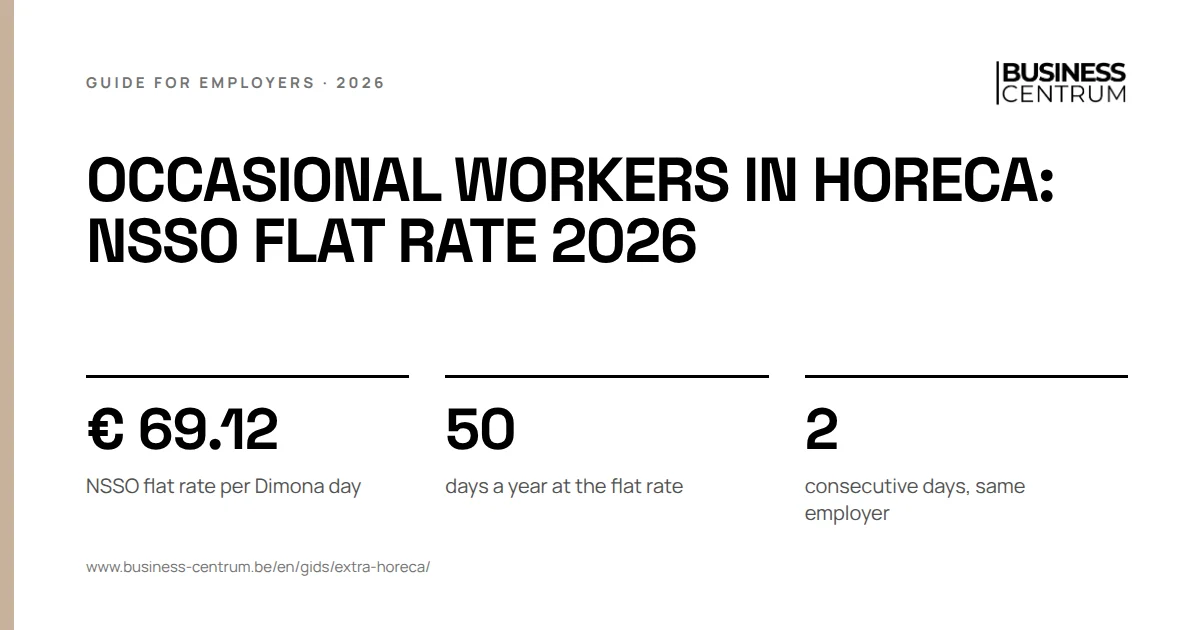
Occasional workers in horeca, known in Belgium as extras, are staff you employ in joint committee 302 for at most 2 consecutive days, on a fixed-term contract or a contract for a clearly defined job. You then pay NSSO contributions not on their real wage but on a flat rate of € 11.52 per hour or € 69.12 per day. That advantage applies as long as the extra stays within his 50 days a year and you stay within your 200 days. The wage itself remains the pay scale of the function.
Occasional workers in horeca at a glance
| Rule | What applies since 1 July 2026 |
|---|---|
| Maximum in a row with the same employer | 2 consecutive days |
| NSSO flat rate with a Dimona in hours | € 11.52 per hour started, at most € 69.12 per day |
| NSSO flat rate with a Dimona per day | € 69.12 per day |
| Increase for a manual worker | 8% on the flat rate |
| Minimum length of a Dimona in hours | 2 hours |
| Quota of the extra | 50 days per calendar year |
| Quota of the employer | 200 days per calendar year |
| Right to a year-end bonus via the Fund | from 44 days with the same employer in a calendar year |
The NSSO adjusts the flat rate to the index and to wage trends in the sector. In the second quarter of 2026 it was still € 11.29 per hour and € 67.74 per day. So check at every new quarter which amount your payroll uses.
The flat rate is only the basis for the social security contributions. It says nothing about what you pay the extra. What you owe him is explained further down, under pay.
Conditions for occasional workers in horeca
The NSSO treats someone as an occasional worker in horeca when three conditions are met together:
- The employer falls under JC 302, or a temporary work agency places the worker with a horeca user.
- The contract is fixed-term or for a clearly defined job. An open-ended contract never makes someone an extra.
- The employment lasts at most 2 consecutive days with the same employer or user.
If the extra works for you for more than 2 consecutive days, he is an ordinary employee for all of his work. Not only the third day falls outside the status, the first two do as well. The NSSO gives its own example: an extra works on 3 and 4 May and you declare him with a Dimona EXT. If he also works on 5 May, you cancel both Dimona EXT declarations and file a new Dimona OTH from 3 to 5 May.
The reverse is allowed. The NSSO accepts that you declare someone who works no more than two days as an ordinary employee anyway. The flat rate is a choice, not an obligation.
If the extra comes through a temporary work agency, his days are deducted from the user's quota, so from yours. The agency enters your company number and your joint committee in the Dimona for that purpose.
Horeca extra contract: in writing or not?
In Belgium a fixed-term contract or a contract for a clearly defined job normally has to be in writing, for each worker and at the latest when he starts. Without a written document it counts as an open-ended contract. The FPS Employment makes an exception for sectors where a collective agreement made generally binding by royal decree allows another form, and names the extras in horeca explicitly as an example.
So you do not have to get an extra to sign a contract. A written contract is still allowed, and it matters for the Dimona once the quota is used up: without a written contract the type stays EXT, with a signed contract it becomes OTH.
NSSO for occasional workers in horeca: the flat rate per hour and per day
The contributions for an extra depend on how you declare him in the Dimona.
- Dimona in hours. You report the start and end time, with a minimum of 2 hours. Every hour started counts as a full hour at € 11.52, with a maximum of € 69.12 per day.
- Dimona per day. You only report the start time. The NSSO then always counts 6 hours, whether the extra works less or more: € 69.12 per day.
On that flat rate you apply the ordinary contribution rates. For a manual worker you first increase the flat rate by 8%, just as for an ordinary manual worker's wage. You may switch systems from day to day.
The extra's social rights do not run through the flat rate. In the DmfA you always report his real hours. The NSSO calculates his rights, such as a manual worker's holiday pay, on the café waiter flat rate of € 155.75 per day or € 20.49 per hour.
Worked example. An extra works as a manual worker on the floor, in category I with 0 years in the function.
| Situation | Base | After the 8% increase |
|---|---|---|
| 5 hours with a Dimona in hours | 5 x € 11.52 = € 57.60 | € 62.21 |
| 5 hours with a Dimona per day | € 69.12 | € 74.65 |
| 8 hours with a Dimona in hours | 8 x € 11.52 = € 92.16, capped at € 69.12 | € 74.65 |
| 8 hours as an ordinary employee | 8 x € 15.21 = € 121.68 | € 131.41 |
For a short shift the Dimona in hours is cheaper. From 6 hours both systems come to the same amount. As an ordinary employee you pay contributions on the full wage, here almost twice the flat rate.
Occasional workers in horeca beyond the limits: when the quota runs out
The flat rate applies to a limited number of days, at two levels at once:
- 50 days per calendar year per extra, all employers combined.
- 200 days per calendar year per employer, for all your extras together.
A day is only deducted when both quotas still have days left. A day counts as one day. If the extra works for two employers on the same day, one day comes off his quota. If you employ five extras on the same day, one day comes off yours. If he works only a few hours, or if a shift runs past midnight without a break, that also counts as one day.
When one of the quotas runs out, you get a warning through the Dimona. The extra may keep working, but with ordinary contributions on his real wage, or on the flat daily wage if he is paid with tips. In the Dimona the type stays EXT if there is no written contract, or becomes OTH with a signed contract. In the DmfA you enter an E in the zone for occasional horeca workers.
You can see how many days an extra has left in the online application Horeca@work - 50 days. The extra can also give you a certificate with his remaining days and an access code. With that code you consult his quota online. The code is valid for 3 months, including the month in which it was created.
Dimona for occasional workers in horeca: type, timing and changes
You declare an extra with a Dimona of type EXT, per employment and per day. The start and end date are the same. If a shift runs past midnight, you report the real dates and times: for example in service on 11 April at 22:00 and out of service on 12 April at 02:00. A correct and timely Dimona is an absolute condition for the flat rate.
If you notice before the shift starts that you chose the wrong system, hours or day, you cancel the declaration and file a new one straight away. Once the shift has started, that is no longer possible. In the DmfA you then follow the system of the Dimona, with the real hours for the social rights.
The time limits for changes:
- Start time. If the extra starts earlier or later, you change the start time at the latest when he starts.
- Earlier end. You have until midnight after the planned end time to report the real end time.
- Later end. You have 8 hours after the planned end time. If the planned end was between 20:00 and midnight, you have until 8:00 in the morning.
- Another day. If he works earlier than reported, you change the date. If he works later, you cancel and file a new declaration.
- No work done. If the extra does not come in, you cancel the Dimona at the latest at midnight of that day.
A missing Dimona is a level 4 offence under the Social Criminal Code. The administrative fine ranges from € 3,000 to € 35,000 per worker, and the NSSO can charge a solidarity contribution of at least € 3,674.09 per worker. How to file a Dimona and through which channels is explained in our guide to the Dimona declaration.
Time registration and the certified cash register for an extra
If you choose a Dimona per day, the declaration has no end time. That is why you then have to enter the extra in the working-time register, even if his quota is used up. You get that register from the Horeca Social and Guarantee Fund. With a Dimona in hours, the start and end time are already in the declaration.
According to the NSSO, attendance registration through the certified cash register system or the NSSO's alternative system (ASA) did not apply to occasional workers. It was a condition for the target group reduction for permanent horeca staff, which was stopped on 1 July 2026. The cash register system or the ASA never replaces the Dimona. For your extras you keep the Dimona and, with a Dimona per day, the register.
Pay of an extra: the JC 302 pay scale
For his pay, an extra is an ordinary employee. You pay at least the pay scale of the function category he works in. The minimum wages in JC 302 were last adjusted on 1 January 2026. Some minimum hourly wages at 0 years in the function, in a 38-hour week:
| Category | Minimum hourly wage |
|---|---|
| I | € 15.21 |
| III | € 15.30 |
| V | € 16.88 |
| VII | € 19.71 |
All categories and years are on our pay scale page for JC 302, as the FPS Employment publishes them. If the extra works in a function paid with tips or service charges, the flat daily wages per function apply to the contributions outside the quota.
An extra can also be entitled to a year-end bonus via the Fund. The JC 302 collective agreement requires him to have worked at least 44 days with the same employer in a calendar year, however long those days were.
Extra, flexi-job or student: what fits your business?
Three statuses look alike, but the rules differ a lot.
| Extra | Flexi-job | Student | |
|---|---|---|---|
| Dimona | EXT, per day | FLX | STU |
| Limit | 2 consecutive days, 50 days a year at the flat rate | at least 4/5 elsewhere in quarter T-3, or retired | 650 hours a year with solidarity contribution |
| Contributions | ordinary contributions on the flat rate | special employer contribution of 28% | solidarity contribution, 5.42% for the employer |
| Pay | JC 302 pay scale | minimum flexi wage of € 12.11 per hour in horeca, plus flexi holiday pay | JC 302 pay scale |
A student can combine both: 650 hours as a student and, on top of that, 50 days as an extra. For the student hours you file a Dimona STU, for the days as an extra a Dimona EXT. What else you arrange for a student is on employing students. The flexi-job in horeca is explained in flexi-jobs in hospitality, and all 2026 rules in our flexi-job guide.
Pitfalls with occasional workers in horeca
- The third day. An extra who works three days in a row is an ordinary employee for all three days. Cancel the Dimona EXT declarations and file a Dimona OTH for the whole period.
- A Dimona per day without the register. An extra with a Dimona per day belongs in the working-time register, even if his quota is used up.
- The quota not checked. Your extra may have used part of his 50 days elsewhere. Check before you apply the flat rate.
- The flat rate used as pay. The flat rate is only the NSSO base. Pay at least the pay scale.
- A late Dimona. Filing the Dimona after the shift has started loses the flat rate for that day and exposes you to the sanction.
- A later end time not reported. With a Dimona in hours you report a longer shift within 8 hours. Otherwise the base is wrong.
What to check now
- Check for every extra of the past weeks that he never worked for you more than 2 days in a row.
- Make sure your payroll has used € 11.52 and € 69.12 since the third quarter.
- Count how many of your 200 days you have already used this year.
- For every Dimona per day, check that the extra is in the register.
- Compare the hourly wage of every extra with the pay scale of his category in JC 302.
What Business Centrum does for you
Business Centrum processes your payroll together with Acerta, including the pay of your extras, flexi-jobbers and students. You have one fixed contact person in Ghent who knows your file. How we work for horeca businesses is described on social secretariat for horeca and horeca payroll. Would you like us to go through your extras together? Request a call back.