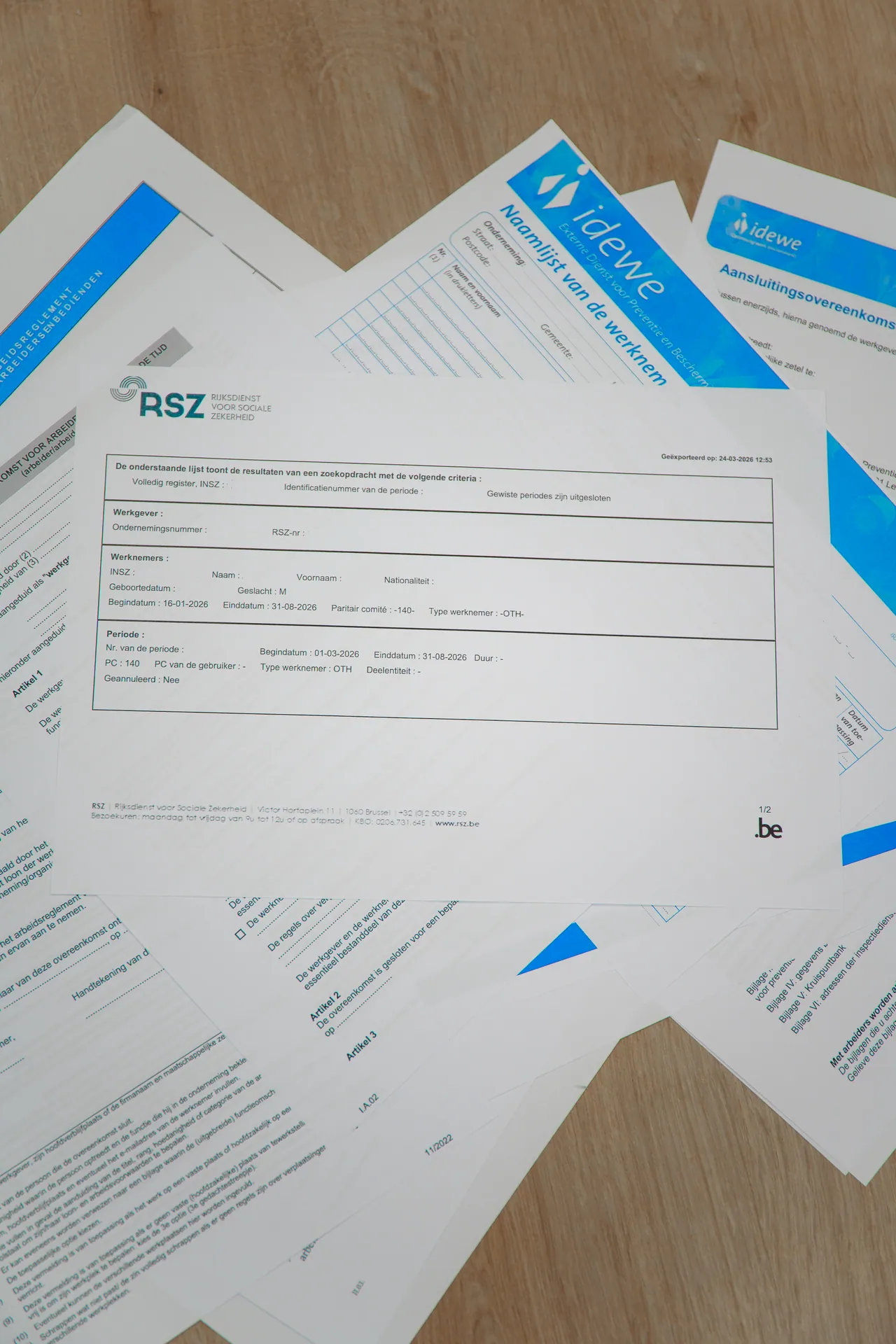
A Dimona declaration in Belgium is the electronic message with which you tell the NSSO (RSZ/ONSS) that an employee is joining or leaving. You file the Dimona IN at the latest when the employee starts work, and the Dimona OUT no later than the first working day after the contract ends. You file it online through the social security portal, yourself or through your social secretariat, for every employee, including a student or a flexi-jobber.
What the Dimona is and why it exists is briefly explained in what is Dimona. This guide is about doing it: when, how, with which data and for which type of employee.
Dimona declaration: the four types and their deadlines
The NSSO has four types of declaration. Each has its own latest moment.
| Declaration | Latest moment |
|---|---|
| Dimona IN | At the latest when the employee starts work |
| Dimona OUT | No later than the first working day after the contract ends |
| Change (update) | Earlier start date: before the employee starts. Earlier end date: the first working day after leaving. Later end date: the first working day after the end date reported earlier |
| Cancellation (cancel) | No later than the start date reported |
If an employee does not start after all, cancel the declaration no later than the start date. If they work longer or shorter than reported, you adjust the Dimona with a change. You report an open-ended contract without an end date. For a fixed-term contract you fill in the end date as soon as you know it.
What do you need for a Dimona declaration in Belgium?
For your first Dimona you must be identified as an employer with the NSSO. You do this through the online service WIDE: you then receive your NSSO number straight away. If you are just taking your first steps as an employer, also read becoming an employer in Belgium.
For each declaration you fill in:
- your company number or the NSSO number of your business;
- the employee's national register number, or their identification details if you do not have that number;
- the joint committee they belong to;
- the type of employee, such as OTH, STU or FLX;
- the start date and, if you already know it, the end date;
- for occasional workers, also the start and end time.
Filing a Dimona: the channels
| Channel | When it is useful |
|---|---|
| Staff register (personeelsbestand), secure | You want to declare securely, several employees at once and with an overview of your staff |
| Dimona, unsecured | You do not have a login yet, or you want to file a single declaration quickly without logging in |
| Dimona Mobile | You declare or adjust from your smartphone |
| Batch or web service | You send dozens of declarations or more every week |
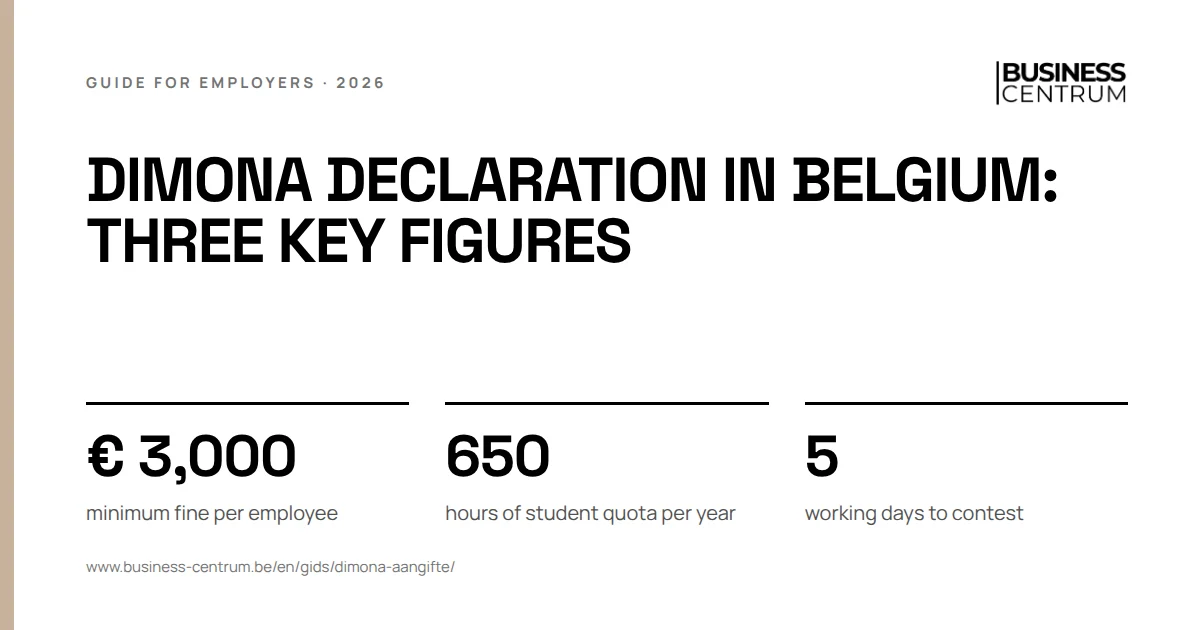
After each declaration you receive a notification: accepted, refused or pending. Only an accepted Dimona IN creates the period. If something in the notification is wrong, you contest it within 5 working days. If the portal is down because of a technical problem, try another channel and report the problem through the NSSO's emergency procedure. An outage does not automatically justify a late declaration.
Filing a Dimona declaration: step by step
- Have the employee sign the contract and note their national register number.
- Choose the right type of employee and the joint committee. For a student that is STU, for a flexi-jobber FLX, and in other cases usually OTH.
- File the Dimona IN before the first working day. In the staff register or through the unsecured service.
- Check the notification. If it is refused, read the code, correct it and send it again, before the employee starts.
- Adjust if the schedule changes. You report a different start or end date with a change.
- File the Dimona OUT no later than the first working day after the contract ends.
Dimona for a student: type STU and the quota
For a student with a student employment contract you always file a Dimona, whatever the period. You declare them as STU, no later than the day they start, with the number of planned hours per quarter. Only then do you get the reduced solidarity contribution. A student has a quota of 650 hours per calendar year at that contribution. Without a timely Dimona STU, that advantage is lost and you pay the normal contributions. An example. A student works three days a week in your shop in July and August 2026, 150 hours in total. You file a Dimona STU for the third quarter with 150 planned hours, no later than their first working day. If they come back in December for the festive season, you file a new Dimona STU for the fourth quarter, with the hours for that period.
More in Dimona for a student and under student workers.
Dimona declaration for a flexi-job: type FLX
You declare a flexi-jobber with the type FLX, per quarter. That can be done at the earliest 1 month before the start of the quarter and must be done before the first work. With an oral flexi-job contract the declaration is made per day, with start and end time. With every Dimona FLX the NSSO checks the conditions and answers OK or NOK: only after OK does the employee work as a flexi-jobber.
In the hospitality sector, you also record the flexi-jobber's start and end time every day, with the registered cash register system or the alternative attendance registration system in the staff register. More in Dimona for a flexi-jobber and under flexi-jobbers.
Other employees: occasional work, apprentices, agency workers
- Occasional workers in agriculture, horticulture and hospitality have their own rules and a declaration with start and end time. You report a later end time within 8 hours.
- Apprentices in dual learning are declared with the type ALT.
- Agency workers are declared by the agency, because it is their employer. If you hire an agency worker yourself, you file your own Dimona. See Dimona for an agency worker.
- No Dimona is needed for some interns, for people working under a PWA employment contract (local employment agency) and for volunteers.
Mistakes in the Dimona declaration that we often see
- Filing on the first working day itself, after the start. The Dimona IN must be in place before the employee starts. Even an hour late is late.
- The wrong type. Declaring a student as OTH costs you the reduced contribution, a flexi-jobber as OTH the flexi-job rates.
- Not adjusting a student's planned hours. If they work more hours than declared, adjust the Dimona STU.
- Leaving an employee who does not turn up. Cancel the declaration no later than the start date. What else to do is in employee does not turn up.
- Letting someone work longer without a change. If a temporary contract continues, report the new end date on the first working day after the end date reported earlier.
- Forgetting the Dimona OUT after a dismissal. It is part of the exit, together with the C4. See dismissal in Belgium.
Dimona and DmfA: two different declarations
The Dimona only reports that someone is joining or leaving, at the moment itself. You then report pay and working time each quarter in the DmfA, the multifunctional declaration the NSSO also uses to calculate contributions. A correct Dimona is therefore the basis: without a period in the staff register, the DmfA will not be right either. More about that quarterly return in what is DmfA.
What does a missed or late Dimona declaration cost?
A missing or late Dimona is a level 4 offence under the Social Criminal Code. The administrative fine is € 3,000 to € 35,000, per employee concerned. The NSSO can also claim a solidarity contribution of at least € 3,674.09 per employee, for 2026. A late declaration also causes problems for the employee: blue-collar workers can receive their holiday pay later, and benefits such as child benefit can be delayed.
Do you notice that a declaration was forgotten? File it straight away and keep proof of when the employee started. What exactly to do next and what the inspectorate checks is in late Dimona.
Does your social secretariat file the Dimona declaration?
You can have the declarations filed by a social secretariat or another service provider you give a mandate to. According to the NSSO, you then remain ultimately responsible for your declarations. Two practical consequences:
- Pass on every new hire in good time, with the contract and national register number, so that the Dimona IN is in place before the first working day.
- Agree attendance registration separately if you work with flexi-jobbers in the hospitality sector. A Dimona does not mean that the daily registration has also been done.
Through the secure environment you can always check yourself in your staff register what has been declared.
Everything about the Dimona
- What is Dimona: the declaration explained.
- Late Dimona: what to do if it went wrong.
- Dimona for a student: type STU.
- Dimona for a flexi-jobber: type FLX.
- Dimona for an agency worker: who files it.
- Dimona management by Business Centrum: we handle the declaration for you.
Business Centrum files the Dimona IN, the changes and the Dimona OUT for every employee, including students and flexi-jobbers, and follows up the notifications. That runs together with Acerta, within your payroll. Want to know how that works for your business? Ask us.