
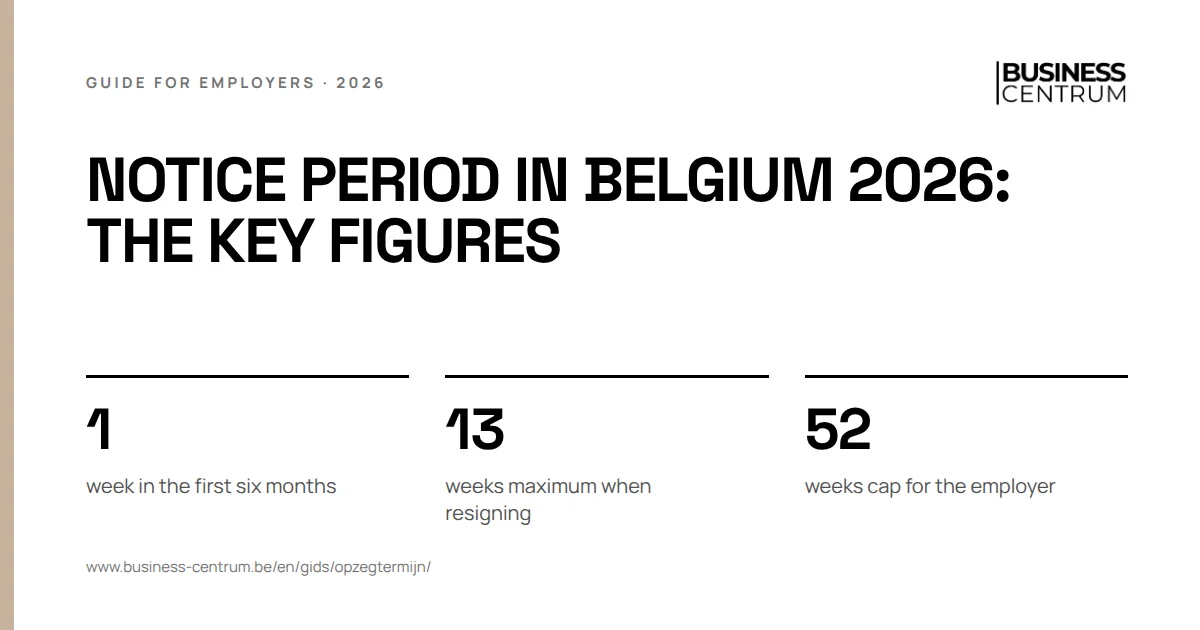
In Belgium, the notice period is the number of weeks an open-ended employment contract still runs after a dismissal or resignation, and it depends on seniority and on who gives notice. If the employer gives notice, it runs from 1 week to more than a year. If the employee resigns, it is never longer than 13 weeks. Since 2026 the contract's start date also counts: anyone who started on or after 1 August 2026 has 1 week's notice in the first 6 months, whoever gives notice.
Want a date straight away? Enter the start date and the date of the letter in calculate the notice period: the tool gives the number of weeks, the Monday on which notice starts and the end date. Below is why the result is what it is.
Notice period in Belgium 2026: what has changed?
The table of 1 January 2014 still applies, to blue-collar and white-collar workers alike. In 2026 two changes were added, and both apply only to new contracts:
- Contracts from 1 June 2026: the employer's notice stops at 52 weeks. That cap only comes into play from 17 years' seniority, so in practice from 2043.
- Contracts from 1 August 2026: in the first 6 months notice is 1 week, both on dismissal by the employer and on resignation by the employee.
Anyone who started before those dates keeps the old figures. Within one business, two employees with the same seniority can therefore have different notice. How that works out in three dismissals, with the laws behind it, is covered in the new notice periods for 2026.
Notice period table: employer and employee side by side
Notice is expressed in weeks. Read the row for the seniority on the day notice starts and the column for whoever gives notice.
| Seniority | Employer, start before 1 August 2026 | Employer, start from 1 August 2026 | Employee, start before 1 August 2026 | Employee, start from 1 August 2026 |
|---|---|---|---|---|
| under 3 months | 1 | 1 | 1 | 1 |
| 3 to 4 months | 3 | 1 | 2 | 1 |
| 4 to 5 months | 4 | 1 | 2 | 1 |
| 5 to 6 months | 5 | 1 | 2 | 1 |
| 6 to 9 months | 6 | 6 | 3 | 3 |
| 9 to 12 months | 7 | 7 | 3 | 3 |
| 12 to 15 months | 8 | 8 | 4 | 4 |
| 15 to 18 months | 9 | 9 | 4 | 4 |
| 18 to 21 months | 10 | 10 | 5 | 5 |
| 21 to 24 months | 11 | 11 | 5 | 5 |
| 2 to 3 years | 12 | 12 | 6 | 6 |
| 3 to 4 years | 13 | 13 | 6 | 6 |
| 4 to 5 years | 15 | 15 | 7 | 7 |
| 5 to 6 years | 18 | 18 | 9 | 9 |
| 6 to 7 years | 21 | 21 | 10 | 10 |
| 7 to 8 years | 24 | 24 | 12 | 12 |
| 8 to 9 years | 27 | 27 | 13 | 13 |
From 8 years, the employee's notice stays at 13 weeks. The employer's notice keeps growing by 3 weeks per year started up to 20 years, and more slowly after that. The full employer table up to 25 years, with the column for the cap, is in the guide notice period employer, together with three worked examples in euros.
Notice period in Belgium on resignation by the employee
An employee who resigns uses the short column of the table: 1 week in the first three months and no more than 13 weeks, however long they have been employed. This applies to a white-collar employee and a blue-collar worker in the same way.
Three things to know as an employer:
- The form. The employee serves notice with a document they hand to you and of which you sign a duplicate for receipt, by registered letter or through a bailiff. Verbal notice does not meet that form.
- The content. The employee's letter must also state the start date and the length of the notice. If that is missing, you can have the notice declared void. It is often better to agree an end date together and put it in writing.
- No suspension. If the employee falls ill or takes holiday during their own notice, the end date does not move.
If the employee wants to leave sooner and you agree, the contract can end by mutual agreement on a date you choose together. How to record that properly is covered in termination by mutual agreement.
Notice period on dismissal by the employer
An employer only serves notice validly by registered letter or through a bailiff. A letter handed over in person is void: the dismissal stands, but you then pay a payment in lieu of notice. The letter states the start date and the length of the notice.
The employer column in the table has two limits. For contracts from 1 June 2026, notice stops at 52 weeks. And if you give notice so that the contract ends at the statutory pension age, notice is no more than 26 weeks.
With notice of at least 30 weeks you must also offer outplacement. An employee with a contract since 2014 reaches that threshold at 9 years' service. The rules and deadlines are in is outplacement mandatory.
Notice period for white-collar and blue-collar employees: one table since 2014
For seniority from 1 January 2014, status no longer makes any difference. A white-collar employee and a blue-collar worker with the same years of service receive the same notice period, in both directions.
If the employee was already employed before 1 January 2014 and you dismiss them, you add two parts. The first part follows the rules of late 2013 for the years up to then, the second part the new table for the years after. For white-collar staff with high pay and a long career, that first part can weigh heavily. The tool does not calculate these old contracts: have them checked.
When does the notice period start?
Notice starts on the Monday after the week in which it was served. A registered letter takes effect on the 3rd working day after posting, where Saturday counts and Sundays and public holidays do not.
An example. You post the registered letter on Monday 2 November 2026. It takes effect on Thursday 5 November, and notice starts on Monday 9 November 2026. You count seniority on that Monday. If an employee is right on a threshold, such as six months or a full anniversary of service, posting a week earlier or later can put them on a different row of the table.
Calculate the notice period in Belgium: the tool and the four steps
The quickest route is the calculator calculate the notice period. If you check it yourself, follow these steps:
- Choose the column. Employer or employee, and the contract's start date before or from 1 August 2026.
- Find the start of the notice. The Monday after the week in which notice was served.
- Count seniority on that Monday. Successive contracts with you count, as do sickness and holidays.
- Read off the weeks and set the end date. Count the number of weeks from that Monday. When the employer gives notice, that date still moves back if suspensions occur.
If you would rather end the contract at once, you pay a payment in lieu of notice: the pay for the whole notice period. The weekly pay of a white-collar employee on a fixed monthly salary is the monthly salary × 3 / 13. For notice of 12 weeks and a monthly salary of € 3,000, that is € 3,000 x 3 / 13 x 12 = € 8,307.69 gross, plus the benefits under the contract.
What happens during the notice period?
Sickness and holidays. When the employer gives notice, sickness, annual leave, maternity leave, temporary unemployment and some types of leave stop the notice. Who pays what if an employee falls ill during notice is explained in sickness during the notice period.
Job-search leave. During notice the employee may be absent on full pay to look for work, usually half a day a week. With long notice from the employer, that becomes one day a week in the last 26 weeks.
Counter-notice. If the employee finds another job during your notice, they may leave with shorter notice: 1 week under three months' service, 2 weeks up to six months, 3 weeks up to a year and 4 weeks after that. If their contract started on or after 1 August 2026, counter-notice in the first six months is 1 week.
Notice period for a fixed-term contract
A fixed-term contract can only end with notice in the first half of its term, and never later than 6 months after the start. You then use the same table as for an open-ended contract. After that, the contract can only end with compensation: the pay up to the end date, but never more than 2 times the notice that would apply to an open-ended contract. Worked out with three contracts in terminating a fixed-term contract.
Everything about the notice period and dismissal
Each page below answers one question. Start with what applies to you:
- Calculate the notice period: the calculator with end date.
- Notice period employer: the full table, the cap and worked examples in euros.
- New notice periods 2026: what the laws of May and June 2026 change.
- Terminating a fixed-term contract: notice in the first half and the compensation after it.
- Sickness during the notice period: the new end date and what you keep paying.
- Template dismissal letter for employers: three template letters.
- Dismissing an employee: every way to end a contract, with the steps and costs.
For every dismissal, Business Centrum calculates the notice on the right start date and seniority, prepares the registered letter and processes the final payslip, the C4 and the Dimona exit declaration together with Acerta. Unsure about a date or an old contract from before 2014? Have it checked before you send the letter.