
A dismissal in Belgium can take five forms: with notice the employee works, with a payment in lieu of notice, for serious cause, by mutual agreement, or through medical force majeure if the employee can permanently no longer work. Which one you choose determines what you pay and which deadlines you must meet. Whatever the method, you need the right form, the right date and a reason you can explain.
Types of dismissal in Belgium: five ways to dismiss an employee
| Method | When | What you pay | Read more |
|---|---|---|---|
| Worked notice | The employee can keep working until the end | Pay during the notice period | Notice period |
| Payment in lieu of notice | You want the contract to end at once | Pay for the whole notice period in one go | Notice period employer |
| Serious cause | A serious fault makes further cooperation impossible | No notice and no payment | Dismissal for serious cause |
| Mutual agreement | You and the employee both want to stop | What you agree together | Termination by mutual agreement |
| Medical force majeure | The occupational doctor finds that the employee can permanently no longer work | No notice, but a contribution of € 1,800 | Medical force majeure |
A fixed-term contract ends automatically on its end date. If you want to end it earlier, separate rules apply: notice is only possible in the first half. That is worked out in terminating a fixed-term contract.
Dismiss an employee in Belgium on an open-ended contract: the steps
- Check whether the employee is protected. Pregnancy, parental leave, time credit, care leave and some mandates give protection against dismissal. See below.
- Determine the notice period. Count seniority on the Monday on which notice would start and choose the column according to the contract's start date. The calculator gives the weeks and the end date.
- Choose: worked notice or payment. Let the employee work their notice, or pay a payment in lieu of notice and let them go at once.
- Draft the letter and send it by registered post. Notice from the employer states the start date and the length. Three templates are in template dismissal letter for employers.
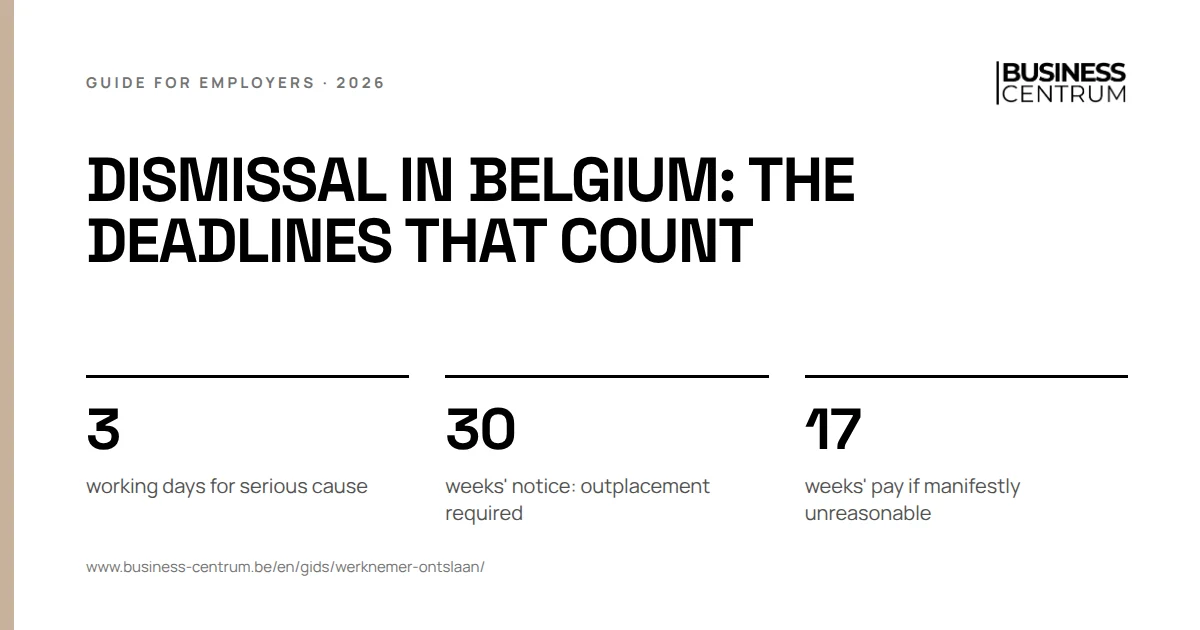
- Offer outplacement where required. From 30 weeks' notice, or for an employee aged 45 or over with at least 1 year's service. A missed deadline costs money.
- Prepare the reasons. If the employee asks for the reasons after the dismissal, you reply by registered letter within 2 months.
- Handle the exit. Dimona OUT no later than the first working day after the end, the C4, the final settlement and, for a white-collar employee, the holiday certificate.
Dismissal without a file: is that allowed?
You do not have to give a reason in the notice letter. But if the employee has at least 6 months' service, they may ask you under collective agreement 109 why you dismissed them. They do so within 2 months of the end of the contract, or within 6 months of notice being served if they are still working it.
If you do not reply, or not correctly, you pay a fixed penalty of 2 weeks' pay. If the court finds the dismissal manifestly unreasonable, because it has nothing to do with the conduct, the aptitude or the needs of your business, it awards 3 to 17 weeks' pay. A file is therefore not a legal requirement, but it is your evidence. Written warnings and reports of performance reviews make the difference, as explained in written warning to an employee. The rules and a model reply are in reasons for dismissal under collective agreement 109.
Protection against dismissal: when you cannot simply dismiss
Some employees are protected against dismissal. You may not dismiss them for a reason linked to that protection. If you do, you pay a fixed compensation on top of the normal payment in lieu of notice.
- Pregnancy. Protection runs from the moment you are informed until 1 month after the end of postnatal leave. A dismissal in breach of it costs 6 months' gross pay. More in dismissing a pregnant employee.
- Parental leave and time credit. Protection runs until 3 months after the end of the leave, for time credit until 3 months. The fixed compensation is 6 months' pay in each case. See dismissal during parental leave.
- Care leave and informal carer leave. Anyone taking these types of leave is also protected, with the same fixed compensation of 6 months' gross pay.
- Health. Sickness gives no protection, but dismissing someone because they are ill is discrimination. That costs 6 months' gross pay. How to approach it properly is in dismissing an employee during sickness.
The strictest protection applies to employee representatives on the works council and on the committee for prevention and protection at work, including candidates who were not elected. They can only be dismissed for serious cause or for an economic or technical reason, and then under a special procedure. The union delegate, the prevention adviser, anyone taking birth leave and anyone who filed a complaint about bullying or discrimination are also protected. If you are dismissing someone in one of these situations, have it checked beforehand.
What does a dismissal in Belgium cost?
The largest item is the payment in lieu of notice: the pay for the whole notice period, plus the benefits under the contract. The weekly pay of a white-collar employee on a fixed monthly salary is the monthly salary × 3 / 13.
Example. A white-collar employee, employed since 1 March 2021, earns € 3,200 gross a month. She is 38. You dismiss her with a payment in lieu of notice, and notice would have started on 2 November 2026. She then has 5 years and 8 months' seniority, which gives 18 weeks' notice.
| Item | Calculation | Amount |
|---|---|---|
| Weekly pay | € 3,200 × 3 / 13 | € 738.46 |
| Payment in lieu of notice | 18 x € 738.46 | € 13,292.31 gross |
| Leaving holiday pay | 15.34% of gross pay in 2026 up to departure | calculated separately |
| End-of-year bonus | pro rata, if your joint committee provides for it on dismissal | calculated separately |
On the payment you withhold the normal employee NSSO contributions of 13.07%. Outplacement is not required here, because notice stays below 30 weeks and the employee is younger than 45.
On top of that come costs you avoid with a proper file: the penalty of 2 weeks if you do not give the reasons, 3 to 17 weeks for a manifestly unreasonable dismissal, and the fixed compensation for a protected employee. With notice of at least 30 weeks, you deduct 4 weeks from the payment if you offer outplacement: see is outplacement mandatory.
Dismissal by the employer for serious cause
Serious cause is a grave fault that makes any further cooperation immediately and permanently impossible, such as theft or violence. You dismiss within 3 working days of knowing the facts with certainty, and you communicate the facts within 3 working days of the dismissal. If you miss a deadline, the serious cause lapses and you pay a payment in lieu of notice. The timeline, the evidence file and two template letters are in dismissal for serious cause.
Termination by mutual agreement or medical force majeure
Mutual agreement. The contract ends on a date you choose together, without notice. Put everything in writing: the end date, any payment and what happens to holiday pay and the end-of-year bonus. For the employee, an agreement can affect their unemployment benefit. A model agreement is in termination by mutual agreement.
Medical force majeure. If an employee has been unfit for at least 6 months and the occupational doctor finds that they can permanently no longer do the agreed work, the contract can end without notice or payment. You do pay a contribution of € 1,800 to the Return to Work Fund. The procedure with all deadlines is in medical force majeure.
The documents after a dismissal
After the contract ends, you file the Dimona OUT, no later than the first working day afterwards. The employee receives the C4 for their unemployment benefit, and a white-collar employee also their holiday certificate. The individual account follows within 2 months of the end of the quarter, the 281.10 tax form with the tax statement for the year. Who prepares what, and by when, is in social documents on dismissal.
All guides on dismissal
- Notice period: the table for employer and employee.
- Notice period employer: the full table with worked examples.
- Template dismissal letter for employers: three template letters.
- Dismissal for serious cause: deadlines, evidence and letters.
- Termination by mutual agreement: the agreement and the C4.
- Reasons for dismissal under collective agreement 109: what you reply and by when.
- Is outplacement mandatory: when, and what it costs.
- Dismissing an employee during sickness: notice, force majeure or agreement.
- Medical force majeure: the procedure step by step.
- Social documents on dismissal: the checklist.
Business Centrum reviews every dismissal with you beforehand: which method fits, which protection applies, how many weeks' notice and what it costs in euros. We prepare the letter and process the final settlement, the C4 and the Dimona OUT together with Acerta. Have your file checked before you send the letter.