
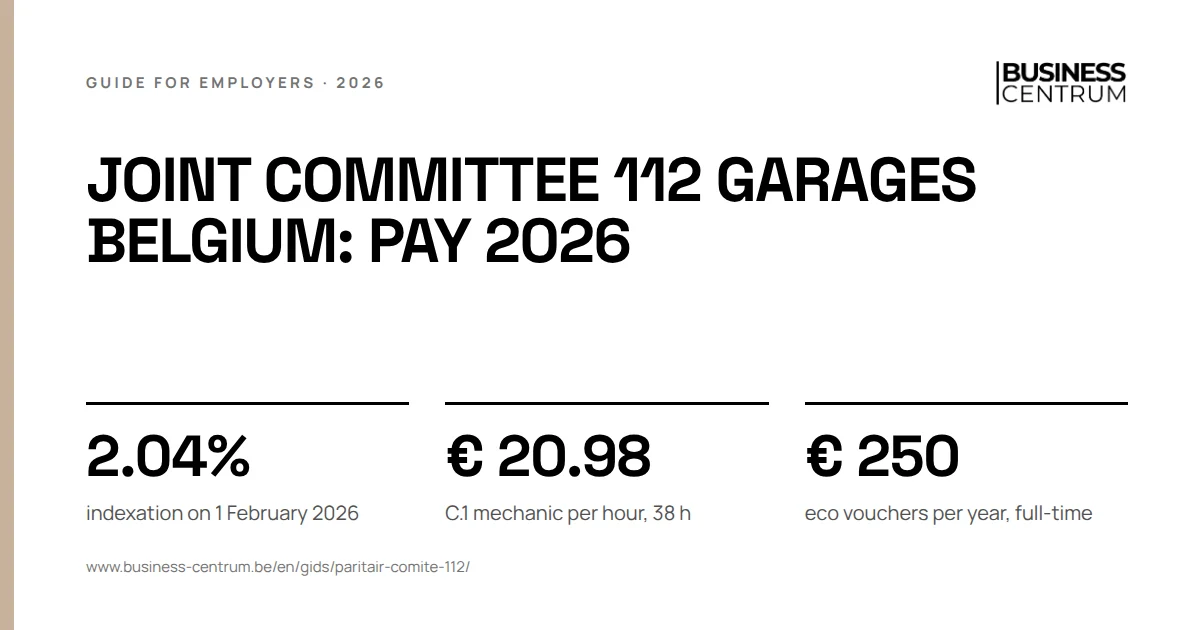
Joint committee 112 (JC 112) covers blue-collar workers at garages in Belgium: vehicle sales, servicing and repair, breakdown assistance, car washes, tyre centres and car parks. Since 1 February 2026, wages have been indexed by 2.04%. A category C.1 mechanic earns at least € 20.98 gross per hour. The year-end bonus is a full month's pay.
Who falls under joint committee 112?
JC 112 covers the blue-collar workers of garage businesses, including those that also repair bodywork on the side. The official scope lists as main activity:
- importing, distributing, selling, repairing, servicing, breakdown assistance, towing and inspecting new and used motor vehicles and trailers;
- running a service station;
- running a car wash;
- running open or covered car parks;
- selling, repairing, fitting and balancing tyres, as well as vulcanising and retreading tyres;
- renting out vehicles without a driver.
What falls outside causes the most mistakes in practice:
| Activity | Committee |
|---|---|
| Garage with workshop, even with a small bodywork section | JC 112 |
| Car wash, tyre centre, car park | JC 112 |
| Body panel and paint repair only | JSC 149.02 |
| Farm machinery and tractors | not JC 112 |
| Service station under the petroleum sector | not JC 112 |
| Garage office staff (reception, sales, accounts) | JC 200 |
Mixed businesses. What counts is the company's main activity, usually measured by your staff's working hours rather than turnover. A garage that also runs a car wash stays in JC 112 for all its workers. A body shop with a small mechanical workshop, on the other hand, stays in 149.02 as long as panel and paint work takes most of the hours. The NSSO lists a committee on your identification record, but that entry does not decide the matter: in an inspection, the inspectorate looks at what your people actually do.
Office staff fall under a different committee: a garage with ten mechanics and three people at the front desk applies two committees. If you are unsure about your main activity, first read how a joint committee is determined.
Which pay scale applies in joint committee 112 in 2026?
JC 112 works with minimum hourly wages per category. The base schedule is 38 hours a week. A 38.5, 39 or 40-hour schedule is only allowed if you grant compensation days. Those schedules carry a lower hourly rate, because the worker works more hours a week and builds up rest days in return.
Minimum hourly wages since 1 February 2026:
| Category | 38 hours a week | 40 hours a week |
|---|---|---|
| A.1 | € 16.46 | € 15.82 |
| A.1.1 | € 17.20 | € 16.46 |
| A.1.2 | € 18.06 | € 17.28 |
| A.2 | € 17.20 | € 16.46 |
| A.2.1 | € 18.06 | € 17.28 |
| A.2.2 | € 18.92 | € 18.11 |
| B.1 | € 18.92 | € 18.11 |
| B.2 | € 19.95 | € 19.09 |
| C.1 | € 20.98 | € 20.08 |
| C.2 | € 22.02 | € 21.07 |
| D.1 | € 23.05 | € 22.06 |
| D.2 | € 24.08 | € 23.04 |
Converted to a month on 38 hours, an A.1 worker earns at least 16.46 x 38 x 13 / 3 = 2,710.41 euros gross, a D.2 technician outside category at least 3,965.17 euros. The scale is a floor. If you pay more, indexation applies to that higher wage too.
Job classification in JC 112: which category is your mechanic in?
The category depends on the activity, the nature of the work, the worker's skills and how independently he works. The 2014 sector agreement gives reference jobs per activity. What counts is what the worker does, not the title on his contract. The 2025-2026 national agreement announces a new job classification. Until that agreement exists, the 2014 classification applies.
| Category | Examples of reference jobs |
|---|---|
| A.1 | pump attendant, washer, gatekeeper |
| A.2 | parts washer, new car polisher, tyre fitter's assistant, driver |
| B.1 | assistant mechanic, warehouse assistant, tyre fitter, paint preparer, junior fast fitter |
| B.2 | service mechanic, tow truck driver up to 3.5 tonnes, tyre fitter-repairer, fast fitter mechanic |
| C.1 | mechanic, storekeeper, breakdown mechanic, panel beater and sprayer, electronics fast fitter |
| C.2 | specialist, warehouse manager, recovery driver, vehicle damage repairer |
| D.1 | technician, mobile technician (road patrol) |
| D.2 | technician outside category |
A worker in A.1 or A.2 moves up to A.1.1 or A.2.1 after 10 years with your company, and to A.1.2 or A.2.2 after 20 years. The pay range runs from 100% for A.2 to 140% for D.2.
A service mechanic who runs diagnostics on his own with the test equipment and traces faults is doing a mechanic's or technician's job. The gap between B.2 and C.1 is € 19.95 against € 20.98 per hour, or about 170 euros gross a month.
Indexation in joint committee 112
JC 112 wages rise every year on 1 February, based on January's smoothed health index compared with a year earlier. The sector indexes both minimum wages and wages actually paid.
| Indexation on 1 February | Percentage |
|---|---|
| 2026 | 2.04% |
| 2025 | 3.65% |
| 2024 | 1.04% |
| 2023 | 10.44% |
Worked example. A C.1 mechanic earned 20.56 euros per hour in January 2026. On 1 February this became 20.56 x 1.0204 = 20.98 euros, the current scale. On 38 hours that is about 69 euros gross more per month.
There is no rise on top of indexation: the wage norm for 2025 and 2026 is 0%. The 2025-2026 national agreement of 16 February 2026 does bring other benefits: a higher cycling allowance, seniority leave after fewer years of service and career leave for older workers.
Cent index. Since 1 June 2026, indexation is limited for a reference wage above € 4,000 a month: the index then applies only up to 2% on that threshold, and the remaining percentage on the full wage. On 38 hours the threshold is € 24.29 per hour. Because JC 112 indexes in February, the limit will bite for the first time on 1 February 2027. The highest scale, D.2, stays below it. So it concerns technicians and workshop managers you pay above the scale. More in our piece on the cent index.
The year-end bonus in joint committee 112
Every JC 112 worker is entitled to a year-end bonus paid by the employer. Student workers are excluded, unless your company grants something better.
How much? The hourly wage on 1 December x the weekly hours of the pay schedule x 52 / 12. On 38 hours a week that is 164.67 hours, exactly one month's pay. A worker who changes schedule during the year gets a bonus based on the average working time.
When? The reference period runs from 1 December to 30 November. You pay by 20 December 2026 at the latest.
Worked example. A C.1 mechanic, 38 hours a week, the whole year: 20.98 x 38 x 52 / 12 = 3,454.71 euros gross. If you count 10 non-qualifying working days this year, for example due to long sickness beyond the cap, he loses 10/260 of the bonus: 3,454.71 x 10 / 260 = 132.87 euros. He then receives 3,321.84 euros.
Absences that count. All suspensions count, within these limits:
- ordinary sickness or accident: at most 100 calendar days per reference period;
- temporary unemployment: at most 150 days;
- work accident and occupational disease: the first 12 months of uninterrupted incapacity;
- maternity leave and birth leave: in full.
For each non-qualifying day, the bonus drops by 1/260.
On leaving, the worker gets one twelfth per started month if you dismiss him (except for serious misconduct), on retirement, force majeure, a fixed-term contract and termination by mutual agreement. If he resigns, he is only entitled to the pro rata bonus with at least 2 years of service, when he leaves during temporary unemployment, or when he leaves a part-time job for one with more hours. In other cases, he loses the bonus if his notice ends before 30 November. You calculate the pro rata bonus on the hourly wage at the time of leaving. More detail by sector in calculating the year-end bonus.
Eco vouchers, seniority leave and cycling allowance
Eco vouchers. A full-time worker receives € 250 in eco vouchers a year. You may convert that amount into another benefit through a company agreement, provided the full annual amount stays guaranteed. Without such an agreement, you give eco vouchers in two instalments of € 125: in June and in December. There is no national abolition.
Seniority leave. Since 1 January 2026, the worker is entitled to one extra day off a year after 12 years with your company. Part-timers get it pro rata.
Career leave. From the calendar year in which the worker turns 55, he gets one extra day off a year. This rises to 4 days from the year in which he turns 60. If your company already gives as many extra-statutory days off, you may grant an equivalent benefit instead.
Bicycle. Since 1 July 2026, workers who cycle in receive € 0.32 per kilometre, for at most 40 kilometres there and back per day. Above that, the ordinary contribution for private transport applies.
Overtime in JC 112
If your garage runs a 38-hour week, a 40-hour week is not overtime when you grant compensation days: the worker then builds up rest days. Real overtime is work beyond 9 hours a day or 40 hours a week, or beyond the limits of your work schedule.
- Overtime premium: 50% on weekdays and Saturdays, 100% on Sundays and public holidays.
- Voluntary overtime: since 1 April 2026, a worker may do up to 360 voluntary overtime hours a year. For 240 of them no overtime premium is due, and those hours are free of NSSO contributions and withholding tax. This requires a written agreement with the worker.
A mechanic who works four extra hours on a Saturday morning for an urgent repair costs you, under the ordinary rules, 4 x 20.98 x 1.5 = 125.88 euros gross plus NSSO. How to record and pay overtime is explained in paying overtime.
Flexi-jobs in joint committee 112
Since 1 July 2026, flexi-jobs are in principle allowed across the private sector. JC 112 is not among the excluded committees, so you can use flexi-jobbers in the workshop, the car wash or the tyre centre. Garages in NSSO employer category 064 could already do so from 1 January 2024.
Worked example. A flexi-jobber working as a washer in category A.1:
- Flexi wage at least € 16.46 per hour, at most 150% of that.
- With 7.67% flexi holiday pay: 16.46 x 1.0767 = 17.72 euros per hour.
- Special contribution of 28%: 17.72 x 0.28 = 4.96 euros.
- Cost to you: 22.68 euros per hour.
The flexi-jobber must work enough elsewhere and cannot be on an ordinary contract with you at the same time. If a flexi-jobber works on hybrid, electric or hydrogen vehicles, he must hold the sector 'safety' certificate for that work. All conditions are in flexi-jobs in all sectors.
Sefocam pension and Educam
Sector pension. All garages are affiliated for their workers to the sector pension managed by Sefoplus. You pay an overall contribution of 1.95% on gross wages at 108%, collected by the NSSO. Of that, 1.64% goes to the pension itself, the rest to solidarity, management costs and the NSSO levy on pension payments. Since 1 July 2025 there is also a plan for garage office staff in JC 200, with a contribution of 1.19%, unless your company already had an equivalent plan of its own.
Training. For training of risk groups, the sector collects 0.15% of gross wages at 108%. Educam, the automotive sector's training institute, runs technical courses for your mechanics.
Notice in JC 112
JC 112 has no notice periods of its own. Since the single status, the statutory periods apply to blue-collar workers, with an old sector rule only for seniority from before 2014. For contracts starting from 1 August 2026, notice in the first six months is 1 week, and 8 weeks after one year. For contracts from 1 June 2026, notice is capped at 52 weeks. See employer notice periods for the full table.
Worked example: what does a mechanic cost in JC 112?
A full-time mechanic, category C.1, on the minimum scale of € 20.98 per hour on a 38-hour week. Average monthly cost in 2026:
| Item | Calculation | Amount |
|---|---|---|
| Gross wage | 20.98 x 38 x 13 / 3 | 3,454.71 euros |
| Employer NSSO | 25% on 108% (3,731.08) | 932.77 euros |
| Holiday contribution | 15.84% on 3,731.08 | 591.00 euros |
| Risk group training | 0.15% on 3,731.08 | 5.60 euros |
| Sector pension | 1.95% on 3,731.08 | 72.76 euros |
| Year-end bonus | 3,454.71 / 12 | 287.89 euros |
| NSSO on the bonus | 25% on 287.89 | 71.97 euros |
| Eco vouchers | 250 / 12 | 20.83 euros |
| Total per month | 5,437.53 euros |
A mechanic on a gross wage of almost 3,455 euros therefore costs you over 5,400 euros a month. The structural reduction, social fund contributions, work accident insurance, workwear and commuting are not included.
Mistakes we often see in JC 112
- A 40-hour week without compensation days. Having staff work 40 hours at the 40-hour rate without rest days means paying too little and risking overtime premium later.
- Category stuck. An assistant mechanic grows into a mechanic, the payslip stays at B.1.
- Seniority in A categories forgotten. After ten and twenty years, the scale for pump attendants, washers and drivers rises automatically.
- Year-end bonus on the old hourly wage. The hourly wage on 1 December counts, not the average for the year.
- Car wash or tyre centre in JC 200 or JC 100. Those activities are expressly listed in the scope of JC 112.
What Business Centrum does for you
Business Centrum handles the payroll of JC 112 workers and JC 200 office staff for garages and tyre centres in East Flanders, together with Acerta. We place your mechanics in the right category, apply the February indexation, calculate the year-end bonus with the right qualifying absences and register flexi-jobbers correctly. For smaller garages without their own HR team, see our approach for small businesses.