
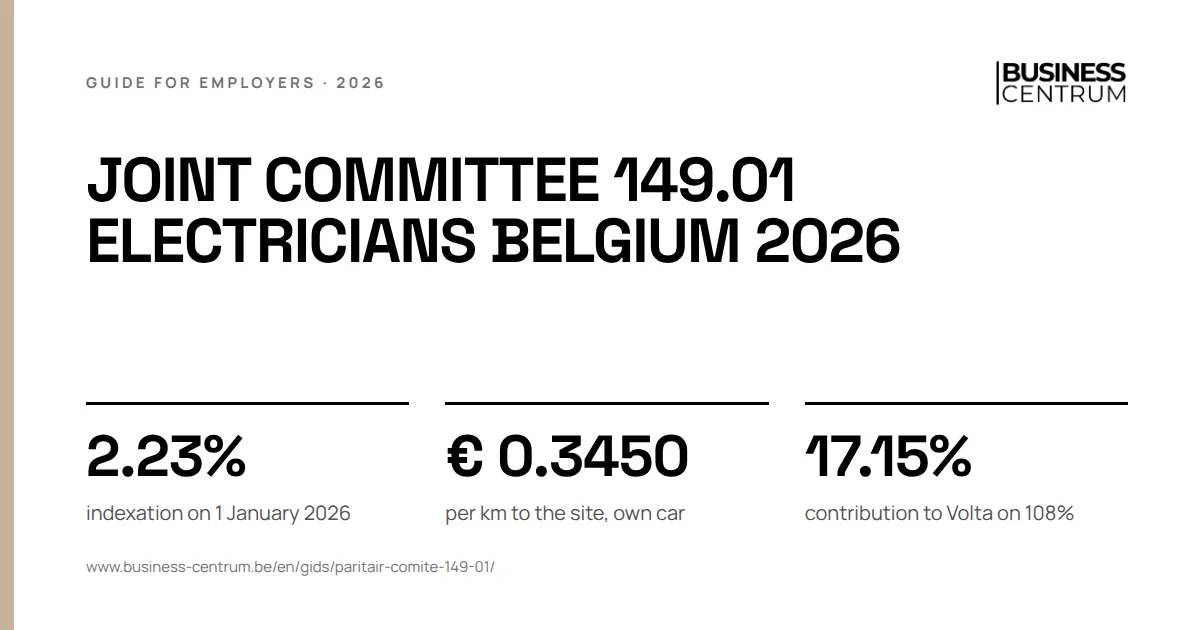
Joint sub-committee 149.01 (JC 149.01) covers blue-collar workers at electricians in Belgium: installation, distribution and wholesale of electrical equipment. Since 1 January 2026, wages have been indexed by 2.23%, from € 16.88 per hour in category A to € 26.82 in category F. On top of pay, you contribute 17.15% to the sector fund Volta, which also pays the year-end bonus.
Who falls under joint committee 149.01?
The sub-committee covers the blue-collar workers of companies whose main activity is:
- electrical and electronic assembly and installation work, including on vehicles and ships: lighting, motive power, heating, low and high voltage, telephony, signalling, low-current systems;
- wholesale or retail of electrical and electronic appliances, even if they also install or repair them (except appliances for vehicles and office machines);
- radio and cable distribution;
- installing or repairing sound, image, signalling and lighting systems;
- installing security equipment.
How does an installer know whether he falls under 149.01? The sub-committee expressly excludes companies covered by another committee. In practice that draws the line:
| Situation | Committee |
|---|---|
| Electrical installer, residential or industrial | JSC 149.01 |
| Installer of alarms, cameras or access control | JSC 149.01 |
| Electrical wholesaler with its own warehouse staff | JSC 149.01 |
| Company that manufactures equipment industrially and also installs it | JC 111 metal |
| General contractor with its own electricians | JC 124 construction |
| Garage repairing vehicle electrics | JC 112 |
| The installer's office staff | JC 200 |
What counts is the main activity. An installer who occasionally does a small renovation stays in 149.01. A builder who also does the wiring stays in 124. If in doubt, have it checked before the first declaration: correcting a wrong committee is retroactive, with pay differences and fund contributions.
Which pay scale applies in joint committee 149.01 in 2026?
The scales are hourly wages for a 38-hour week. They depend on the category and on seniority within the same qualification and company.
Minimum hourly wages since 1 January 2026, by years of seniority:
| Seniority | A | B | C | D | E | F |
|---|---|---|---|---|---|---|
| 0 to 1 year | € 16.88 | € 17.89 | € 19.41 | € 21.10 | € 22.28 | € 23.63 |
| 5 years | € 17.39 | € 18.43 | € 19.99 | € 21.73 | € 22.95 | € 24.34 |
| 10 years | € 17.81 | € 18.87 | € 20.48 | € 22.26 | € 23.51 | € 24.93 |
| 20 years | € 18.65 | € 19.77 | € 21.45 | € 23.32 | € 24.62 | € 26.11 |
| 26 years | € 19.16 | € 20.31 | € 22.03 | € 23.95 | € 25.29 | € 26.82 |
Seniority. After one year the minimum wage rises by 1%, then by 0.50% each year, up to a maximum of 13.50%. Fixed-term contracts and agency work with you count if the worker then gets a permanent contract.
Other rules:
- A worker who temporarily leads a team of at least four people gets 5% to 10% extra for that period.
- Student workers get at least 80% of the scale for the category of a worker doing the same job.
- Youth rates no longer exist: an 18-year-old worker gets the full scale.
Which category of joint committee 149.01 does your electrician fall into?
The sector agreement has six categories. According to the social partners, the description gives a general picture: a worker who does not meet every requirement can still belong to a category.
| Category | Who | Feature |
|---|---|---|
| A | labourer | simple tasks under supervision, no trade training |
| B | semi-skilled worker, 2nd category | at least 6 months' training, simple diagrams |
| C | semi-skilled worker, 1st category | at least 12 months' training, works alone or in a team |
| D | skilled worker, 3rd category | reads plans, works unsupervised, gives instructions |
| E | skilled worker, 2nd category | knows the trade fully, runs the site technically and organisationally, discusses technical issues with third parties |
| F | skilled worker, 1st category | as E, plus delicate issues: departures from the quote, conflicts between workers, staff management |
An electrician who completes an installation on site on his own and prepares the inspection is in practice at least in D. The gap with C is € 19.41 against € 21.10 per hour at the start, or about 278 euros gross a month. In electrical trading companies, only categories A to C apply to cleaners, gatekeepers and warehouse staff without trade training.
Indexation in joint committee 149.01
Wages rise every year on 1 January. The sector indexes both minimum wages and wages actually paid.
| Indexation on 1 January | Percentage |
|---|---|
| 2026 | 2.23% |
| 2025 | 3.58% |
| 2024 | 1.13% |
| 2023 | 11.19% |
There is no general rise on top of indexation. The wage norm for 2025 and 2026 is 0%. The February 2026 sector agreement spends the margin on meal vouchers, mobility and training.
Cent index in January 2027. Since 1 June 2026, indexation is limited for a reference wage above € 4,000 a month, which on 38 hours is an hourly wage above € 24.29. In 149.01 the limit will first bite at the 1 January 2027 indexation, and here it also hits scale wages: category F is above the threshold from five years' seniority (€ 24.22 after four years, € 24.34 after five), category E from eighteen years (€ 24.40). For those wages, the index applies only up to 2% on € 4,000, with the remaining percentage on the full wage. More in our piece on the cent index.
The mobility allowance in joint committee 149.01 in 2026
The sector agreement on transport costs of February 2026 distinguishes travel to the head office from travel to a site.
To the head office or pick-up point. You reimburse public transport at 100%, or 80% under a third-party payer scheme. With private transport, the worker gets the national table amount for a train season ticket, for the whole month.
To a site that is not the place of hire, since the indexation of 1 February 2026:
| Transport to the site | Allowance per km, return |
|---|---|
| Public transport | full reimbursement |
| Own car or other own transport | € 0.35 |
| Passenger in an employer's vehicle | € 0.17 |
| Driver of a company vehicle with passengers | € 0.19 |
| Driver of a company vehicle without passengers | € 0.18 |
There is no cap on kilometres. The amounts rise every 1 February with the social index.
Worked example. An electrician lives 25 kilometres from the site and drives his own car: 50 x 0.3450 = 17.25 euros per day, or 345.00 euros for twenty site days. If you pick him up in the van, he gets 50 x 0.1732 = 8.66 euros per day as a passenger and the driver 50 x 0.1929 = 9.65 euros.
Travel from one site to another during the day is working time: you pay the costs and the wage. If a site keeps the worker away from home for more than 12 hours a day, you provide board and lodging.
Bicycle and mobility leave. The cycling allowance rose on 1 October 2026 from € 0.27 to € 0.32 per kilometre, for at most 40 kilometres or € 12.80 per day. Since 2026, each full block of 25,000 kilometres a year gives a day of mobility leave, against 27,000 kilometres before.
Year-end bonus in JC 149.01: Volta pays
In 149.01 you do not pay the year-end bonus yourself. The subsistence fund Volta pays it directly to the worker around 15 December 2026. You fund it through a contribution of 13.15% on gross pay at 108%.
- Amount: 8.33% of the gross pay the worker earned in the sector during the reference period.
- Reference period: from 1 July of last year to 30 June of this year.
- Counted days: sickness, temporary unemployment, maternity leave and other suspensions count up to 130 days if the worker worked at least 120 days. Otherwise the cap is a third of the days worked.
- Leaving: the worker gets a pro rata bonus whatever the reason for leaving, except dismissal for serious misconduct.
Worked example. A category D electrician with five years' seniority, on the minimum scale: € 21.26 per hour from July to December 2025, € 21.73 since January 2026. That is 6 x 3,500.81 + 6 x 3,578.21 = 42,474.12 euros gross over the reference period. His bonus is 8.33% of that, or 3,538.09 euros gross, almost a month's pay.
Eco vouchers and meal vouchers in JC 149.01: what changed on 1 October 2026?
Until now a full-time worker received € 250 in eco vouchers a year. In a company without a union delegation, you could only convert them into a pay rise of € 0.09 per hour.
The 2025-2026 sector agreement lets the employer choose from 1 October 2026:
| Scenario 1 | Scenario 2 | |
|---|---|---|
| Meal voucher, employer's share | plus € 2 | plus € 1 |
| Eco vouchers | last award for the period from 1 October 2025, then abolished | kept |
| No meal vouchers yet | introduce with a € 2 employer's share | introduce with a € 1 employer's share |
The worker pays at least € 1.09 per voucher, your share may not exceed € 8.91. If you pay a meal allowance instead of vouchers, you raise that allowance as long as the legal ceiling has not been reached. A rise you already gave in 2026 may be deducted.
What does each scenario cost? At 220 working days a year, scenario 1 costs you 220 x 2 = 440 euros, scenario 2 220 x 1 + 250 = 470 euros. Above 250 working days, scenario 1 becomes more expensive. A full comparison by sector is in eco vouchers in 2026 and the new maximum voucher in 10-euro meal vouchers.
Volta: contributions, allowances and training grant
You pay Volta these contributions, on blue-collar gross pay at 108%:
| Contribution | Percentage |
|---|---|
| Year-end bonus | 13.15% |
| Sector pension | 2.10% |
| Supplementary allowances | 1.10% |
| Training, innovation and risk groups | 0.80% |
| Total | 17.15% |
On the net pension contribution of 2%, you also pay the special NSSO contribution of 8.86%. Since 1 January 2026, FBZ Volta Plus has been the organiser of the sector pension.
Temporary unemployment. Volta pays a top-up of € 14.63 per day. For economic unemployment this applies for at most 150 days a year, and Volta only pays the first 60. From day 61 you pay the top-up yourself, with the following month's wages.
Training grant. Each year you get a grant credit of 16 training hours per worker. Each hour of approved training earns € 23.30 if you have fewer than 20 employees, and € 19.06 if you are larger. An installer with five workers can recover up to 5 x 16 x 23.30 = 1,864.00 euros a year. The credit stays valid for three years.
Shifts, night work and dangerous work
- Shift work (early and late shift): base pay rises by 10%.
- Night work between 8 pm and 6 am: 20% extra.
- Unhealthy or dangerous work and work at height: 15% premium, not cumulative. Work on a ladder counts as a stable level as long as the worker's feet are no higher than 4 metres. The worker must be told beforehand and may refuse exceptionally dangerous work.
Notice and flexi-jobs in JC 149.01
JC 149.01 has no notice periods of its own. Since the single status, the statutory periods apply, with an old sector rule only for seniority from before 2014. For contracts starting from 1 August 2026, notice in the first six months is 1 week, and 8 weeks after one year. For contracts from 1 June 2026, notice is capped at 52 weeks. The table is in employer notice periods.
Since 1 July 2026, flexi-jobs are also allowed in 149.01. The flexi wage is at least the scale and at most 150% of it, and you pay a 28% special contribution. The social partners point out that for certain jobs a flexi-jobber needs the same safety certificates and skills as a permanent electrician. See flexi-jobs in all sectors.
Worked example: what does a category D electrician cost?
A full-time third-category skilled worker, five years' seniority, on the minimum scale of € 21.73 per hour on a 38-hour week. Average monthly cost in 2026, under scenario 2:
| Item | Calculation | Amount |
|---|---|---|
| Gross wage | 21.73 x 38 x 13 / 3 | 3,578.21 euros |
| Employer NSSO | 25% on 108% (3,864.46) | 966.12 euros |
| Holiday contribution | 15.84% on 3,864.46 | 612.13 euros |
| Volta, incl. year-end bonus and pension | 17.15% on 3,864.46 | 662.76 euros |
| Special NSSO contribution on the sector pension | 8.86% on 2% of 3,864.46 | 6.85 euros |
| Eco vouchers | 250 / 12 | 20.83 euros |
| Total per month | 5,846.90 euros |
The mobility allowance, meal vouchers, the structural reduction and work accident insurance are not included. If the electrician drives 50 kilometres to the site in his own car twenty days a month, add another 345.00 euros.
Mistakes we often see in JC 149.01
- Seniority not passed on. The scale rises every year, even if nobody asks.
- Mobility allowance at the wrong rate. Own car, passenger and driver each have their own per-kilometre amount.
- Year-end bonus paid twice. Volta already pays the bonus. Putting it on the payslip as well means paying twice.
- Eco vouchers scrapped without a choice. Without a timely choice, scenario 2 applies and the eco vouchers remain due.
- Wrong committee. An installer declared as a construction or metal company misses the mobility rules and the Volta grants.
What Business Centrum does for you
Business Centrum processes the pay of 149.01 workers and JC 200 office staff for electricians and installers in East Flanders in a single payroll, together with Acerta. We track each worker's seniority, calculate the mobility allowance by type of transport, apply the chosen meal and eco voucher scenario and claim the Volta grants. For installers who work on building sites, see our approach for the construction sector.