
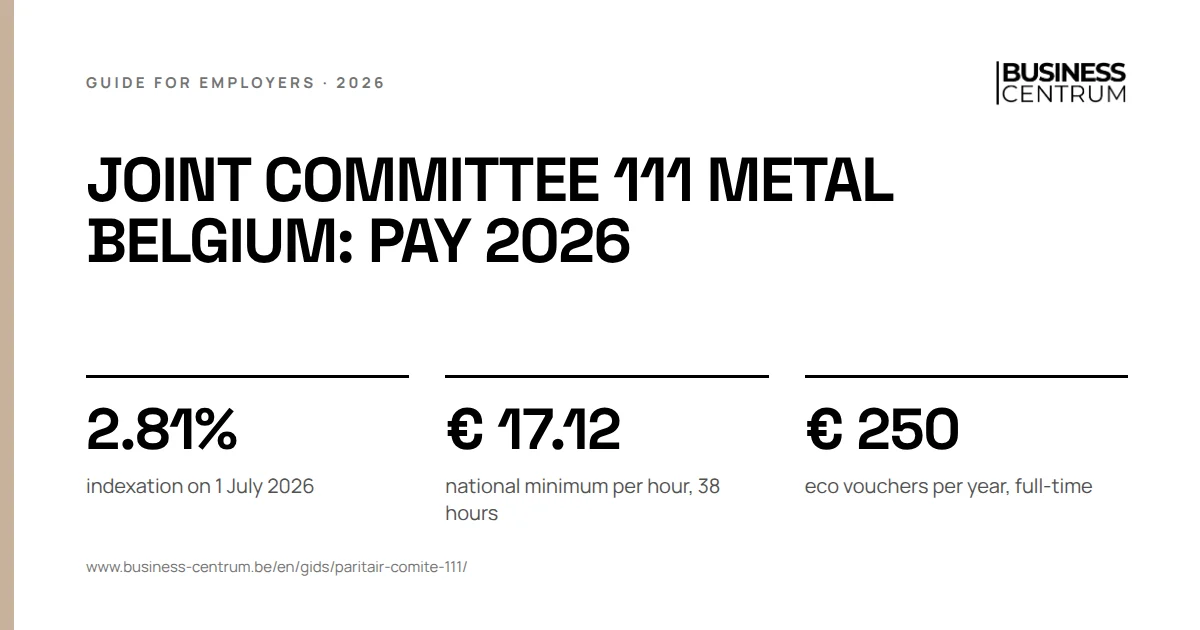
Joint committee 111 (JC 111) covers blue-collar workers in metal, machine and electrical engineering in Belgium. On 1 July 2026, wages rose by 2.81%. The national minimum is now € 17.12 gross per hour. In East Flanders you pay more per class, up to € 20.74 in class 11.
Who falls under joint committee 111?
JC 111 covers companies that manufacture, process, work or assemble parts in metal, plastics or composite materials, where this requires techniques specific to metal, machine and electrical engineering. Their design offices are included. Think of steel fabrication shops, machine builders, sheet metal works, welding shops, boilermakers, machine maintenance and repair, and galvanising.
The committee only covers blue-collar workers. White-collar staff at the same company fall under JC 209. A machine builder with twenty people in the workshop and five in the office therefore runs two committees and two pay systems: hourly wages for the workers, monthly salaries for the office staff.
In payroll practice, people speak of three sub-sectors. They are not official sub-committees, but they decide which scale you apply:
| Sub-sector | Activity | Scale |
|---|---|---|
| 111.01 | industrial metal processing | national minimum, with a scale by class in East and West Flanders |
| 111.02 | craft metal processing | same |
| 111.03 | erection of bridges and metal frames | own scale in ten classes |
For the provincial scale, what counts is the province of the operating site, not where the worker lives or where the job site is.
Where the boundary with other committees lies. Three borderline cases come up often among our clients in East Flanders:
- Metal joinery. A company that makes and fits metal windows, gates or stairs falls under JC 111. If your own staff fit more than half of your annual production and that fitting takes more than 35% of all hours worked by your blue-collar staff, you fall outside JC 111 and usually under construction. Read our guide to joint committee 124 for construction.
- Electrical installations. An installer who manufactures, wholly or partly on an industrial basis, the equipment he installs falls under JC 111. A pure installer falls under joint sub-committee 149.01 for electricians.
- Garages and metal trading. Repair of vehicles that belongs to the garage sector falls under JC 112. A company whose main activity is trading metal does not fall under JC 111.
Which pay scale applies in joint committee 111 in 2026?
The scales are hourly wages for a working week of 38 hours. The guaranteed national minimum is € 17.12. Brabant, Antwerp, Limburg, Namur and Hainaut follow that minimum. Liège-Luxembourg has its own hourly wages per weekly working time. East and West Flanders have a scale by class based on the MSC classification.
East Flanders, since 1 July 2026:
| Class | Minimum hourly wage | Class | Minimum hourly wage |
|---|---|---|---|
| 1 | € 17.12 | 7 | € 18.73 |
| 2 | € 17.12 | 8 | € 19.31 |
| 3 | € 17.29 | 9 | € 19.74 |
| 4 | € 17.58 | 10 | € 20.24 |
| 5 | € 17.87 | 11 | € 20.74 |
| 6 | € 18.30 |
The East Flanders scale does not apply to Volvo Cars and Volvo Group Belgium, which have their own agreements. Industrial apprentices have their own hourly wage: € 11.13 at 16, € 13.19 at 17 and € 15.41 at 18.
Converted to a month, a full-time worker in class 11 earns at least 20.7418 x 38 x 13 / 3 = 3,415.48 euros gross. The scale is a floor. If you pay more, that higher wage rises with every sector indexation.
Erection of bridges and metal frames. This sub-sector works 37 hours a week with two wages per class. The base wage applies in the workshop and for travel, the effective wage on site. The effective wage is roughly 18% higher, as a danger bonus. The scale runs from € 16.66 base and € 19.66 effective for a worker in training up to € 26.45 effective for a foreman.
How does job classification work in East Flanders?
The classes follow the MSC method. The sector agreement gives a short description per class but states that it is only indicative. Classifying a job remains work for someone who knows the method.
What separates the classes in practice:
- Classes 1 to 3: fixed, repetitive tasks under supervision, with no or very short training. Every mistake shows at once.
- Classes 4 to 7: varied tasks within one area, from class 6 with lower secondary technical education. In class 7 the worker works without guidance.
- Classes 8 to 11: upper secondary technical education, setting up and adjusting machines independently from drawings. Classes 10 and 11 add unplanned tasks and verbal instructions.
A welder who sets up his own machine from a drawing is not class 5. The gap between class 5 and class 9 is € 17.87 against € 19.74 per hour, or about 307 euros gross a month. A worker who feels wrongly classified can claim that difference retroactively, within the statutory limitation periods.
How does indexation work in joint committee 111 in 2026?
JC 111 wages rise every year on 1 July. The sector indexes the minimum wages and the wages actually paid, even when they are above the scale.
| Indexation on 1 July | Percentage |
|---|---|
| 2026 | 2.81% |
| 2025 | 2.72% |
| 2024 | 3.34% |
| 2023 | 6.05% |
On 1 January 2026, the national minimum hourly wage also rose by € 0.26. Provincial minimums only went up where they would otherwise have fallen below that national minimum. There is no general rise on top of indexation: the wage norm for 2025 and 2026 is 0%, and talks on a new sector agreement for that period produced nothing.
Worked example. A sheet metal worker in class 6 earned 17.80 euros per hour in June 2026. On 1 July this becomes 17.80 x 1.0281 = 18.30 euros, the new scale of € 18.30. For a full-time month that is about 82 euros gross more.
The cent index already bites in JC 111 in 2026. Since 1 June 2026, indexation is limited for a reference wage above € 4,000 a month. For an hourly wage you calculate that reference wage as hourly wage x 38 x 13 / 3, or hourly wage x 164.67. The threshold is therefore € 24.29 per hour. Because JC 111 indexes in July, the 2026 indexation is the first one in the sector to which the limit applies.
Take a foreman on 26.00 euros per hour in June 2026. His reference wage is 26.00 x 38 x 13 / 3 = 4,281.33 euros. Fully indexed it would become 4,401.64 euros. Under the cent index he gets 2% on 4,000 euros, or 80.00 euros, plus 0.81% on 4,281.33 euros, or 34.68 euros. His new reference wage is 4,396.01 euros, which is 26.6964 euros per hour instead of 26.7306 euros. On what you save, you pay a special wage moderation contribution to the NSSO. The full rules are in our piece on the cent index and the calendar per sector in wage indexation 2026.
The year-end bonus in joint committee 111 in East Flanders
The JC 111 year-end bonus is set per province. East Flanders applies the provincial agreement of 2017, with a few large companies excluded.
Who is entitled? The worker must have actually worked at least 60 working days in the reference period, which runs from 1 December to 30 November. If he does not work a five-day week, the threshold is recalculated pro rata. Days of reduced working time and time off in lieu of overtime count as worked.
How much? The bonus is a number of hours: weekly hours x 52 / 12. On 38 hours a week that is 164.67 hours. You multiply those hours by the individual basic hourly wage on 30 November, plus any production bonus. You pay it no later than the last working day before Christmas.
Worked example. A class 6 worker on the minimum scale, full-time on 38 hours, the whole year: (38 x 52 / 12) x 18.3003 = 3,013.45 euros gross. That is exactly one month's pay.
What counts and what does not:
- Work accident and occupational disease: counted up to 365 calendar days per accident.
- Sickness: the first two periods with guaranteed pay, at most 6 months in total.
- Holidays, public holidays, short leave, temporary unemployment (except due to a strike), maternity leave: fully counted.
- Unjustified absence: 8 hours deducted per day on a 40-hour week, pro rata in other schedules.
On leaving, a worker who meets the threshold of days worked gets one twelfth per month worked, also when he resigns, at the end of a fixed-term contract, on retirement and in case of medical force majeure. Only dismissal for serious misconduct cancels the right. Starting in the first half of a month or leaving in the second half counts as a full month.
Since 2023 you may convert up to 50% of the bonus into days off or a bike lease. This requires a company agreement and the worker's individual consent, and the conversion must be cost-neutral. A full comparison by sector is in calculating the year-end bonus.
Eco vouchers, shift bonus and extra leave in JC 111
Eco vouchers. A full-time worker receives € 250 in eco vouchers a year, in 2025 and in 2026. Only companies that already chose another equivalent benefit under earlier sector agreements may keep it. There is no national abolition, see eco vouchers in 2026.
Shift bonus in East Flanders. In successive shifts, the supplement is at least 10% for day shifts and 20% for the night shift. Paid breaks count towards that percentage. A shifted schedule does not by itself give a right to the supplement.
Waasland. Industrial metal processing companies in Beveren, Kruibeke, Lokeren, Sint-Gillis-Waas, Sint-Niklaas, Stekene and Temse give their workers 5 extra days off a year, except for a few shipyards.
Commuting and mobility allowance in JC 111
The sector agreement of November 2023 sets the rules for commuting to the fixed workplace:
| Transport | What you pay |
|---|---|
| Train, tram, bus | the national contribution plus 12.50% |
| Bicycle, electric included | € 0.27 per km, at most € 10.80 per day |
| Car or other transport | € 0.08 per km return, at least € 1.69 per day, at most € 9.20 per day |
Mobility allowance to the site. Workers who travel from home or the pick-up point to a job site receive € 0.16 per kilometre, whatever the means of transport, company van included. A fitter who lives 30 kilometres from the site drives 60 kilometres there and back: 60 x 0.1579 = 9.47 euros per day, or 189.48 euros for twenty site days. A more generous scheme already in place at your company still applies.
Sector funds: metal subsistence fund and sector pension
On top of NSSO contributions, you pay into the Subsistence Security Fund for the metal processing industry (FBZ) and into Pensioenfonds Metaal.
| Contribution, East Flanders | Percentage |
|---|---|
| FBZ, Mtech+ training fund and other funds | 2.39% |
| Sector pension, incl. NSSO and solidarity | 2.59% |
| Total | 4.98% |
The sector pension itself is 2.29% of gross pay in Flanders, plus 0.10% for the solidarity part. Only companies whose own pension plan rests on a company agreement concluded by 31 December 1999 at the latest, and approved by the FBZ, are exempt.
The fund also pays your workers. During temporary unemployment a full-time worker gets € 14.15 per day, plus an increased top-up of € 5.41 per day. There are also top-ups for sickness, full unemployment and career breaks.
Notice and flexi-jobs in joint committee 111
JC 111 no longer has its own notice periods. Since the single status, the statutory periods apply to blue-collar workers. Only seniority from before 2014 can still bring in an old sector rule. For contracts starting from 1 August 2026, notice in the first six months is 1 week, and 8 weeks after one year. For contracts from 1 June 2026, notice is capped at 52 weeks. The full table is in employer notice periods.
Since 1 July 2026, flexi-jobs are in principle allowed across the private sector, and JC 111 is not among the excluded committees. The flexi wage is at least the scale for the job and at most 150% of it. On top comes 7.67% flexi holiday pay, and you pay a special contribution of 28%. Who can be a flexi-jobber is explained in flexi-jobs in all sectors.
Worked example: what does a class 6 welder cost in East Flanders?
A full-time welder, class 6, on the minimum scale of € 18.30 per hour, at a company in East Flanders that is affiliated to the sector pension. Average monthly cost in the second half of 2026:
| Item | Calculation | Amount |
|---|---|---|
| Gross wage | 18.3003 x 38 x 13 / 3 | 3,013.45 euros |
| Employer NSSO | 25% on 108% (3,254.53) | 813.63 euros |
| Holiday contribution | 15.84% on 3,254.53 | 515.52 euros |
| Sector funds | 4.98% on 3,013.45 | 150.16 euros |
| Year-end bonus | 3,013.45 / 12 | 251.12 euros |
| NSSO on the bonus | 25% on 251.12 | 62.78 euros |
| Eco vouchers | 250 / 12 | 20.83 euros |
| Total per month | 4,827.49 euros |
For a gross wage of just over 3,000 euros, you are looking at almost 4,830 euros a month. The structural reduction, work accident insurance, the external prevention service and commuting are not included. If the welder works on sites, add the mobility allowance.
Mistakes we often see in JC 111
- Applying the national minimum in East Flanders. Paying only the national minimum in Ghent or Aalst puts you below the provincial scale from class 3 upwards.
- Class too low. Workers grow in their job, the class on the payslip does not.
- Actual wages not indexed. In JC 111 you also index what you pay above the scale, except the part that has fallen under the cent index since July 2026.
- Year-end bonus on the wrong hourly wage. In East Flanders the hourly wage of 30 November counts, production bonus included, and on leaving the wage on the first day of the month of departure.
- Mobility allowance forgotten. Workers who drive straight to the site, even in a company vehicle, are entitled to the per-kilometre allowance.
What Business Centrum does for you
Business Centrum processes the pay of JC 111 workers and JC 209 office staff for metal companies in East Flanders in a single payroll, together with Acerta. We place your workers in the right class, apply the July indexation and the cent index correctly and calculate the year-end bonus under the provincial agreement. For companies on the line between metal and construction, we check which committee is right. See how we work for the construction sector.