
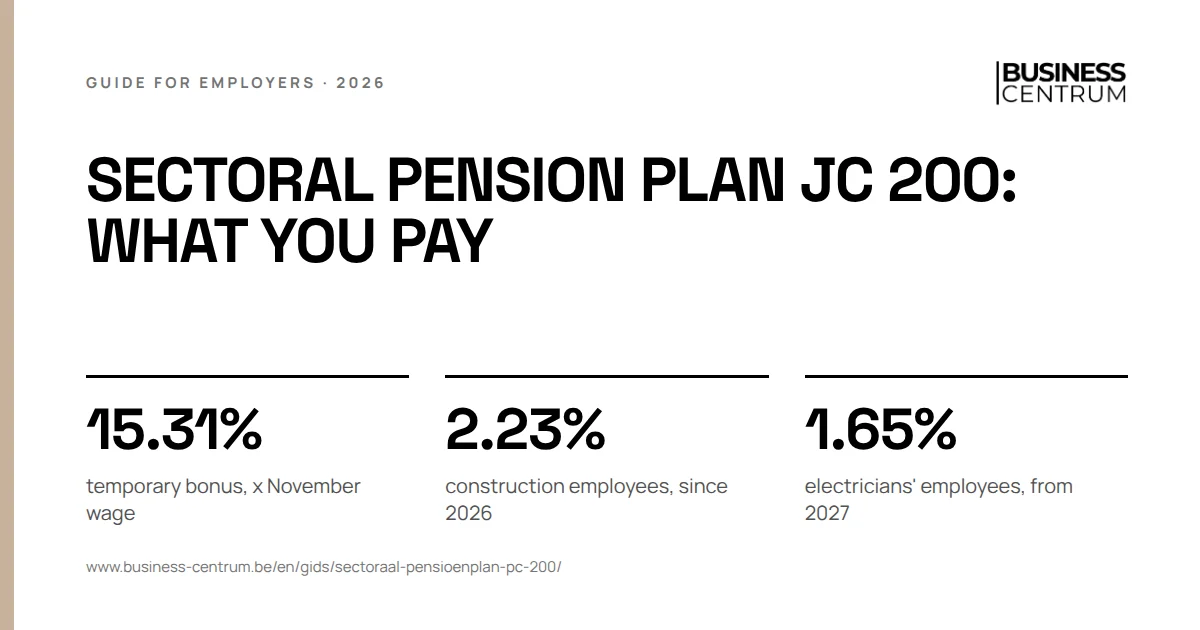
A general sectoral pension plan JC 200 for all white-collar employees does not exist. Social Fund 200 says so itself: within the auxiliary joint committee for employees there is no general sectoral supplementary pension. What does apply depends on who else you employ. If you only have white-collar employees, nothing changes. If your employees work in the same business activity as blue-collar workers with a sector pension, you pay a temporary annual bonus of 15.31% of the November wage or, since the start of the plan for your sub-sector, a contribution through the NSSO.
Sectoral pension plan JC 200 at a glance
| Your situation | What applies in 2026 |
|---|---|
| You only have white-collar employees in JC 200 | No obligation under this scheme |
| Employees and blue-collar workers, but your blue-collar workers have no supplementary pension | No obligation under this scheme |
| Construction employees, with blue-collar workers in JC 124 | Sector plan since 1 January 2023, 2.23% of the reference wage |
| Employees in garages, bodywork, the metal trade, precious metals or metal recovery | Sector plan since 1 July 2025, 1.19% of the NSSO wage, NSSO included |
| Employees in taxis and car hire with driver | Sector plan since 1 January 2025, 1% of the NSSO wage |
| Employees at electricians | Sector plan since 1 January 2026, 1.10% plus 8.86% NSSO, 1.65% from 1 January 2027 |
| Employees in another business activity where the blue-collar workers have a sector pension | Temporary annual bonus of 15.31% of the November wage, until a plan exists |
The table follows the JC 200 purchasing power agreement, the sector agreements per business activity and the explanations of Social Fund 200. Not sure which committee your employees and blue-collar workers fall under? First read our guide on joint committee 200.
Why JC 200 has no general supplementary pension
JC 200 is an auxiliary committee: it covers the white-collar employees of employers that have no committee of their own for employees. Those employers work in very different sectors. A general sector pension never came about. The problem arose with the harmonisation of blue-collar and white-collar status.
The Supplementary Pensions Act (WAP) of 28 April 2003 requires employers to remove differences in supplementary pension between blue-collar and white-collar workers. Many blue-collar workers get a sector pension through their committee. Their white-collar colleagues in JC 200 did not. That inequality has to go.
That is why the social partners of JC 200 concluded the purchasing power agreement on 1 July 2019. It gave employees a purchasing power increase of 1.10% and linked a special scheme to it for employers whose blue-collar workers have a supplementary pension in the same business activity. For them, that 1.10% did not become a pay rise but a temporary annual bonus. The budget of that bonus is ultimately meant to fund a supplementary pension for the employees.
The 2025 coalition agreement wants to go further: by 2035, a supplementary pension for all employees with an employer contribution of at least 3%. According to Social Fund 200, there are no implementing decrees yet. Today it is an intention, not an obligation.
The temporary annual bonus: 15.31% of the November wage
The temporary annual bonus applies to the employees of employers that employ both white-collar and blue-collar workers in the same business activity, where the blue-collar workers have a supplementary pension and the employees have none or a less favourable plan. The agreement looks at the situation on 1 September 2019. An annex to the agreement lists the mirror committees of the blue-collar workers, such as 112, 121, 124, 145 and 149.01.
- Amount: the November gross monthly wage of the reference year x 15.31%. That is 1.10% x 13.92.
- Who: employees in service on 1 September 2019. The reference year is the calendar year, with a pro rata based on actual and assimilated days. Someone who leaves during the year also gets his share.
- When: with the December wage.
- Not: for employees paid at the minimum scale on 31 August 2019. Those who were then less than 1.10% above the scale receive an adjusted bonus.
Worked example. An employee who was already in service on 1 September 2019 earns € 3,200 gross in November and worked the whole year. His temporary annual bonus is € 3,200 x 15.31% = € 489.92 gross, paid in December.
The social partners of each business activity have until 31 December 2026 to conclude an agreement in JC 200 that turns the budget into a supplementary pension, taking effect on 1 January 2030 at the latest. If no agreement comes for your activity, the obligation to pay the bonus ends from 1 January 2030. You must then use the budget yourself for a supplementary pension that removes the difference with your blue-collar workers, in line with the WAP.
JC 200 supplementary pension for employees per business activity
For a series of sub-sectors the plan already exists. As soon as it starts, the temporary annual bonus stops, because the whole budget goes to the pension. Social Fund 200 lists these sub-sectors:
| Business activity (committee of the blue-collar workers) | Start | Employer contribution | Organiser and pension institution |
|---|---|---|---|
| Construction (JC 124) | 1 January 2023 | 2.23% of the reference wage since 1 January 2026, all included | fbzp-fsep Constructiv, Pensio B OFP |
| Garages (JSC 112), bodywork (JSC 149.02), metal trade (JSC 149.04), precious metals (JSC 149.03), metal recovery (JSC 142.01) | 1 July 2025 | 1.10% plus NSSO, together 1.19% | a subsistence security fund per sector, Sefoplus OFP |
| Taxis and car hire with driver (JSC 140.02 and JC 140) | 1 January 2025 | 1% of the NSSO wage, all included | FBZ P2P Taxi+, Sefoplus OFP |
| Electricians (JSC 149.01) | 1 January 2026 | 1.10% plus 8.86% NSSO; 1.65% from 1 January 2027 | FBZ Volta Plus FSE, Sefoplus OFP |
| Brickworks (JSC 114) | 1 January 2022 | arranged by each company | the company itself |
A few details make the difference to your payroll cost:
- Construction. Until 1 January 2026 the contribution was 1.28% of the reference wage. Since then it is 2.23%, with a solidarity component added. The employee's account receives 1.80% of the reference wage. The reference wage is the NSSO wage of certain DmfA codes multiplied by 1.04.
- Sefocam sectors. The employee's account receives 1.05%. By 31 December 2029, the net contributions for blue-collar and white-collar workers must be equal, except in precious metals, where they already are. So expect further increases.
- Electricians. In 2026 it is an ordinary pension plan. From 1 January 2027 a solidarity component is added and the contribution rises to 1.65%. That is fixed and belongs in your 2027 payroll budget.
Construction example. A construction employee with an NSSO wage of € 3,200 a month costs you about € 71.36 a month in sector contribution. The exact base is in the agreement; your payroll calculates it per quarter in the DmfA.
How you pay the JC 200 supplementary pension: NSSO and DmfA
You do not pay the contribution directly to a pension fund. The NSSO collects it together with your normal contributions, based on the employer category code in the DmfA. So the code decides whether you pay.
| Business activity | Employer category code |
|---|---|
| Construction | 024, 026, 044, 054 |
| Garages | 064 |
| Bodywork | 065 |
| Taxis | 068 |
| Metal trade | 477 |
| Precious metals | 478 |
| Metal recovery | 079 |
| Electricians | 467 |
| Brickworks | 495 |
| Employees without a sector contribution | 010 |
For the metal trade and precious metals, Sefocam reports that the agreement text mentions an outdated code; the table shows the code Sefocam gives. Social Fund 200 puts the responsibility on you: per technical business unit you check that employees who do the same activity as the blue-collar workers also have the same code. Employees in another activity get 010. If your blue-collar workers fall under more than one committee, the employees' plan follows the sub-sector with the most blue-collar workers. This is called the predominance principle.
The special NSSO contribution of 8.86% on pension payments is included in the amount collected for these sector plans, or withheld by the NSSO itself. You do not calculate or declare it separately. If you have a company plan of your own, it is different: you calculate the 8.86% yourself and declare it separately, says the NSSO.
Opting-out and exclusion: can I get out with my own plan?
A real opting-out, where you run the sector plan yourself at company level, is not provided for in these agreements. The agreements for construction, garages, taxis and electricians state explicitly that no use is made of the opting-out in article 9 of the WAP.
There is, however, an exclusion, called "outside the scope", for employers that on the start date already had an at least equivalent plan for all employees concerned:
- Construction: an equivalent plan no later than 1 January 2023. New employers and employers who enter the situation later can show the same at that moment.
- Sefocam sectors: an equivalence test with a certificate from the actuary of the insurer or pension fund, plus an employer statement, sent by registered mail to the sector organiser no later than 20 January 2025.
The deadlines for existing employers have passed. An excluded employer must remain equivalent. In construction, an excluded employer can still join later.
What the employee receives and where he sees it
In construction, the Sefocam sectors and at electricians, the net contribution is credited each quarter to an individual account of the employee. The Sefocam plans are defined contribution plans: the account grows with the pension fund's return, and over the whole membership that return must reach at least the statutory WAP minimum, which Sefocam puts at 1.75%. If the employee dies before retiring, the reserves built up in those plans go to his beneficiaries.
The employee sees his rights on mypension.be: per plan, the reserves and the pension institution. Active members can also read the pension rules there, says the FSMA. If an employee asks where his pension is, send him there first.
Leaving the company: what happens to the supplementary pension?
When an employee leaves, the sector organiser or the pension institution contacts him. He receives an exit statement with his vested reserve and his options: leave the reserve in the plan or transfer it. If the vested reserve is below € 194.04, he has no choice and it stays in the plan.
For you as an employer, this mainly means: declare the departure correctly in the Dimona and the DmfA, because the sector contribution runs through that return.
Pitfalls with the JC 200 supplementary pension
- Wrong employer category code. A construction employee under code 010 builds up nothing; an employee in another activity under a construction code costs you a contribution you do not owe.
- Paying the annual bonus after the plan has started. Since the start of the sector plan for your sub-sector, the temporary annual bonus stops. Paying twice is a cost you will not recover.
- Forgetting new employees. For the temporary annual bonus, the situation on 1 September 2019 counts. In a sector plan, every employee concerned is a member, including a new one.
- Missing the 2027 step. At electricians the contribution rises to 1.65% on 1 January 2027. Include it in your budget.
- Counting the 8.86% twice. In a sector plan through the NSSO, the special contribution is already included. Only for a plan of your own do you declare it separately.
- Waiting until 1 January 2030. If no agreement comes for your activity, you must have a compliant solution of your own by that date.
What you check now
- Check whether, besides white-collar employees in JC 200, you also employ blue-collar workers, and whether they have a sectoral supplementary pension.
- Find your business activity in the table. If it is there, check the start date and the code of every employee per technical business unit.
- If it is not there, pay the temporary annual bonus in December to the employees who were in service on 1 September 2019.
- If you have a group insurance of your own for your employees, have it checked whether it is equivalent and whether you are formally outside the scope.
- Put the 2027 contribution in your payroll budget, especially at electricians. Your employees' pay scales are in the JC 200 pay scale, the overview of all sectors in our guide on the sectoral pension plan.
What Business Centrum does for you
Business Centrum processes your payroll together with Acerta. That processing includes the right employer category code per employee, the DmfA on which the NSSO collects the sector contribution, and the temporary annual bonus in December where it still applies. You have one fixed contact person in Ghent who knows your file. How this works for SMEs is explained on our page about the social secretariat for SMEs. Would you like us to review your JC 200 situation? Request a call back.