
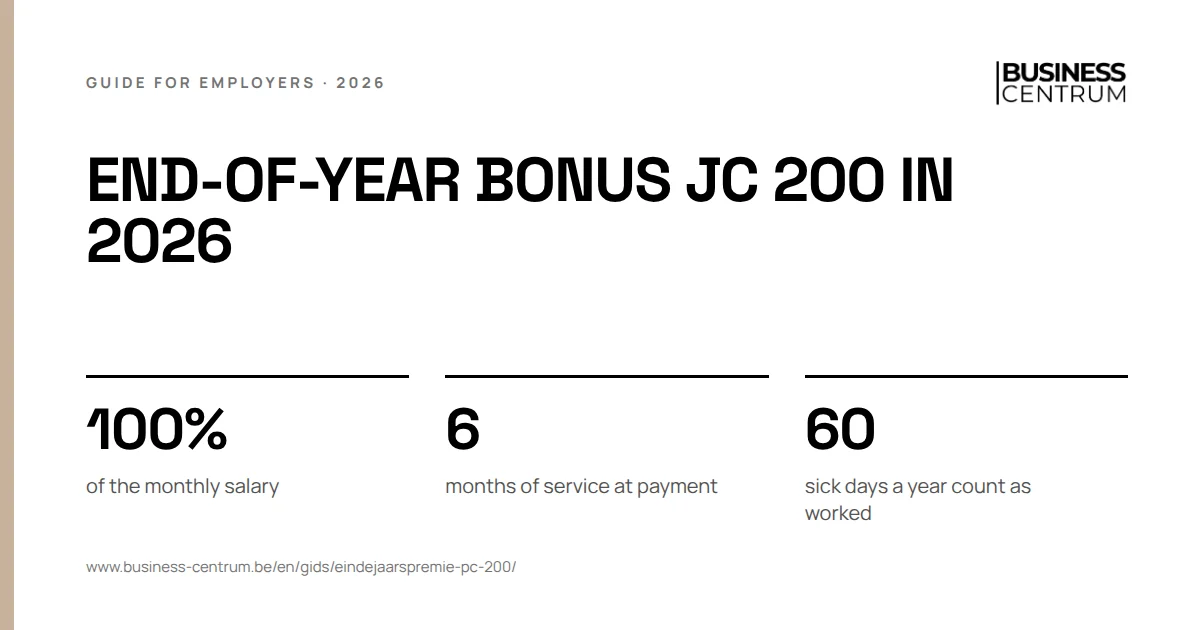
The end-of-year bonus in JC 200 equals one monthly salary, and you as the employer pay it yourself, at the latest in December. At the time of payment, the employee has at least 6 months of service. Someone who started or left during the year gets a share for each full calendar month worked.
Who gets the end-of-year bonus in JC 200?
The collective agreement applies to the white-collar employees of all companies that fall under the Supplementary Joint Committee for White-Collar Employees. Blue-collar workers in the same company fall under another committee and have their own rules. Whether your employees belong in JC 200 is explained in our guide on joint committee 200.
An employee is entitled to the full bonus if he meets three conditions:
- Employed at the time of payment. He is still bound by an employment contract as a white-collar employee. For someone who leaves earlier, a separate list of cases applies, further down this page.
- At least 6 months of service at the time of payment. A previous period as a temp worker counts if the hiring follows that temp period and the job is similar. A gap of 7 days or less between two temp assignments counts as employment.
- Started no later than the first day of the year. Someone who started later gets a bonus in proportion to the number of months worked, provided he was effectively present for at least 6 months.
How much is the end-of-year bonus in JC 200?
The bonus equals the employee's monthly salary. The agreement gives no other percentage and no fixed amount: an employee who worked the whole year gets 100% of his monthly salary. The agreement says nothing separate about part-time employees; it only refers to the monthly salary.
Two special rules apply to sales representatives:
- Fully variable pay: the bonus is the monthly average of the pay over the last twelve months, capped at the highest amount of the fourth category of the pay scale.
- Partly variable pay: the same monthly average and the same cap, unless the fixed part of the pay is higher. The bonus is then capped at that fixed part.
Worked example: an employee who started in April
This is an example, not a calculation for your situation. An employee earns € 3,000 gross a month and started on 1 April 2026. In December he has more than 6 months of effective presence. He worked nine full calendar months: 3,000 x 9/12 = € 2,250 gross. Had he only started on 1 August, he would not reach the 6 months by December and the sector agreement would give him no bonus.
When do you pay the end-of-year bonus in JC 200?
You pay the bonus at the latest at the end of the calendar year, so in December, or when the annual accounts are filed. An agreement at company level can set a different moment. If so, also record which period the bonus covers, so that the condition "employed at the time of payment" is clear to everyone.
The bonus goes through the normal payroll, with 13.07% employee social security and withholding tax under the scale for exceptional payments. What your employee keeps net, and what the bonus costs you on top of the basic employer contribution of 25%, is explained in our guide to end-of-year bonus calculation.
Which absences reduce the end-of-year bonus in JC 200?
You may reduce the bonus in proportion to absences during the year. But a long list of absences counts as worked, and you may not deduct those:
| Absence | Counts for the bonus |
|---|---|
| Annual holidays and public holidays | in full |
| Short leave, paternity leave, paid educational leave, trade union leave | in full |
| Workplace accident, occupational disease, maternity leave, prophylactic leave | in full |
| Sickness or accident | 60 days a year |
| Temporary unemployment for economic reasons or force majeure | 5 days a year, since 1 January 2026 |
An employee who was sick for ninety days in 2026 therefore has 60 days treated as worked. You may only reduce the bonus for the days above that. The agreement does not say whether you calculate the reduction in calendar days, working days or months. Choose a method, apply it to everyone in the same way and record it.
End-of-year bonus JC 200 on dismissal or leaving
If an employee leaves before the bonus is paid, he only gets a bonus if his case is listed in the agreement. He then gets a share for each full calendar month worked in the current year.
| Situation | Right to a pro rata bonus |
|---|---|
| Dismissal by the employer, except for serious misconduct, even if the employee then gives counter-notice | yes, with 6 months of service at departure |
| Retirement | yes, with 6 months of service at departure |
| Unemployment with company top-up after dismissal | yes, with 6 months of service at departure |
| End due to permanent force majeure | yes, with 6 months of service at departure |
| Resignation or end by mutual agreement | yes, with at least 3 years of service with the company |
| End of a fixed-term contract or a clearly defined job of at least 6 months | yes |
| Dismissal for serious misconduct | no |
For a resignation, the threshold was 5 years until the end of 2025. Since 1 January 2026 it is 3 years, and here too a previous temp period in a similar job counts.
Example. An employee with a monthly salary of € 3,000 and two years of service resigns and leaves on 30 September. He does not have three years of service, so the sector agreement gives him no bonus. If you dismiss him on the same date, he gets 3,000 x 9/12 = € 2,250 gross. The amount belongs in the final pay settlement and on the social documents at dismissal.
Can your own company scheme replace the end-of-year bonus?
The sector agreement does not apply to two types of companies:
- companies that grant an at least equivalent benefit during the year, whatever it is called, as a contractual bonus or as a gift;
- companies that set the pay and working conditions of their employees themselves by agreement, if the benefits of that agreement taken together are at least equal to those of the sector agreement.
A more favourable scheme in your company therefore keeps applying. A less favourable one does not replace the sector agreement. If you are unsure whether your own bonus is equivalent, compare the two schemes on amount, conditions and leavers.
End-of-year bonus and the minimum income in JC 200
The end-of-year bonus also counts for the guaranteed average minimum monthly income. When you pay the bonus, you settle the monthly pay and benefits of the previous 12 months. If that settlement is lower than the minimum income for that period, you pay the difference as a top-up, together with the bonus. For employees on the minimum, December is also the month of that settlement. More in our article on the minimum income in 2026.
Mistakes we see with the end-of-year bonus in JC 200
- Deducting every sick day. The first 60 days of sickness a year count as worked.
- Applying the old resignation threshold. Since 2026, 3 years of service are enough, no longer 5.
- Forgetting the temp period. An employee hired after a temp assignment in the same job often reaches the 6 months sooner than his contract date suggests.
- Deducting all temporary unemployment. Since 2026, 5 days count as worked.
What Business Centrum does for you
Business Centrum calculates the end-of-year bonus of your employees under this agreement, together with Acerta, as part of your payroll administration. We track the days treated as worked, include the bonus in the final settlement when someone leaves and give you an overview of what December will cost in the autumn. The rules of the other committees are in our overview of the end-of-year bonus in 2026 per joint committee.