
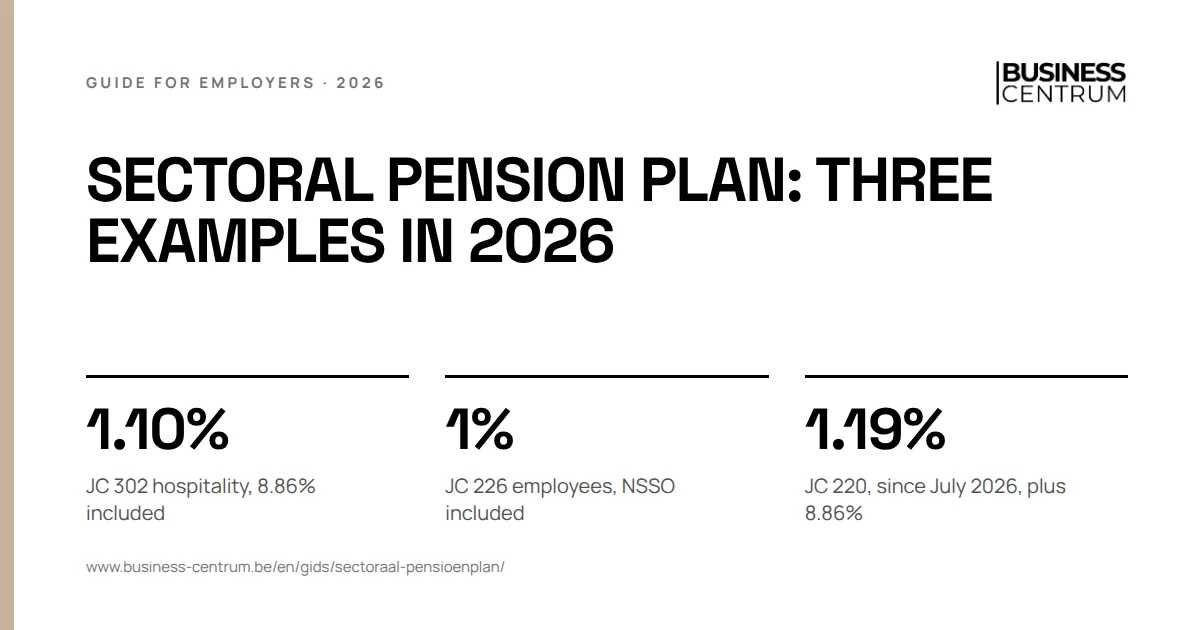
A sectoral pension plan is a supplementary pension that the social partners of a joint committee introduce by collective agreement for all workers in the sector. It is the second pension pillar, on top of the statutory pension, and falls under the Supplementary Pensions Act (WAP) of 28 April 2003. If your committee has such a plan, you take part in principle as an employer and pay a contribution, usually a percentage of pay that the NSSO collects together with your normal contributions. How much that is varies widely per committee: from 1% of the NSSO wage for employees in JC 226 to 2.59% in Flemish metalworking.
Sectoral pension plan: how it works
Four parties play a role. The FSMA, which supervises supplementary pensions, describes them like this:
- The social partners of the committee conclude the agreement that introduces the plan. It sets out who joins, how much is paid and whether companies with a plan of their own may stay outside the sector plan.
- The organiser promises the pension. For a sector plan this must be a body run jointly by employers and workers. Usually it is a subsistence security fund of the sector.
- The pension institution manages the money: a pension fund (OFP) or an insurance company.
- You as the employer pay the contribution. In the plans in the table below, the agreement puts the contribution on the employer.
The FSMA is clear about the obligation: if a plan has been introduced in a sector by collective agreement, all employers in that sector are in principle required to take part. Their workers are therefore members too. An agreement can, however, allow a company to build up a supplementary pension itself instead of the sector plan. This is called opting-out, and that plan of its own must reach at least the level of the sector plan.
In the plans in the table, the agreement fixes a contribution, usually a percentage of pay, and the net contribution is credited to an individual account of the worker. What he receives at retirement depends on those payments and the return. The WAP imposes a minimum return that the organiser must guarantee; according to Sefocam it is currently 1.75%.
Contribution for the sectoral supplementary pension per joint committee
The table shows the committees in which the SMEs we serve most often work, with the contribution we could check in a primary source. "Plus NSSO" means the special contribution of 8.86% comes on top of the percentage; "NSSO included" means it is already in it.
| Committee | Organiser and pension institution | Employer contribution | Base and since | Source |
|---|---|---|---|---|
| JC 111 metalworking, blue-collar (Flanders) | FBZ Metalworking Industry, Pensioenfonds Metaal OFP | 2.29%, with NSSO and solidarity 2.59% | full gross pay, since 1 July 2017 | FBZ Metaal, Pensioenfonds Metaal |
| JC 112 garages, blue-collar | sector fund, Sefoplus OFP | 1.95%, NSSO included | NSSO wage | Sefocam |
| JC 118 food industry, blue-collar | Fonds 2de pijler PC 118, AG Insurance | 1.52%, plus NSSO | 108% of pay, since 1 January 2014 | agreement 130432 |
| JC 121 cleaning | SFSOO | 1.50% | fixed contribution, plan since 1 January 2008 | SFSOO |
| JC 124 construction, blue-collar | fbzp-fsep Constructiv, Pensio B OFP | allocation from 1.80% to 2.65% depending on years in the sector, paid from the contributions to Constructiv | 108% x 1.04 of the NSSO wage, since 1 January 2026 | agreement 199072 |
| JSC 140.03 road haulage, blue-collar | SFTL, Pensio TL | 0.92%, NSSO included | 108% of pay, since 1 July 2018 | agreement 149433 |
| JC 145 horticulture | Fonds tweede pijler PC 145, AG Insurance | blue-collar 2.20%, plus NSSO; white-collar since 1 January 2026, 1.10% from 1 January 2027 | blue-collar 108% since 1 January 2023, white-collar the NSSO wage | agreements 177030 and 200416 |
| JSC 149.01 electricians, blue-collar | FBZ Volta Plus | 2.10% gross, plus NSSO on the net contribution | NSSO wage, since 1 January 2026 | agreement 199671 |
| JC 200 white-collar | no general plan | temporary annual bonus of 15.31% of the November wage, or a plan per business activity | see the JC 200 guide | 2019 purchasing power agreement |
| JC 207 chemicals, white-collar | sector FBZ, AG Insurance | 0.85%, minimum € 57.41 per quarter, plus NSSO | NSSO wage, since 1 January 2016 | agreement 146650 |
| JC 209 metalworking, white-collar | as set out in the sector agreement | 2.29% plus 0.10% solidarity | reference wage, since 1 January 2020 | agreement 187003 |
| JC 220 food industry, white-collar | Fonds Tweede Pijler PC220 | 1.19% plus 0.06% solidarity, plus NSSO; 1.28% from 1 July 2027 | NSSO wage, since 1 July 2026 | agreement 200983 |
| JC 226 employees in international trade, transport and logistics | Social Fund 226, Vivium | 0.92%, with NSSO 1% | NSSO wage | Social Fund 226 |
| JC 302 hospitality | Fonds Tweede Pijler PC302, AG Insurance | 1.01%, with NSSO 1.10% | blue-collar 108%, white-collar the NSSO wage, since 1 January 2020 | agreement 155566 |
| JC 330 healthcare | sector funds, federal and Flemish | federal: allowance of at most € 28 per quarter for 2025; Flemish: 0.44% of gross pay in the second half of 2026 | set each year by agreement | agreements 200386 and 199634 |
The names of organisers and pension institutions are given as the agreement or the sector fund states them. Every source, with the date on which we checked it, is listed in the sources block at the bottom of this page. If your committee is not in the table, we found no sector plan or no contribution we could prove. Not sure which committee your workers fall under? Our guide finding your joint committee shows how.
Two committees need more explanation. For employees in JC 200 there is no general plan; what you pay there depends on your blue-collar workers. That is set out in our guide on the sectoral pension plan JC 200. For employees in international trade, transport and logistics, read the guide on the sectoral pension plan JC 226.
Paying a sectoral pension: through the NSSO or directly
For most committees in the table, the NSSO collects the contribution. It works like this: your DmfA contains an employer category code, and based on that the NSSO charges the contribution for the sector plan. The NSSO passes it on to the sector, which places it with the pension institution. According to the NSSO this has two advantages: everything is on one return, and the special contribution of 8.86% is included in the contributions collected, so you do not calculate or declare it separately.
If the NSSO does not collect the sector contribution, you pay the organiser directly. Even then you do not pay the 8.86% yourself: since 1 January 2014 the organiser of a sector scheme owes that special contribution in your place.
It is different if you have a plan of your own. If the agreement lets you stay outside the sector plan with an equivalent company plan, you calculate the 8.86% yourself and declare it separately in the DmfA. The same applies to a group insurance you have alongside a sector plan, for example only for your white-collar employees.
Worked example: what a sectoral supplementary pension costs per month
Three workers, three committees, with the percentages from the table:
- Employee in JC 226 with an NSSO wage of € 3,200 a month: € 3,200 x 1% = € 32 a month, NSSO included.
- Employee in JC 220 with the same wage, since 1 July 2026: 1.19% and 0.06% of € 3,200, plus 8.86% on the pension part, together € 43.37 a month. From 1 July 2027 the pension part rises to 1.28%.
- Blue-collar worker in JC 302 earning € 2,800 gross a month: the reference wage is 108% of that, so € 3,024. On that, 1.10%, or € 33.26 a month, NSSO included.
These are monthly amounts to estimate your payroll cost. The NSSO calculates per quarter, on the pay as you declare it in the DmfA.
Opting-out or exemption: can I stay outside the sector plan with my own plan?
The agreement of your committee decides that, not you. There are three forms:
- No exception at all. For example JC 121 and JC 220: no opting-out. JC 207 does not use the WAP opting-out either.
- Exclusion for those who already had a plan on a fixed date. In JC 111 only for companies with an approved company agreement concluded no later than 31 December 1999. In JC 118 for companies with an equivalent plan on 31 December 2002. In JSC 140.03 an equivalent plan in place on 1 July 2011 could continue, with a yearly actuarial certificate. In JC 302, companies that already had a plan on 22 June 2011 and had it certified in time fall outside the scope.
- Opting-out. In JC 209 the plan applies to employers that are not exempted and do not apply an opting-out.
Those dates are long gone. In practice, a new SME can rarely stay outside the sector plan. If you have a group insurance of your own, check whether it comes on top of the sector plan or formally replaces it. Paying twice when you do not have to costs money; not paying when you must creates arrears with the NSSO.
What the worker receives and where he sees it
The worker builds up a reserve on an individual account with the pension institution. Many sector plans also have a solidarity component with its own contribution, as in JC 111, 118, 145, 209, 220 and 302. In JC 111, for example, a worker who is ill or temporarily unemployed receives a top-up from it to keep building his pension, says Pensioenfonds Metaal. What the component covers exactly is set out in each sector's solidarity rules.
He sees his rights on mypension.be. The FSMA points to it as the place where a worker finds all his supplementary pensions, with the reserves per plan and the pension institution. If a worker asks about his sector pension, that is the first place to look.
When he leaves the company, he receives an exit statement from the pension institution or the organiser, with his vested reserve and his options: leave the reserve in the plan or transfer it. If it is below € 194.04, he has no choice and it stays in the plan.
Pitfalls with a sectoral pension
- Wrong employer category code. The code in the DmfA decides whether the NSSO collects the sector contribution. A wrong code means no build-up, or a contribution you do not owe.
- Forgetting or double-declaring the 8.86%. In a sector plan through the NSSO it is already included or borne by the organiser. For a plan of your own, you declare it yourself.
- Treating blue-collar and white-collar workers differently. The WAP requires employers to remove differences in supplementary pension between blue-collar and white-collar workers. That is why there are plans for employees in JC 200 who work alongside blue-collar workers with a sector pension.
- Missing an increase. In JC 220 the contribution rises on 1 July 2027, in JC 145 it changes for white-collar employees on 1 January 2027. Put it in your payroll budget.
- Keeping a plan of your own without knowing whether it counts. A group insurance only replaces a sector plan if the agreement allows it and you are formally excluded.
What you check now
- Look up the joint committee of your blue-collar and white-collar workers, and see in the table whether there is a sector plan.
- Check the employer category code per worker and per technical business unit in your payroll.
- If you have a group insurance of your own, check whether you are formally outside the sector plan or whether both run side by side.
- If you employ white-collar staff in JC 200 and blue-collar workers with a sector pension, read the JC 200 guide and check whether the temporary annual bonus or a plan per activity applies.
- Include the contribution per committee in your 2027 payroll budget, with the increases already fixed. What you pay at least per committee is in the pay scales per joint committee.
What Business Centrum does for you
Business Centrum processes your payroll together with Acerta. That includes the employer category code per worker and the DmfA through which the NSSO collects the contribution for your sector fund. You have one fixed contact person in Ghent who knows your file. How our payroll administration works is explained on the service page. Would you like us to check which sector pension applies to your workers? Request a call back.