
A cafeteria plan is a flexible reward plan in which an employee converts part of his pay, such as part of his end-of-year bonus, into a budget that he spends himself on benefits from a list set by the employer. According to the Ruling Commission (DVB/SDA) of the FPS Finance, popular choices are IT equipment, a lease car, a lease bike and extra days off. Belgium has no specific law on cafeteria plans. Each chosen benefit follows its own social security and tax rules, and the conversion itself must stay within employment law and your sector agreement.
Cafeteria plan Belgium: the meaning at a glance
| Question | Answer as of 20 October 2026 |
|---|---|
| Is there a law on cafeteria plans? | no, bill 56K0945 is pending in the Chamber |
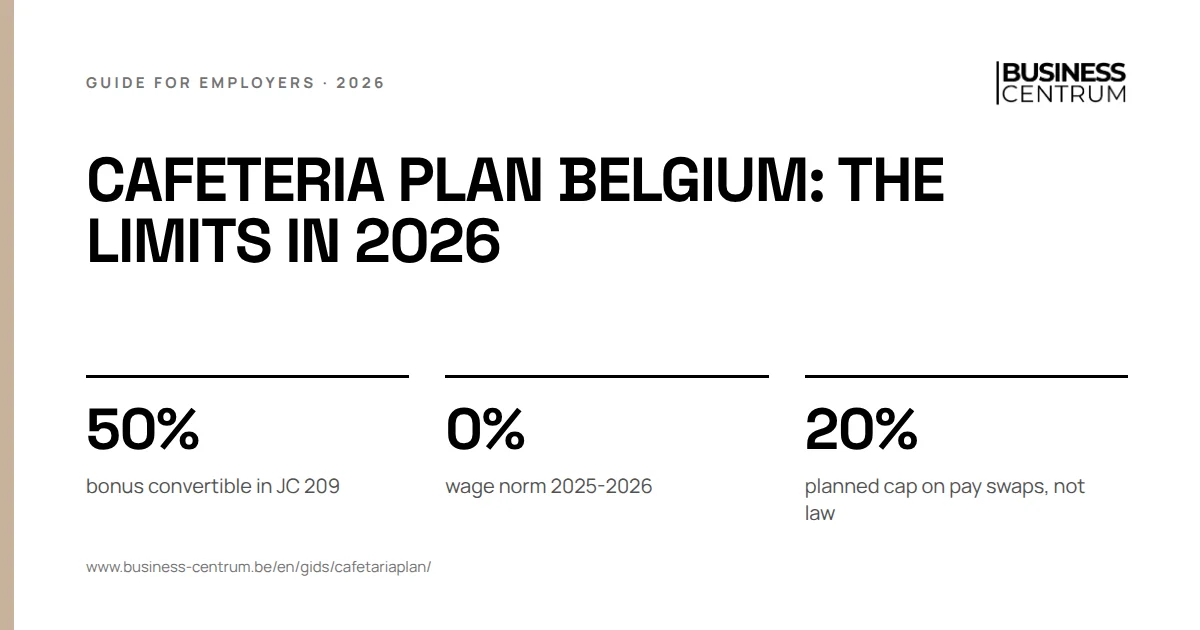
| Cap on gross pay swaps | 20% of annual pay in the coalition agreement, not yet law |
| Wage norm 2025-2026 | 0%, indexation and pay scale increases remain guaranteed |
| Converting the end-of-year bonus in JC 209 or JC 111 | at most 50%, into days off or a bike lease |
| Converting the end-of-year bonus in JC 226 | at most 60% of the fixed part, into an equivalent benefit |
| Tax ruling | possible, not required |
| Meal vouchers or CBA 90 bonus in exchange for pay | no |
No law regulates the cafeteria plan as a whole: that is why the coalition agreement wants to put flexible pay on a legal footing. The Ruling Commission describes it like this: within the framework set by the employer, employees agree to convert part of their current pay components into a budget they can use as they choose for benefits from the employer's list. That is why it is also called a gross pay swap or flexible pay.
How does a cafeteria plan work? The five conditions
Without a law of its own, you build the plan on the rules that do exist. Sector agreements, NSSO instructions and case law give five conditions.
- A budget from pay you are allowed to convert. That is a variable element such as the end-of-year bonus, if your sector agreement allows it, or a benefit you grant yourself at company level. Pay that the sector agreement imposes, such as the pay scale, is not converted.
- No new pay rise above the wage norm. The wage norm for 2025-2026 is 0%. According to the FPS Employment, benefits you already granted may continue in another form, but without an increase. A cafeteria plan with an extra budget on top of the existing package conflicts with that.
- A choice in advance. The employee chooses before the period starts and signs an individual agreement. The sector agreements that allow conversion also require him to receive information about the consequences beforehand.
- Cost-neutral. The JC 209 agreement says so explicitly: the conversion may not lead to cost savings. The employer does not save money at the employee's expense.
- No benefit that may not replace pay. Some benefits are only exempt if they come on top of pay. They are listed further down under "what is not possible".
Offer the plan per objective category of employees and put in writing who may choose, from what and at what value. That keeps it explainable during an inspection and for your employees.
Cafeteria plan and the end-of-year bonus: where does the budget come from?
The end-of-year bonus is the most common source, but only where the sector agreement allows it. A few examples from the collective agreement database of the FPS Employment:
| Committee | What you may convert | Into what |
|---|---|---|
| JC 209, white-collar workers in metalworking | at most 50% of the end-of-year bonus | days off or bike lease |
| JC 111, blue-collar workers in metalworking | at most 50% of the end-of-year bonus | days off or bike lease |
| JC 226, white-collar workers in international trade, transport and logistics | at most 60% of the fixed part | an equivalent benefit |
| JSC 319.01, Flemish welfare sector | up to € 12,688.15 over three years | bike leasing |
In JC 209 and JC 111 this concerns the end-of-year bonus from the provincial or regional agreements. The conditions are similar: a company-level agreement confirming the conversion, an individual agreement of the employee, voluntariness and prior information about the consequences. Without a company-level agreement, conversion is not possible in those sectors. If your committee says nothing about it, you pay the end-of-year bonus as the agreement sets it. How to calculate that bonus per sector is explained in our guide on calculating the end-of-year bonus.
A second source is a benefit you grant yourself at company level, on top of what the sector imposes. The wage norm applies there too: you change the form, not the amount.
The riskiest route is reducing the fixed monthly salary. In the case decided by the Court of Cassation on 25 March 2019, an employer reduced gross pay above the pay scale and replaced that part with a "child benefit supplement" without social security contributions. The Court did not accept it: a supplement must compensate a loss of income or an extra expense caused by a social risk. According to the bill on cafeteria plans (DOC 56 0945/001), that arrangement ran through a cafeteria plan.
Cafeteria plan example: what can you include?
What is possible follows from the rules for each benefit. In its 2025 annual report, the Ruling Commission names these popular choices:
- IT equipment. For a device the employer provides free of charge, a flat-rate benefit in kind applies per year: € 72 for a PC, € 36 for a tablet or mobile phone, € 60 for an internet connection and € 48 for a phone subscription. The amounts apply per device and are added up. The Ruling Commission considers that a second device of the same type should be valued at its real value, but acknowledges that the law does not currently exclude it.
- A lease car. A company car from the plan is a company car: the employee pays a benefit in kind, the employer the solidarity contribution. How to calculate that benefit is in our guide on the benefit in kind of a company car.
- A lease bike. In the sectors in the table above, the end-of-year bonus can be used for it, within the limit of the agreement.
- Extra days off. JC 209 and JC 111 also allow these in exchange for part of the end-of-year bonus.
The Ruling Commission assesses other benefits case by case. In its annual report for 2,023 it decided that air conditioning or a fan for the home office and a smart TV presented as an "accessory" to IT equipment are taxed at their real value. If you want certainty about a benefit that does not fit a fixed rule, you can ask for a ruling.
Pension savings. Bill DOC 56 0945/001 wants to exclude payments for third-pillar pension savings from cafeteria plans explicitly. That is not law yet. We do not cover supplementary pensions through the employer on this page: each plan has its own rules.
What is not possible in a cafeteria plan?
In its instructions for quarter 2026/3, the NSSO is clear about several benefits that are only exempt if they do not replace pay:
- Meal vouchers. Vouchers granted to replace or convert pay, bonuses, benefits in kind or any other benefit are always pay. How meal vouchers do work is explained in our guide on the employer contribution to meal vouchers.
- A CBA 90 bonus. Non-recurring result-related benefits may not be introduced to replace or convert pay (instructions 2026/3). More in our guide on the CBA 90 bonus.
- Child benefit supplements, childcare and holiday camps. A supplement granted to compensate a pay cut or as part of a pay optimisation system, as can occur in a cafeteria plan, is pay for the NSSO (instructions 2026/3). Reimbursing school costs, holiday camps or childcare is not an exempt supplement either.
- The mobility budget. The statutory mobility budget may not replace pay, a bonus or another benefit (instructions 2026/3). It is a separate system for those entitled to a company car: see our guide on the mobility budget.
Downsides of a cafeteria plan: what the employee and you give up
For the employee. What he does not receive as gross pay does not count in amounts based on gross pay. The double holiday pay of a white-collar employee is 92% of the gross salary of the month in which his holiday starts. A benefit instead of gross pay does not raise that amount. The bill lists what an employee should be informed about: the status of each benefit, the contributions due and the consequences for his social security benefits, group insurance, holiday pay and end-of-year bonus. Even without that law, that is the information an employee needs before he signs.
On dismissal. Under article 39 of the Employment Contracts Act, payment in lieu of notice includes not only current pay but also the benefits acquired under the contract. Chosen benefits therefore count, and you must be able to value them.
For the employer. You bear the risk that the NSSO requalifies a conversion as pay, with the ordinary contributions on it. You need rules, in some sectors a company-level agreement, an agreement per employee, a choice round per period and the right codes in payroll.
The ruling. Under article 23 of the Act of 24 December 2002, an advance decision binds the FPS Finance for the future, as long as its conditions are met. The NSSO is a different institution and decides for itself what counts as pay. A tax ruling therefore does not cover the social security side.
Worked example: converting an end-of-year bonus in JC 209
This is an example with made-up amounts, not a calculation for your employee. A white-collar employee in JC 209 is entitled to an end-of-year bonus of € 3,000 gross. Your company has a company-level agreement confirming the conversion, and the employee signs an individual agreement after being informed about the consequences.
- At most 50% may be converted: € 3,000 x 50% = € 1,500.
- That € 1,500 goes to days off or a bike lease, cost-neutral for you.
- You pay the other € 1,500 as an ordinary end-of-year bonus, with social security and withholding tax.
If the employee chooses nothing, he receives the full bonus in cash. The agreement leaves the choice to him.
Cafeteria plan in Belgium in 2026 and 2027: what is coming?
The coalition agreement of 26 February 2025 states that the system of flexible pay will be given a legal framework. The government wants to cap gross pay swaps at 20% of annual gross pay, while keeping administration simple. Separately, two members of parliament filed a bill on 24 June 2025 to regulate cafeteria plans. The bill takes over a text from the previous parliamentary term and is still pending in the Social Affairs committee.
What to check now
- Look in the agreements of your joint committee to see whether, and how much of, the end-of-year bonus you may convert, and into what.
- Record the conversion in a company-level agreement where your sector requires it, and in an individual agreement per employee.
- Remove from the plan what may not replace pay: meal vouchers, a CBA 90 bonus, child benefit supplements and childcare.
- Calculate for each benefit the benefit in kind and the contributions you still owe.
- Inform your employees in writing about the consequences for their holiday pay, their benefits and their end-of-year bonus.
- Follow the law announced in the coalition agreement: the 20% cap may limit your plan later.
Pitfalls of a cafeteria plan
- Cutting fixed pay to fund benefits. That is the arrangement the Court of Cassation rejected. Dropping below the pay scale is never allowed.
- Converting without a company-level agreement in a sector that requires one.
- Granting an extra budget in a period with a wage norm of 0%.
- Converting after the fact. The sector agreements require agreement and information in advance. A choice made afterwards cannot be justified.
- Treating a ruling as a social security guarantee. It binds the tax authorities, not the NSSO.
- Not keeping the value of each benefit. On dismissal you need it for the payment in lieu of notice.
What Business Centrum does for you
Business Centrum processes your payroll together with Acerta, with one fixed contact person in Ghent who knows your file. If you are considering a cafeteria plan, we review your pay package and fringe benefits in a staff analysis. In payroll administration we process your employees' pay every month. Would you like us to look at your pay package together? Request a call back.