
The mobility budget is an annual budget that an employee with a company car, or with the right to one, can receive instead of that car: in 2026 it ranges from € 3,233 to € 17,244 a year. The employee spends it on a zero-emission car, on sustainable transport or on housing close to work, and receives the rest in cash. As of 20 October 2026 it is not mandatory in Belgium. The government wants to make it mandatory, but that law does not exist yet.
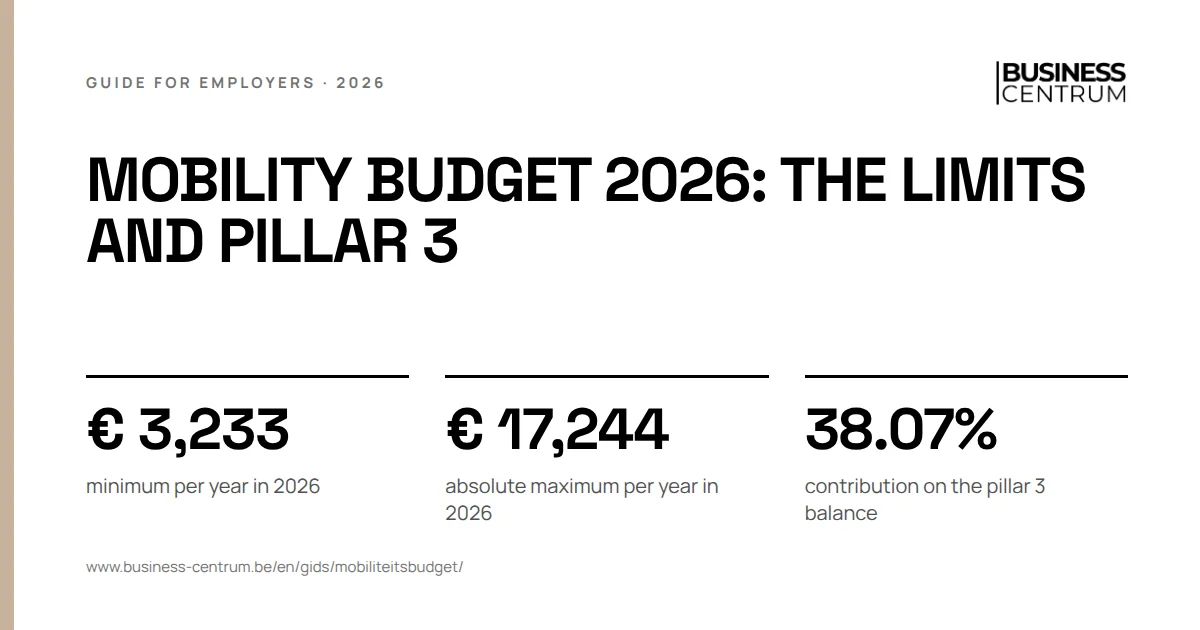
Mobility budget Belgium 2026 at a glance
| Rule | What applies in 2026 |
|---|---|
| Minimum per year | € 3,233 |
| Absolute maximum per year | € 17,244 |
| Maximum compared to pay | 20% of total annual gross pay |
| Employer already had company cars | at least 36 months without interruption |
| Pillar 1 | only a car without CO2 emissions, ordered from 1 January 2026 |
| Housing in pillar 2 | home within 10 km of the usual workplace |
| Contribution on the pillar 3 balance | 38.07%, withheld from the employee |
| 2027 amounts | not yet published |
The rules come from the Act of 17 March 2019 introducing a mobility budget, as amended since 2021, and from the administrative instructions of the NSSO (RSZ/ONSS). The amounts follow the index; the other rules only change when the law changes.
Is the mobility budget mandatory in 2027?
Not today. Article 4 of the Act leaves the introduction of a mobility budget to the employer's exclusive decision. The NSSO confirms it: the employer decides whether to introduce it, and the employee chooses freely.
What does exist are plans. The federal coalition agreement of 26 February 2025 states that employers will systematically offer the mobility budget to employees entitled to a company car. The government then approved a preliminary draft law. The National Labour Council and the Central Economic Council gave their advice on 29 April 2026 (advice no. 2.485). According to that advice, the obligation depends on the average number of employees, with thresholds at 15 and 50 employees. The Council of Ministers press release names 1 January 2027 as the planned start date.
In practice: if you provide company cars, you can prepare, but you do not have to introduce anything because a date appears in the press. Do look at which employees are entitled to a car and what those cars cost you each year. That amount will become their budget.
Who can offer a mobility budget?
An employer can introduce the mobility budget if, for at least 36 months without interruption and immediately before the introduction, he has provided one or more company cars. A business active for less than 36 months may also do so, if it provides company cars at that time. A continuation of another company's activity does not fall under that exception.
The employer sets the conditions himself and communicates them to all employees. He does not have to offer the budget to everyone: he may work with objective categories of employees. For spending, he must offer at least one option in pillar 2, sustainable means of transport. If he distinguishes between employees, he must be able to justify it objectively.
Who can receive a mobility budget?
An employee who has a company car, or is entitled to one under the employer's car policy, can ask to exchange it. Since 1 January 2022 he can join immediately, even if he never had a company car before. The law used to require a minimum period with a car; that condition has been abolished.
- A car only counts if there is private use. It must be a car for which a solidarity contribution and a benefit in kind are due.
- One budget per employee. Someone with several company cars exchanges one.
- No budget funded by pay. If the employee received the car in exchange for pay, the statutory mobility budget is not possible. The budget itself may not replace pay, a bonus or another benefit either. If you want to convert pay into benefits, that is a different system: see our guide on the cafeteria plan.
- In writing. The employee applies in writing and the employer replies in writing. A positive reply becomes part of the employment contract.
- Job without a car. If the employee moves to a job without a company car, the right ends on the first day of the current month.
Calculating the mobility budget: amount, minimum and maximum
The budget equals the employer's annual gross cost of the company car, including all tax and social security charges. That includes the lease or depreciation, fuel, insurance, the solidarity contribution and other car costs. If the employer owns the car, he counts depreciation of 20% a year instead of financing costs. He may deduct the cost of business trips, provided he reimburses those trips separately.
Since 1 January 2024 the employer chooses between a formula based on actual costs and a flat-rate formula. That choice applies to all employees for 3 years.
Then the limits apply. The law sets base amounts of € 3,000 and € 16,000, indexed every year on 1 January:
| Year | Minimum per year | Absolute maximum per year |
|---|---|---|
| 2025 | € 3,164 | € 16,875 |
| 2026 | € 3,233 | € 17,244 |
| 2027 | not yet published | not yet published |
Besides the absolute maximum, a second cap applies: the budget may not exceed 20% of the employee's total annual gross pay. The lower of the two limits applies.
The three pillars of the mobility budget
The employee divides his budget over three pillars, in this order.
Pillar 1: an environmentally friendly company car. For a car ordered or leased from 1 January 2026, only a car without CO2 emissions qualifies. The date of the signed order form or lease contract decides. If the employee chooses pillar 1, he may only have such a car during the mobility budget.
Pillar 2: sustainable transport and housing. Public transport, organised collective transport, bicycles and company bicycles, electric motorcycles, shared cars, parking costs linked to public transport and certain housing costs. For motorised vehicles ordered from 1 January 2026, the same rule applies: no CO2 emissions. Taxis and renting a car without a driver for at most 30 calendar days a year may still emit.
Pillar 3: the cash balance. Whatever is left after pillars 1 and 2 is paid to the employee once a year, at the latest with the pay of the first month of the following calendar year.
Mobility budget and mortgage: housing costs in pillar 2
The law treats three kinds of housing costs as sustainable transport: rent, interest on a mortgage loan and, since 2022, the capital repayments of that loan. The home must be within a radius of 10 kilometres of the usual place of work.
According to the advice of the National Labour Council and the Central Economic Council, there is currently no limit on the share of the budget that may go to housing. The advice also points to an administrative tolerance: an employee whose home is his usual workplace can claim housing costs even if he lives further away. The Councils ask to cap housing at 50% of the budget, for new budgets. That is a request in an advice, not law: today the 10 kilometre rule applies without a cap.
Ask the employee for supporting documents: a rental contract or a loan statement, with the address of the home. That way you can show during an inspection that the expense fits pillar 2.
Mobility budget: tax and social security treatment per pillar
| Pillar | NSSO | Employee income tax | What the employer pays |
|---|---|---|---|
| 1. Zero-emission car | excluded from NSSO pay | benefit in kind, like any company car | quarterly CO2 solidarity contribution |
| 2. Sustainable transport and housing | fully exempt | exempt | deductible as a business expense |
| 3. Cash balance | no ordinary contributions, but a special employee contribution of 38.07% | exempt | deductible as a business expense |
The employer withholds the 38.07% contribution and pays it to the NSSO. According to the official FAQ, the employee also builds up rights for sickness, unemployment and pension with it. How the benefit in kind of a pillar 1 car is calculated is explained in our guide on the benefit in kind of a company car.
A warning on commuting allowances. The budget covers commuting. If you pay a travel allowance on top, it counts as pay. Only an allowance you already paid next to the company car in the 3 months before the request stays exempt, in the same order of magnitude. Which allowances you otherwise have to pay is explained in our articles on the commuting allowance and the bicycle allowance.
Worked example: what is left in pillar 3?
This is an example with made-up amounts, not a calculation for your employee. An employee is entitled to a company car that costs the employer € 9,000 a year. His total annual gross pay is € 60,000, so the one-fifth cap is € 12,000. The budget is € 9,000: below that cap and between the 2026 minimum and maximum. He chooses no car and buys a train season ticket of € 1,200 in pillar 2.
- Balance for pillar 3: € 9,000 minus € 1,200 = € 7,800.
- Special employee contribution: € 7,800 x 38.07% = € 2,969.46.
- The employee receives € 4,830.54, tax-free, with the January pay.
The train ticket costs him nothing and is free of social security and tax. The larger the share in pillar 2, the less contribution falls on the balance.
Mobility budget Belgium 2027: what is law and what is only planned?
| Change | Status on 20 October 2026 |
|---|---|
| Employee can join immediately, since 1 January 2022 | law, in force |
| Capital repayments of a mortgage loan in pillar 2 | law, in force |
| Choice between actual costs and flat rate, since 1 January 2024 | law and royal decree, in force |
| Only zero-emission cars in pillar 1, since 1 January 2026 | law, in force |
| Mandatory offer to employees entitled to a company car | coalition agreement and preliminary draft, no law |
| Cap housing at 50% of the budget | request in the National Labour Council advice, no law |
| A mobility budget for everyone | coalition agreement, no text |
The mobility budget is tied to the company car policy. What changes on 1 January 2027 for the solidarity contribution and the deduction of company cars is in our news article on the company car in 2027. The budget also counts towards the wage norm, and ordinary wage indexation does not apply to it.
Reporting: DmfA and form 281.10
- Pillar 1. The employer pays a quarterly CO2 solidarity contribution under its own code and reports the benefit of the car under DmfA pay code 10.
- Pillar 2. No separate reporting.
- Pillar 3. The balance, even if zero, goes under DmfA pay code 29, with the special contribution on the employee line. The amount of the budget itself is also reported in the DmfA.
- Tax form. On form 281.10 you state in box 27 the total mobility budget the employee was entitled to that year.
What to check now
- Have you provided company cars for at least 36 months, or has your business existed for less time? Then you may introduce the mobility budget.
- Calculate per job what the car costs you each year, and compare it with € 3,233, € 17,244 and 20% of annual pay.
- Put the conditions and the pillar 2 offer in writing and make them known to all employees.
- Check the order date of each pillar 1 car: from 1 January 2026, zero emissions only.
- Plan the payment of the balance at the latest with the January pay, withholding 38.07%.
- Follow the law on the mandatory offer: only when it is in the Official Gazette will you know what you must do and from when.
Mistakes employers make with the mobility budget
- Funding the budget with pay. A budget that replaces pay or a bonus is not a statutory mobility budget. You cannot rely on the social security exemption then.
- No pillar 2 offer. The law requires at least one sustainable means of transport in the offer.
- Paying an extra commuting allowance. On top of the budget it counts as pay, except for the 3 month exception.
- A hybrid or petrol car in pillar 1 after 2025. For an order from 1 January 2026 it no longer qualifies.
- Housing without proof. Without an address and a contract you cannot show the 10 km distance.
- Waiting for "mandatory". A date in the press is not a law. Introduce what you want, but not because you think it is already required.
What Business Centrum does for you
Business Centrum processes your payroll together with Acerta, with one fixed contact person in Ghent who knows your file. If you provide company cars or are considering a mobility budget, we review your pay package and fringe benefits in a staff analysis. In payroll administration we process your employees' pay every month. Would you like us to look at your pay package together? Request a call back.