
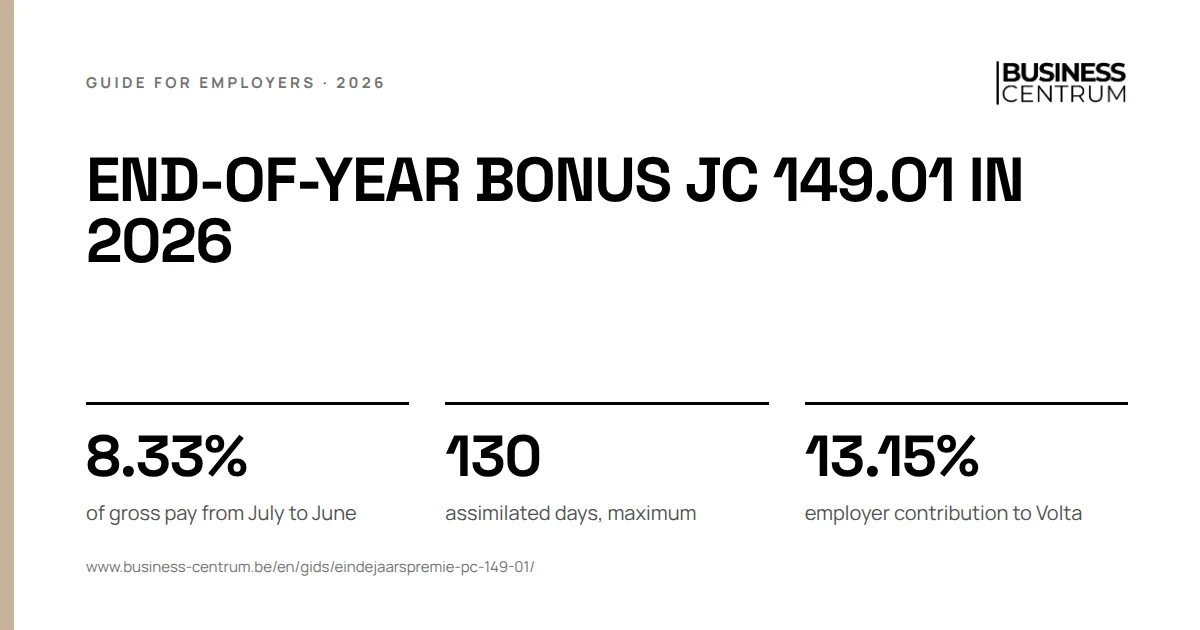
The end-of-year bonus JC 149.01 is 8.33% of the gross pay your worker earned in the sector, and the fund Volta pays it out, not you. For the 2026 bonus, pay from 1 July 2025 up to and including 30 June 2026 counts, and payment takes place before 31 December 2026. You fund the bonus through a contribution on the gross pay of your workers.
Who gets the end-of-year bonus JC 149.01?
The collective agreement of 24 June 2026 applies to the employers and workers of the Joint Sub-committee for electricians: installation and distribution. It replaces the 2022 collective agreement on the same subject. By workers, the agreement means male and female blue-collar workers, with the exception of student workers and apprentices. White-collar employees are not covered.
Volta points out that since bonus year 2022 the two former schemes have been merged: the general scheme and the scheme for companies affiliated to the former federation FEE. The same rules now apply to all workers and employers in the sector. Which activities fall under 149.01 and which pay scales apply is explained in our guide on joint committee 149.01.
The agreement sets no length-of-service condition and no date on which the worker must be employed. The bonus is calculated pro rata to the work done in the reference period. According to Volta, only a worker dismissed for serious misconduct loses his right.
Who pays the end-of-year bonus in JC 149.01?
For employers that fall under Belgian social security, the social security fund (fonds de sécurité d'existence) pays the bonus, through its end-of-year bonus department at Volta. So you do not put the bonus on the payslip yourself. A foreign employer that does not fall under Belgian social security does pay the end-of-year bonus directly to its workers.
You fund the bonus each quarter through the NSSO:
| Element | What the agreement and Volta say |
|---|---|
| Base contribution in the agreement | 7.80% of gross wages at 108%, increased by the employer NSSO contribution |
| Total contribution for the end-of-year bonus | 13.15% of gross pay at 108% |
| Possible reduction | never below 7.70%, and only if the reserves exceed € 1,250,000 |
The fund's board of directors sets the total contribution each quarter. Volta deducts its administration costs from the contributions paid and makes the statutory deductions from the bonus. Your total sector contribution, on top of the end-of-year bonus, is in our guide on joint committee 149.01.
How much is the end-of-year bonus JC 149.01?
Volta pays 8.33% of the gross pay during the reference period in the sector. The agreement defines that gross pay as all wages on which NSSO contributions are collected and which are declared in the DmfA under remuneration codes 1 to 6 inclusive.
For assimilated days, Volta uses the worker's average daily wage. That is the total payroll of the four quarters of the reference period, divided by the number of collectively paid days in that period.
From the gross bonus, Volta deducts the personal NSSO contribution of 13.07% and withholding tax of 23.22%. The worker receives an end-of-year statement with the calculation, and the following year a 281.10 tax form for his tax return.
Worked example: an electrician with a full reference period
This is an example, not a calculation for your situation. An electrician earned € 42,000 gross in the sector between 1 July 2025 and 30 June 2026, declared under remuneration codes 1 to 6. His gross bonus is 42,000 x 8.33% = € 3,498.60. Had he also had assimilated days, the average daily wage for those days x 8.33% would be added, within the cap below. How a bonus you pay yourself works out gross and net is explained in our guide to end-of-year bonus calculation.
Which absences count for the end-of-year bonus JC 149.01?
The agreement lists the periods that are treated as days worked. It identifies them by their code in the DmfA:
| Assimilated period | DmfA code |
|---|---|
| Sickness or accident during the second week of guaranteed pay, a role in the labour courts, public holidays and replacement days during temporary unemployment | 10 |
| Incapacity for work with a top-up or advance under collective agreements 12bis and 13bis | 11 |
| Compensatory rest days for reduced working hours, not paid when taken | 20 |
| The first twelve months of interruption due to accident or ordinary sickness | 50 |
| Maternity protection, birth or paternity leave, adoption leave, foster parent leave, prophylactic leave | 51, 52, 53 |
| Workplace accident and occupational disease, the period of guaranteed pay without NSSO contributions | 60, 61 |
| Temporary unemployment: economic reasons, bad weather, other reasons, force majeure | 70, 71, 72, 77 |
| Youth and senior holidays, foster care leave, military service | 73, 75, 26 |
A cap applies. Since 1 July 2023, at most 130 days per reference period are assimilated, if the worker can prove at least 120 days worked. If he worked less, the maximum is 1/3 of his days worked. Days worked are the days under DmfA codes 1 to 5 inclusive, 14 and 20.
End-of-year bonus JC 149.01 on dismissal, retirement or end of contract
If someone leaves during the reference period, the bonus follows the work done. The agreement makes three groups:
| Situation | Bonus |
|---|---|
| Fixed-term contract, clearly defined job or replacement | pro rata to the work done |
| Resignation | pro rata to the work done |
| Dismissal by the employer, except for serious misconduct | pro rata to the work done |
| End due to force majeure or by mutual agreement | pro rata to the work done |
| Dismissal with unemployment with company supplement (SWT/RCC), retirement, death | full bonus: average daily wage x 260 x 0.0833 |
| Dismissal for serious misconduct | no bonus |
For bonus year 2026, Volta gives a flat-rate amount of € 2,293.79 net for SWT/RCC, retirement and death. On death, the bonus goes to the beneficiaries.
When someone leaves, the bonus also goes through the fund. Volta calculates it after the reference period, based on the pay data available at that time. So make sure the DmfA for the last quarter is correct. The social documents at dismissal are covered in a separate article.
When does Volta pay the end-of-year bonus in 2026?
The agreement lets the fund's board of directors set the payment arrangements, with one limit: payment takes place before 31 December following the end of the reference period, based on the pay data available at that time. Volta writes that the workers receive the bonus in their bank account around 15 December 2026. Volta gives no fixed day; the payment date is on the worker's end-of-year statement.
Volta only pays into a bank account. The worker provides the account number in My Volta, with itsme. If the account number comes in later, the bonus is also paid later. The right to the bonus lapses after 5 years.
If the fund paid too much, it reclaims the unduly paid bonus with an adjusted end-of-year statement. The worker must then in principle repay within 3 months.
Mistakes we see with the end-of-year bonus JC 149.01
- Paying the bonus yourself. Volta already pays. Anyone who also puts it on the payslip pays twice.
- Leaving an error in the DmfA. Volta calculates with the pay data available at the end of December. Pay declared too low gives a bonus that is too low.
- Thinking a short period of employment yields nothing. The agreement sets no minimum duration; a short contract also gives a pro rata bonus.
- Workers without a bank account number at Volta. Without an account number, Volta does not pay; point new workers to My Volta.
What Business Centrum does for you
Business Centrum handles the payroll administration of electrical companies in 149.01 together with Acerta: correct DmfA declarations with the right codes for absences, so that Volta calculates your workers' bonus correctly, and the calculation of your sector contributions. How the end-of-year bonus is arranged in the other committees is in our overview of the end-of-year bonus in 2026 per joint committee.