
The JC 136 indexation in January 2027 falls on 1 January 2027: the minimum hourly wages and the actual hourly wages of blue-collar workers in paper and cardboard processing rise with the four-month health index of December 2026 against that of June 2026. The committee indexes twice a year, in January and in July, so each step absorbs half a year of price movement. The percentage is only known once Statbel publishes the December index on 23 December 2026.
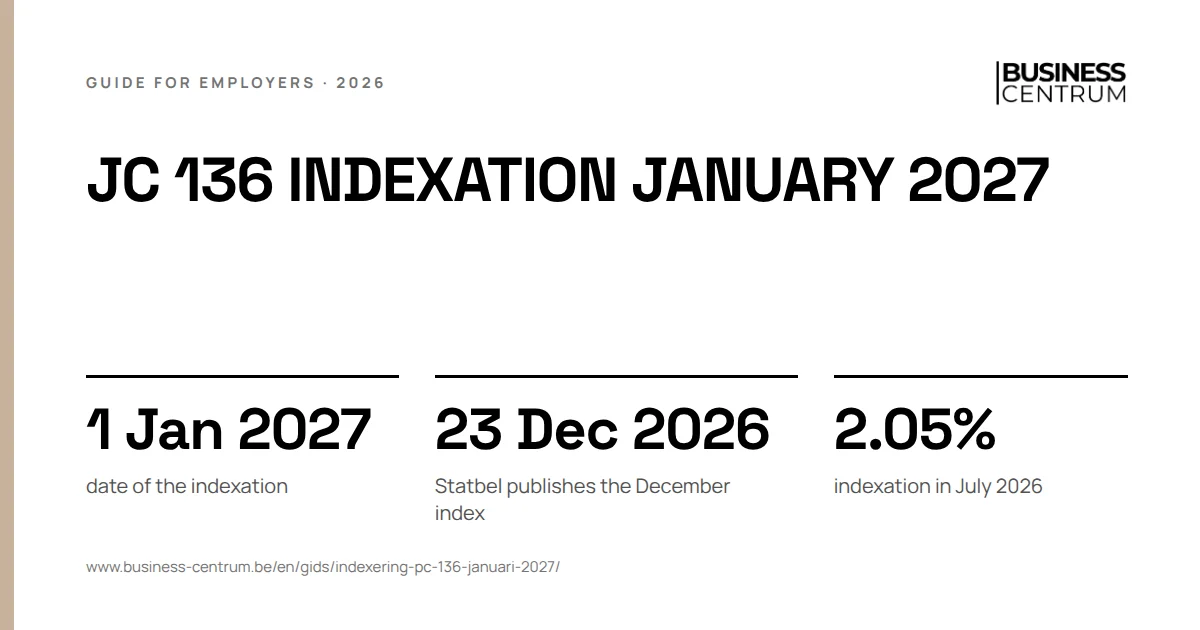
The percentage of the JC 136 indexation in January 2027
Until then there is no official percentage. The entry for January 2026 in the JC 136 history was last edited on 19 January 2026.
Federal Planning Bureau forecast. In its inflation forecasts of 6 October 2026 the Planning Bureau estimates the smoothed health index at 102.35 points in November 2026 and 102.92 points in December 2026. That is an estimate of the index, not a percentage for JC 136. The Planning Bureau does not calculate a sector percentage, and neither do we: the percentage only follows from the final figures of Statbel. The next forecasts appear on 3 November 2026.
How does the indexation work in JC 136?
The rule is in article 4 of the working and pay conditions agreement of 17 December 2025. It applies to the blue-collar workers of all companies under the committee, including wallpaper makers and makers of paper tubes. Twice a year you compare the four-month health index:
- on 1 January: December of the previous year against June of the previous year;
- on 1 July: June of the current year against December of the previous year.
For January 2027 that is December 2026 against June 2026. Statbel publishes that index every month, as the moving average of four months. The collective agreement sets no rounding of the percentage or of the wages.
What rises with it? The minimum hourly wages and the actual hourly wages. If you pay above the pay scale, that higher hourly wage rises by the same percentage. A rise or fall applies from the first opening of the accounts of the month.
A fall is cushioned. If the calculation at the end of June or December gives a negative result, a separate agreement neutralises that fall up to 1%, in total over the whole term of that agreement. It runs until 30 June 2027.
JC 136 indexation history since 2023
This is how hourly wages in paper and cardboard processing rose on 1 January and 1 July in recent years, according to the history in the FPS minimum wage database:
| Indexation on | Percentage |
|---|---|
| 1 July 2026 | 2.05% |
| 1 January 2026 | 0.73% |
| 1 January 2025 | 1.21% |
| 1 July 2024 | 2.34% |
| 1 January 2024 | 0.98% |
| 1 July 2023 | 0.15% |
| 1 January 2023 | 5.89% |
For July 2025 the history lists no percentage but new pay scales, with the new pay agreement. Because the committee indexes twice a year, a January percentage here is smaller than in committees that only index in January. Add January and July together for a full year. In 2026 the steps were 0.73% and 2.05%.
What is already fixed for January 2027, and what is not?
What is already fixed:
- The date: 1 January 2027, and the next step on 1 July 2027.
- The formula: the four-month health index of December 2026 against that of June 2026.
- Who gets the rise: the minimum hourly wages and the actual hourly wages of the blue-collar workers.
- The cents index: in JC 136 the first moderation is already over, see below.
What is not fixed yet:
- The percentage. It follows from the December 2026 index, published on 23 December 2026.
- The new minimum hourly wages per class. FPS Employment then publishes them in the minimum wage database.
The cents index in the JC 136 indexation of January 2027
In JC 136 the cents index does not bite for the first time in January. The first indexation after its start on 1 June 2026 was that of 1 July 2026, with 2.05%. That is more than the 2% that a full-time reference wage above € 4,000 a month only receives on € 4,000. The moderation of the first period was therefore complete in July. Under the cents index rule, the index then applies to the full wage again. In January 2027 you therefore index the whole reference wage in JC 136, also above € 4,000.
Meanwhile you pay a special wage moderation contribution to the NSSO. How to calculate it, with a full example, is in our piece on the cents index.
Worked example: how the July 2026 index worked
A blue-collar worker earned € 15.00 an hour in June 2026. On 1 July 2026 that rose by 2.05%: 15.00 x 1.0205 = € 15.3075 an hour. The collective agreement sets no rounding, so follow the rounding of your payroll software and of the sector. In January 2027 you calculate the same way with the new percentage.
Where do you find the percentage for January 2027?
You find the percentage and the new amounts in these places:
- Statbel publishes the December 2026 index figure on 23 December 2026. With it, the formula of the collective agreement can be filled in completely.
- FPS Employment puts the percentage and the new amounts in the minimum wage database. The entry for January 2026 was last edited on 19 January 2026.
- The collective agreement database of FPS Employment holds the committee's pay agreement, with the classes and the indexation rule.
You then also see the new pay scales on our page with the JC 136 pay scale. White-collar staff of the same companies fall under JC 222, with the same formula: see the JC 222 indexation in January 2027. Cleaning also indexes in January and July, with a different formula: see the JC 121 indexation. What a pay rise yields net for your employee is in our guide gross to net. How the 2026 index turned out per sector is in our news on wage indexation in 2026. Not sure which committee applies to your workers? Read our explanation of the right joint committee.
What Business Centrum does for you
Business Centrum applies the January 2027 indexation in JC 136 in your payroll administration, together with Acerta, with the percentage that follows from the collective agreement. We apply the percentage to the minimum and actual hourly wage of each worker, in January and in July, and follow the cents index per employee. All committees that index in January, with their formula, are in our overview of salary indexation in Belgium 2027.